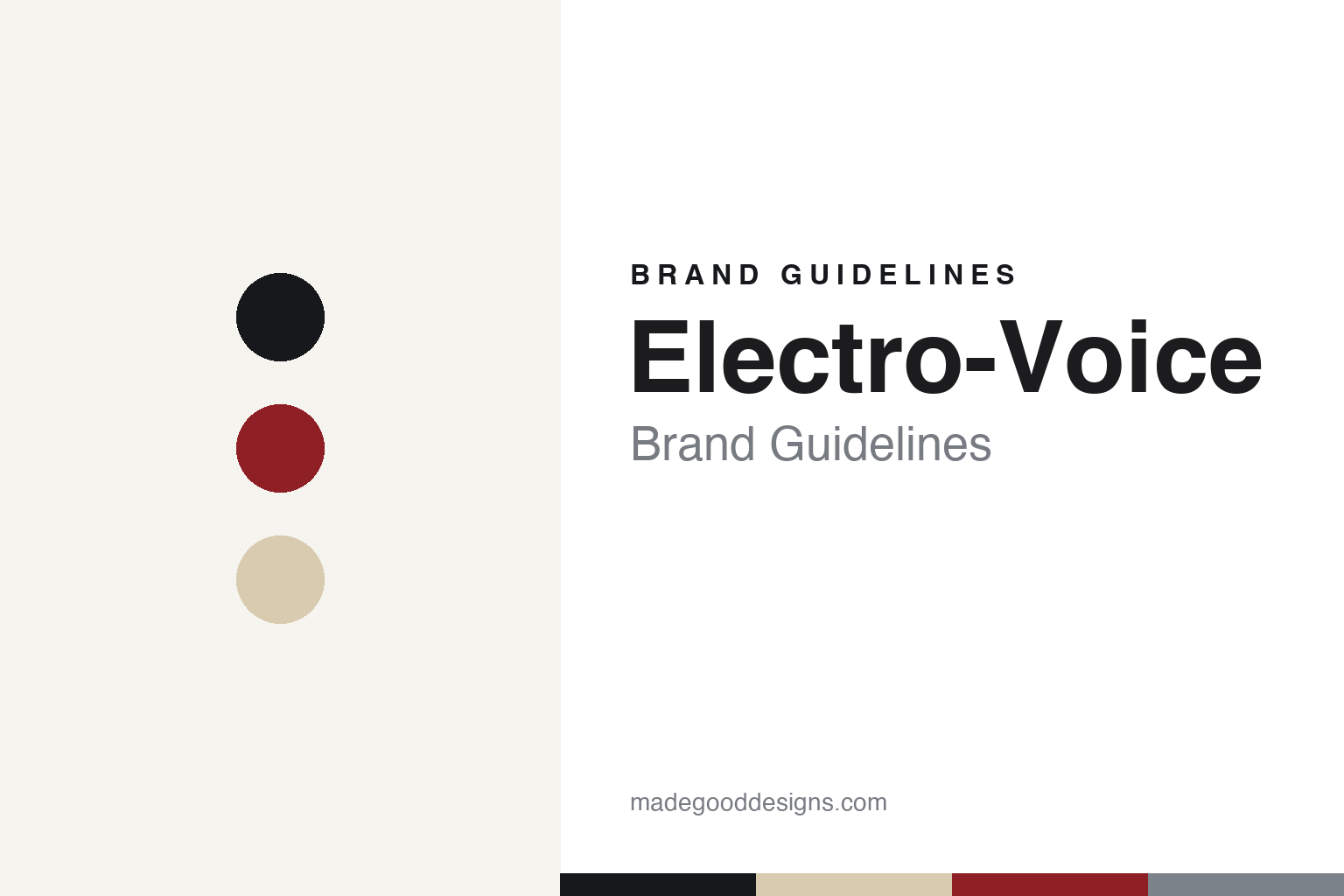
Electro-Voice Brand Guidelines
The South Bend radio shop that named itself after a football coach’s PA.
Aa
Two constants: an Electro-Voice graphite, broadcast beige and signal red palette and an Industrial sans register. Abstract homage — not an Electro-Voice product or mark; no microphone, loudspeaker, logo or nameplate is reproduced.
Radio Engineers
A radio shop in a tyre company’s basement.
Electro-Voice dates itself to 1927. That year Al Kahn and Lou Burroughs started a small business called Radio Engineers, servicing radios in the basement of the Century Tire and Rubber Company in South Bend, Indiana — with $30 of capital and a second-hand car, ProSoundWeb reported in 2017. The Depression nearly finished it. “We found ourselves insolvent to the extent of $5,000,” Kahn wrote in a company history in the early 1950s, and the partners turned to audio work instead.
The name came from a football field. Early in 1930 the pair built a public-address system for Knute Rockne, the Notre Dame coach, so that he could direct four practice squads from a tower; Rockne called it his “electric voice,” and the company took the hint. It was incorporated as Electro-Voice in 1930 — on 1 June according to English Wikipedia, on 1 July according to ProSoundWeb, so we give only the year. The company’s website today says simply that it has made audio equipment “since 1927.”
Microphones were at first made for the firm’s own PA rentals, but selling them to others soon became the main business. According to English Wikipedia, Burroughs withdrew for a time, leaving Kahn as sole owner, and returned as chief engineer in 1936. In 1934, by Kahn’s own account, he adapted the hum-cancelling winding of an old watt meter into a humbucking coil, first used in the V-1 Velocity microphone. During the Second World War the firm developed noise-cancelling microphones such as the T-45 lip microphone, and in 1946 it moved to a larger plant in Buchanan, Michigan, which remained its manufacturing home for more than half a century.
Colour
The Buchanan Hammer and the RE20.
Its best-known early microphone was treated like a hammer. The 664 dynamic of the mid-1950s became known as “the Buchanan Hammer” after Burroughs drove nails into a board with it during sales demonstrations, English Wikipedia says. It was also the first product to use Variable-D, a design EV developed in 1953 to reduce the proximity effect — the bass boost a directional microphone adds when a voice comes close.
In April 1963 the company received a Technical Achievement Award from the Academy of Motion Picture Arts and Sciences, cited “for a highly directional dynamic line microphone” — the 642 Cardiline shotgun. English Wikipedia calls it the first Academy Award given for an audio product, but the Academy’s list of technical awards, as reproduced by Wikipedia, includes microphones honoured in 1931, so we do not repeat that claim.
The RE20, a large cardioid dynamic designed by the engineer Tom Lininger, followed. The TEC Awards, which inducted it into their Technology Hall of Fame in 2015, date it to 1968; Live Design gave 1969 in a 2019 anniversary piece. It became a fixture of radio studios, appeared on screen in Frasier, and, according to a 2006 book by David Simons, was the producer Robert Margouleff’s choice for Stevie Wonder’s vocals on Talking Book and Innervisions. It is still sold, in beige and black versions, alongside the neodymium RE27N/D and the RE320.
EV was as much a loudspeaker company. It patented a constant-directivity horn in 1978, launched the Entertainer portable PA in the mid-1970s, bought Greg Mackie’s mixer maker TAPCO soon after, introduced neodymium N/DYM microphones in the 1980s, and built concert systems such as Manifold Technology and X-Array, which ProSoundWeb said served as AC/DC’s touring system for 20 years. The company also says its microphones were there for John Glenn’s orbit of the Earth and for Martin Luther King Jr.’s “I Have a Dream” speech; we give those as its claims.
Typography
Beyond the biggest names.
Behind the best-known microphone names stands a group of smaller specialists, each built around one kind of microphone: the condenser, with a charged diaphragm; the ribbon, a thin strip of foil in a magnetic field; and the dynamic, a moving coil.
Three condenser makers here are German. Schoeps was founded in Karlsruhe in 1948 and says it makes its whole range in Durlach, the city’s old town, and remains family-owned. Microtech Gefell, in Gefell in Thuringia, traces itself to the firm Georg Neumann founded in Berlin in 1928, which moved to Gefell in 1943; its legal notice names Georg Neumann KG as sole shareholder. Brauner, a valve-microphone maker, closed its production site at Rees on the Lower Rhine in 2021 and said in July 2026 that production would restart.
DPA Microphones, founded in Denmark in 1992 by two former Brüel & Kjær employees, has its head office at Kokkedal and its factory at Asnæs; in February 2026 the British group Audiotonix announced an agreement to buy it.
The ribbon specialists are Royer Labs of Burbank, California, founded in 1998, which says every Royer is hand-made in the USA, and Coles Electroacoustics of Hoddesdon, Hertfordshire, which says it has made the BBC-designed 4038 in Britain for more than 50 years.
Electro-Voice, best known for dynamic microphones and loudspeakers, began in South Bend, Indiana, and since 2025 has belonged to Keenfinity Group, the former Bosch business owned by the investment firm Triton.
This guide sets out what can be checked about each brand — who founded it, who owns it, and what it says about where its products are made — and marks clearly what rests only on the company’s own word.
Aa
An industrial sans — a name coined for a coach’s PA. (Specimen set in Archivo, a sans STAND-IN; NOT the Electro-Voice logo.)
Electro-Voice
Gulton, Mark IV, Telex, Bosch, Triton.
Ownership changed often. A company timeline by Keith Clark, editor of ProSoundWeb, says Gulton Industries bought EV in 1967, and that Mark IV Industries bought Gulton in 1986, grouping EV with Altec Lansing and others as Mark IV Audio. Securities filings fill in the rest. On 10 February 1997 a company owned by the New York fund Greenwich Street Capital Partners bought EV’s parent from Mark IV, and on 2 February 1998 that business, EV International, merged with Telex Communications of Minnesota; EV International was the surviving company and took the Telex name, the filings say. In March 2002 Telex reported that it would close the Buchanan factory, with about 135 staff, that spring and move production to its other plants; the old site has been designated a federal Superfund site, for which Mark IV agreed to indemnify Telex, according to Telex’s filings.
In June 2006 Bosch agreed to buy Telex — home of Electro-Voice, Dynacord, Midas, Klark Teknik, RTS and Telex — for $420 million including debt, Pro Sound News reported. Nineteen years later Bosch sold its security and communications product business to the investment firm Triton; the sale completed on 30 June 2025, Inavate reported, and the business now trades as Keenfinity Group, based in Munich. Keenfinity lists Electro-Voice in its audio business with Dynacord, RTS and Telex, and EV’s website is copyrighted to Electro-Voice Dynacord LLC.
Where are EV products made? Keenfinity said in 2025 that all its products are developed and made in-house, at plants in Straubing in Germany, Ovar in Portugal, Hermosillo in Mexico and Zhuhai in China. We found no statement linking a particular EV product to a particular plant; EV’s website says only that it designs its enclosures, waveguides and drivers in-house.
For a design guide, Electro-Voice shows how a name coined for a football coach can outlast a long chain of owners. Compare Shure, another American dynamic-microphone maker, and Sennheiser, a German rival. For this guide we use graphite, broadcast beige and a deep signal red with a sans, an unofficial interpretation; no product or logo is reproduced.
Explore & save
Keep Electro-Voice’s identity on hand — save it to a board in the Made Good inspiration library.
Electro-Voice identity set
Pin the Electro-Voice graphite, broadcast beige and signal red palette and the Industrial sans register to your own board.