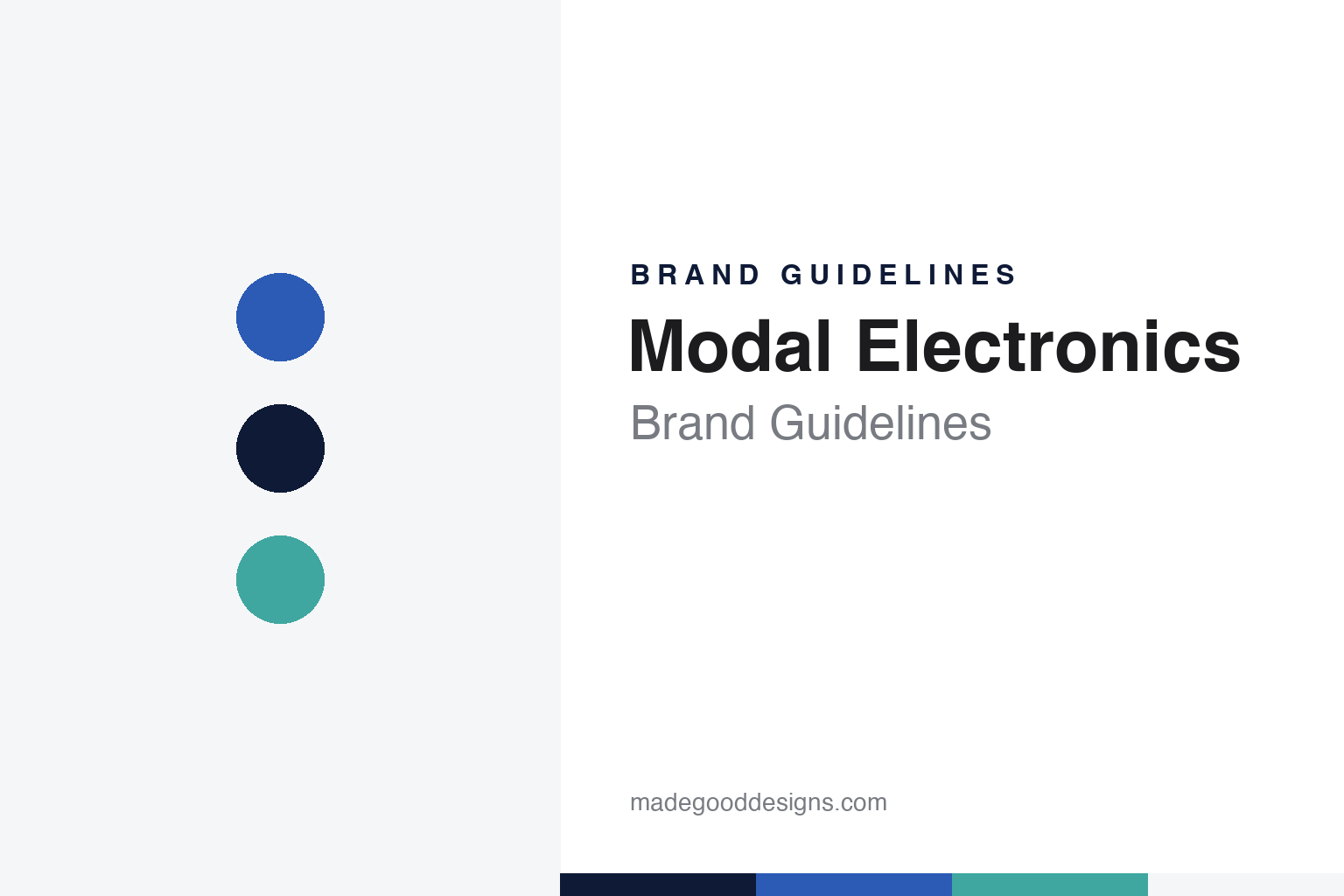
Modal Electronics Brand Guidelines
The Bristol synth maker that outlived its own company.
Aa
Two constants: a cobalt, navy and teal palette and a technical sans register. Abstract homage — not a Modal Electronics product or mark; no instrument, logo or nameplate is reproduced.
Modulus to Modal
A Bristol start-up with a flagship first.
Modal Electronics began as a British company. Companies House records show it was incorporated on 19 July 2013 under the name Modulus Ltd and renamed Modal Electronics Limited in February 2015, with its business listed as the manufacture of musical instruments. Its founding directors were Paula Maddox, whom English Wikipedia credits as the inventor of the Monowave, a wavetable synthesiser first shown at a PPG user meeting in 2001 and built in a limited run of 25, and Philip Taysom, whom Gearnews described in 2023 as Modal’s founder. Maddox left the board in March 2017, according to the register.
The company’s website later said it was “headquartered in Bristol, UK,” and its 2015 site gave an office address in the city; Gearnews wrote in 2016 of “their workshop in Bristol.” Its first instrument set the tone. The Modal 002, a 12-voice hybrid with digitally controlled oscillators feeding an analogue signal path and a transistor ladder filter, was listed on the 2015 site at £2,995 before VAT, with a five-octave Fatar keyboard, a 4.3-inch screen and an Ethernet port. Smaller siblings followed: the eight-voice 008, the two-voice 001 at £1,350, and rack versions of both larger models. Modal later called the 002 the first polyphonic digital/analogue hybrid with a transistor ladder filter and the first synth with 10,000 patch memories — its own claims, which we have not tested.
Colour
From a £79 kit to eight-voice keyboards.
In 2016 Modal changed direction. The CRAFTsynth, a snap-together digital monosynth kit that its website said could be assembled in about ten minutes, went on sale through Gear4music at £79, Gearnews reported in November 2016. In July 2018 Sound On Sound reported that the SKULPT, a four-voice virtual-analogue synth with eight oscillators per voice, would launch on Kickstarter at a projected price under $300. CRAFTsynth 2.0, a monophonic wavetable synth, “moves away from the DIY approach,” SOS said in its January 2020 review.
The keyboards that now define the brand came next. The ARGON8 wavetable family, which Modal dates to 2019, came in three formats: a 37-key keyboard, the 61-key ARGON8X and the desktop ARGON8M. SOS wrote in June 2020 that it “punches way above its price tag.” The COBALT8 virtual-analogue range shared its hardware: the review unit’s box said Argon 8 on the side, SOS noted in February 2021, calling the synth “a beautifully judged virtual analogue synth.” A five-voice COBALT5S followed in 2022, and the CARBON8, an eight-voice “experimental” digital synth, was shown at Superbooth in 2023 and at the NAMM Show in January 2024, Synthtopia reported. In 2022 Modal also offered Filton, a dual analogue transistor ladder filter, as a limited Kickstarter edition.
As the range grew, so did its reach. In 2022 Modal named exclusive distributors for Scandinavia, for Spain, France, Italy and Portugal, and for Germany, Austria, Switzerland and the Benelux countries, and in January 2023 it appointed American Music & Sound for the United States, its website shows. Modal does not say where its synths are built in the manuals, product pages and press releases we checked, so we do not say either.
Typography
Design and documentation.
Beyond the largest names in electronic instruments sits a tier of smaller synthesizer makers, some dating from the 1960s and others barely a decade old. Many have changed hands.
Oberheim, founded by Tom Oberheim in 1969, passed to Gibson after a 1988 bankruptcy; English Wikipedia says Gibson returned the trademark to its founder in 2019. Focusrite plc says it bought the Oberheim brand and trademarks from Tom Oberheim in 2022, and the brand, based in San Francisco, now works alongside Focusrite’s Sequential. Buchla began with Don Buchla in Berkeley in 1963; Australian investors bought it in 2012, and in 2018 its assets passed to Buchla U.S.A., which says many products are hand-built to order.
Waldorf, founded in 1988, went insolvent in 2004; Waldorf Music GmbH, set up in 2006, gives its address as Remagen, Germany. Access, maker of the Virus, calls itself a privately held German manufacturer; its website is published by Kemper GmbH of Recklinghausen, and German Wikipedia says no Virus has been produced since February 2024.
Modal Electronics, a British company incorporated in 2013, entered administration in 2023; after a 2024 restructuring involving Alltronics Holding, Modal calls itself a brand of a Hong Kong–registered company. Polyend, founded by Piotr Raczyński, is based in Olsztyn, Poland. 1010music, which debuted in 2016, gives Los Angeles as its home and lists China as the country of origin for its current hardware.
This guide sets out what can be checked about each brand — who founded it, who owns it, and what it says about where its products are made — and marks clearly what rests only on the company’s own word.
Aa
A technical sans for an instrument-panel register. (Specimen set in Space Grotesk, a sans STAND-IN; NOT the Modal Electronics logo.)
Modal Electronics
Administration, then a Hong Kong owner.
The business behind the brand did not survive intact. In September 2023 Synthtopia, citing UK government records, reported that Modal Electronics Ltd had gone into administration; Companies House had earlier issued, then suspended, a strike-off notice, and unaudited accounts showed liabilities exceeding assets. The next day managing director Christian Stahl told Gearnews it was part of “a complex restructuring” that had been under way for nine months, that product support continued and that all staff had been retained. The UK company moved from administration to dissolution and was dissolved on 10 December 2024, according to Companies House.
In May 2024 Modal announced it had completed its restructuring. Synthtopia reported an “ownership transformation” through a collaboration between Alltronics Holding Ltd and the company’s leadership team, quoting Alltronics chief executive Eric Lam on a “joint venture.” By July 2024 the Modal website described the brand as belonging to WT Technology Development Company Limited, which its terms place in Hong Kong; we could not establish from the sources checked how that company relates to Alltronics. Press releases now carry a Hong Kong dateline, although a distributor announcement still calls the UK “Modal’s home market,” and Sound On Sound called Modal a “British company” in September 2026.
The brand has kept releasing products. A 61-key CARBON8X and a three-year warranty were announced in May 2025. From April 2026 Modal and its US distributor stopped selling in the United States, citing tariffs and import costs. In May it showed the ELEMENT One, an eight-voice virtual-analogue synth with 37 keys, aftertouch and a four-axis joystick, weighing 4.5 kg and priced at €649 that it says was developed with the Hartmann Design team, and which Gearnews called the first instrument developed entirely after the restructuring; in August, Sweetwater became its exclusive US retailer.
For a design guide, Modal Electronics shows how a synth brand can outlive the company that created it. Compare Novation, another British synth maker, and Arturia, a rival in affordable digital keyboards. For this guide we use cobalt, navy and a teal with a sans, an unofficial interpretation; no product or logo is reproduced.
Explore & save
Keep Modal Electronics’s identity on hand — save it to a board in the Made Good inspiration library.
Modal Electronics identity set
Pin the Modal Electronics cobalt, navy and teal palette and the technical sans register to your own board.