Mutable Instruments Brand Guidelines
The open-source Eurorack maker from Paris that closed in 2022.
Aa
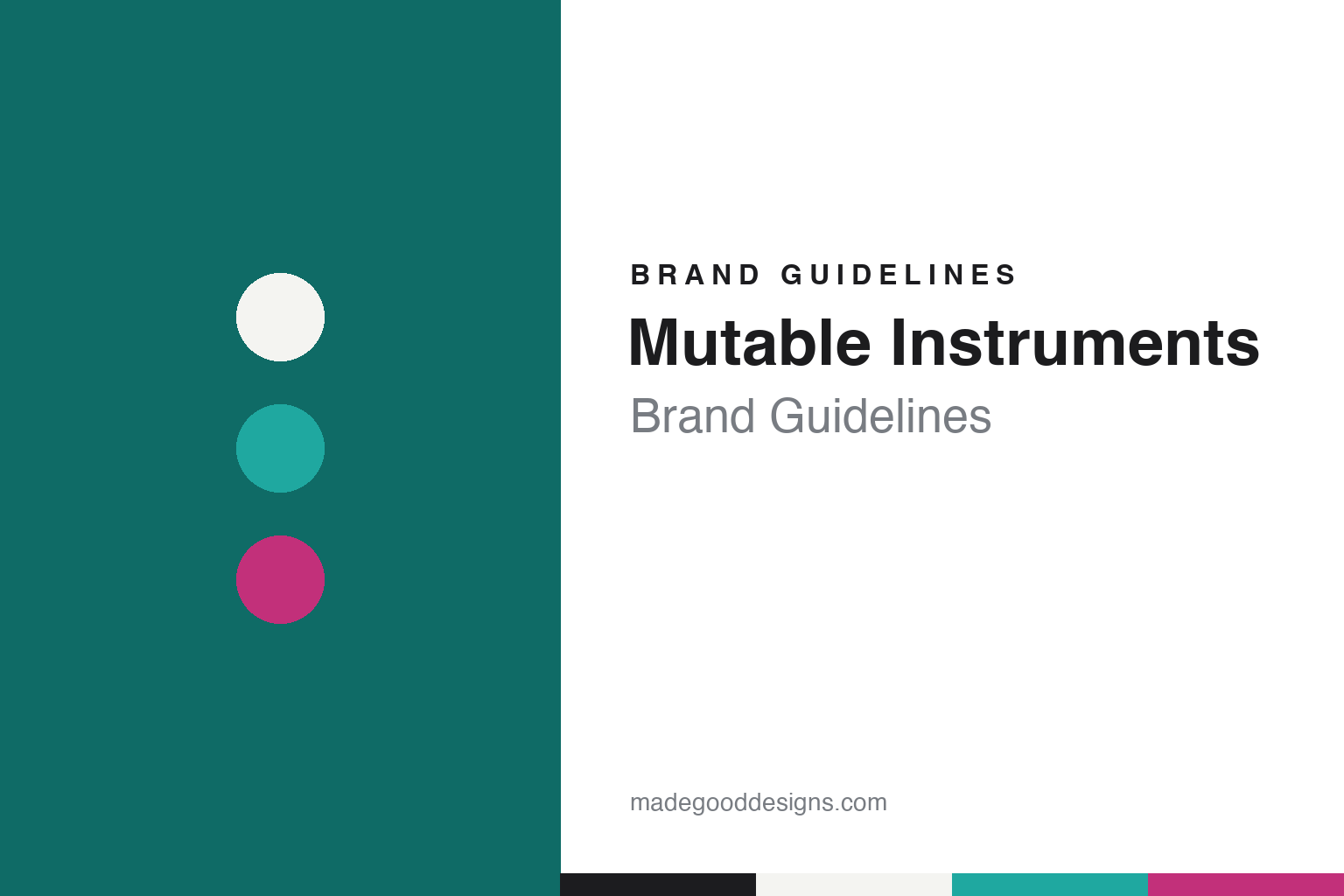
Two constants: a white, turquoise and fuchsia palette — the knob colours Mutable’s own documentation says it used on early modules — and a clean sans register. Abstract homage — not a Mutable Instruments product or mark; no module, logo or panel is reproduced.
A workshop in Paris
One designer, open source from the start.
Mutable Instruments was an electronic-instrument company in Paris, designed and run, by its own account, by one person: Émilie Gillet. Its own timeline, on an archived “About us” page from December 2022, begins in 2009 with “quirky DIY hybrid synths,” and the copyright line on the same page dates the company, a French SARL, from 2011; we give both dates rather than pick one. The page described “a workshop in Paris” and said the company had, “by design, no employees! Just me!” Gillet was its product designer, hardware and software engineer, salesperson and customer support at once.
Before the company, Gillet says, she worked on the large user-profile and query-analysis systems behind services such as Google AdWords and Last.fm, researched drum transcription, and wrote niche music software, including a granular-synthesis tool for BeOS and a loop-based music program for PalmOS.
The first products were desktop kits for builders. An archived 2010 version of the website carried the slogan “The simplest synths that could possibly rock,” promised that firmware, schematics and circuit-board designs were “freely available under GPL/Creative Commons licenses,” and said every design used through-hole parts so that beginners could solder them. It named the Citroën 2CV and the Lubitel camera as models of engineering simplicity. Synthtopia lists those early instruments as the Shruthi-1, Anushri, Ambika and MIDIpal, and says they were phased out in 2014.
The move to Eurorack began with a small purchase. In the company’s documentation archive, Gillet recalls being asked as early as March 2010 to turn the Shruthi’s oscillator into a module, being unenthusiastic because modular systems looked “too expensive, bulky, and 60s,” and then buying a small Doepfer system early in 2012 and immediately seeing the potential. Code written for an abandoned polyphonic synth project, Ambika-X, became the Braids and Yarns modules.
Colour
From Braids to Beads.
The first Eurorack modules — Braids, Edges, Grids, Ripples and Volts — were released in August 2013, according to the module timeline in Mutable’s documentation archive. Tides, Frames and Yarns followed in March 2014, Peaks that August, and Clouds, Elements, Streams and Shelves in January 2015; Rings arrived in December 2015, and Marbles, Plaits and Stages in March 2018. The last new module, Beads, came out in February 2021. Clouds, the granular “texture synthesizer,” had been discontinued in October 2017, so it was not on sale at the end; Beads became its successor.
The archive is candid about how the designs were made. Clouds began as “Aeons,” a spectral sampler that Gillet says sounded great on a computer but reacted badly to control voltages on hardware; after demonstrations showed that people liked its granular mode most, she “killed everything else and focused on that.” Synthtopia, writing in December 2022, said that patching Rings into Clouds was one of the combinations that had “helped define modern styles of modular synthesis.”
Openness was the point of the name. An archived 2015 “About us” page said the company released the code and schematics of everything it built, and that this was “the ‘Mutable’ in ‘Mutable Instruments’”: users could understand, customise and adapt their instruments. English Wikipedia’s Eurorack article cites Gillet giving transparency and customisation as her reasons. Others took up the invitation. Gillet herself named an alternative firmware for Tides “Sheep,” after the game in Peter Greenaway’s film Drowning by Numbers, English Wikipedia says, and further alternative firmwares for Braids and Peaks followed. Arturia’s MicroFreak synthesizer uses seven oscillator modes from Plaits; Synthtopia notes versions in the VCV Rack software; and Behringer has sold low-cost Eurorack modules based on Plaits, Marbles, Ripples and Tides, according to English Wikipedia.
Typography
The Eurorack format.
Eurorack is a modular synthesizer format that English Wikipedia says was originally specified in 1995 by Doepfer Musikelektronik, Dieter Döpfer’s company at Gräfelfing in Upper Bavaria; Doepfer’s own timeline dates the first A-100 modules to 1996, and the company now says it receives ready-built modules from outside manufacturers, doing only final testing in-house. Other makers began building to Doepfer’s published specification in the mid-2000s, and by 2022, Wikipedia says, citing ModularGrid, more than 600 manufacturers offered over 15,000 modules.
The seven makers in this guide span that history. Tiptop Audio, which Wikipedia lists among the format’s mid-2000s adopters, says it has “joined forces” with Buchla to resume production of the Buchla 200 series, and its founder, Gur Milstein, told Sound On Sound in 2024 that he had built a factory in Thailand that makes all its products. 4ms Company says Dan Green founded it as a pedal business near Chicago in 1996, began designing Eurorack modules in Austin in 2009 and moved to Portland, Oregon, in 2012.
Intellijel is Canadian — “made with love by robots in Canada,” its website says — and Sound On Sound credits it with its own widely adopted 1U format. Noise Engineering, owned by the husband-and-wife team Stephen McCaul and Kris Kaiser, says its products are “designed and built in Southern California.” XAOC Devices described its team in 2021 as based in the suburbs of Warsaw; its manuals say “Made in the European Union.”
Mutable Instruments, Émilie Gillet’s company, worked from a Paris workshop and had its modules made in Normandy, its website said, until it shut down in December 2022. In the sources we checked, we found no record of any of the others being sold to an outside owner.
This guide sets out what can be checked about each brand — who founded it, who owns it, and what it says about where its products are made — and marks clearly what rests only on the company’s own word.
Aa
A clean sans for a brand built on openness. (Specimen set in DM Sans, a sans STAND-IN; NOT the Mutable Instruments logo.)
Mutable Instruments
Knob colours, and an ending.
The visual identity was a collaboration. The 2022 “About us” page credits Hannes Pasqualini and his wife Elizabeth, from Italy, with Mutable’s visual identity, “from logos to faceplates and manuals,” and Martin Rattini with the module photographs. No typeface or colour values are published. One colour story is documented, in a tech note by Gillet: early modules used white knobs for frequency, turquoise for a secondary parameter and fuchsia for a third, but as modules grew more complex the rule stopped making sense — Clouds even kept the knob colours of its abandoned “Aeons” design — and “at this point I gave up and decided to use only white knobs.” Under the heading “Cost,” the note says simply: “Nope.”
The company said its modules were “made in Normandy”; it did not name the manufacturer, and we have not confirmed this independently. The ending is documented. In April 2022 Synthtopia reported Gillet’s forum post that “no new module is in preparation” and that “Beads is the last module I designed, back in 2019”; production would stop module by module, and Synthtopia reported that she planned to stop working in music technology. In December 2022 the website announced that the production of all modules had halted and that Mutable Instruments would “permanently shut down in December 2022.” CDM marked the occasion with news of a final Plaits firmware update and called Gillet’s greatest contribution “proving open-source hardware could work for a brand over the long haul.” The website now reads “Mutable Instruments has shut down in December 2022” and links to the documentation archive and the open-source code.
For a design guide, Mutable Instruments shows how a brand can be built on openness and restraint, and how its designs can outlive the company once they are public. Compare Arturia, the French synth maker whose MicroFreak borrows from Plaits, and Make Noise, another Eurorack maker with a distinctive design voice. For this guide we use white, turquoise and fuchsia on near-black with a sans, an unofficial interpretation; no product or logo is reproduced.
Explore & save
Keep Mutable Instruments’s identity on hand — save it to a board in the Made Good inspiration library.
Mutable Instruments identity set
Pin the Mutable Instruments white, turquoise and fuchsia palette and the clean sans register to your own board.