Ashdown Brand Guidelines
The Essex bass-amp maker that put a meter on the front panel.
Aa
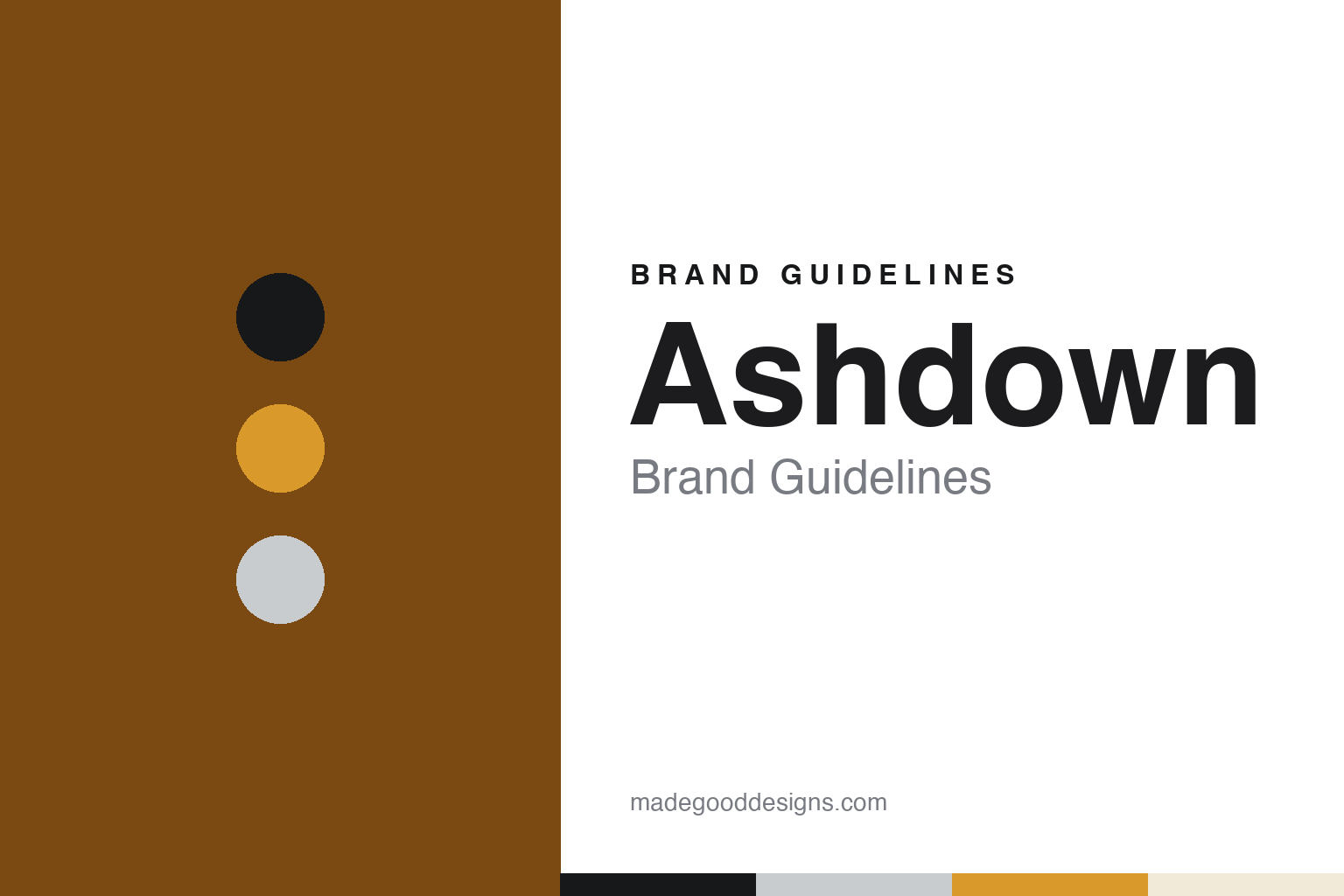
Two constants: an Ashdown black, amber and alloy palette and a condensed sans register. Abstract homage — not an Ashdown product or mark; no amplifier, logo or nameplate is reproduced.
Out of Trace Elliot
A former managing director starts again at home.
Ashdown Engineering is a British maker of bass amplifiers, founded in 1997 by Mark Gooday. Gooday came from Trace Elliot, the Essex company that built its name on amplifiers for bass players. Ashdown’s own history page says he joined Trace Elliot in 1985, “starting in production,” and was its managing director “by the late 1990s.” English Wikipedia’s Trace Elliot article, without citing a source, dates his appointment as managing director to 1986, and the website of Ashdown’s UK distribution business says he ran Trace Elliot “for the 12 years prior to forming Ashdown.” The three accounts do not agree, so we give all of them.
The break came when Trace Elliot changed hands. English Wikipedia says the American group Kaman bought Trace Elliot in 1992, cut back its music division in 1997 and sold the company to three of its directors, who sold it on to Gibson in 1998. Its article on Ashdown says Gooday was let go by Kaman and had already been planning a company of his own.
The start was small. In a summary of Gooday’s 2017 interview for its oral history programme, the American trade association NAMM calls Ashdown “a family business that he started in his living room.” Ashdown’s own news pages tell the same story as a move from “a factory of 200 workers in Maldon, to building amplifiers by hand around a dining room table.”
The name is personal. Ashdown says Gooday named the company “after his wife’s family name.” English Wikipedia adds, without a source, that the logo was built from that name, his love of cars and the Austin-Healey badge; we report that as unconfirmed.
The company is based at Heybridge, next to Maldon, the Essex town where English Wikipedia says Trace Elliot had moved its factory. Ashdown’s online shop gives Ashdown Engineering as a trade name of Ashdown Design & Marketing Ltd, and the UK companies register shows that this company was set up in 1995 and that Gooday became a director in November 1997. The register also lists Fred Friedlein, whom English Wikipedia names as Trace Elliot’s founder, as a director from January 2001 to March 2002.
Colour
The meter, the Magnifier and the UK-built ranges.
Ashdown’s best-known feature is the VU meter. The company says that from the start it stood out for its “VU meters, bold aesthetics, and rugged, road-ready designs,” and that the ABM heads — short for Ashdown Bass Magnifier — became its main range. For a design guide, that needle meter is the feature to note: it is what makes an Ashdown head recognisable across a stage.
The range grew in stages. Aspen Pittman’s The Tube Amp Book (2003) records that Ashdown added Peacemaker guitar amplifiers in 2001, at 50 and 100 watts, followed by cheaper 20- and 40-watt models built on printed circuit boards. Guitar World reviewed the NM2 Double Distortion pedal in September 2013, and in January 2014 Premier Guitar reported the launch of the Rootmaster series. The company lists later additions: pedals such as the Pro DI, Funk Face and Mega Drive; the CTM-100 and CTM-300 valve heads; Saint, Saint Soap and Capri bass guitars; and the SX valve guitar amplifiers, which it says launched in 2025. English Wikipedia says Ashdown also set up a separate company, Hayden, for hand-wired amplifiers.
Players are a large part of how Ashdown presents itself. The company says Pino Palladino used its gear “as early as 1998,” names John Entwistle of the Who among early users, and lists signature amplifiers for Geezer Butler of Black Sabbath, Shavo Odadjian of System of a Down and Guy Pratt. These are the company’s own claims.
Where the products are made is spelled out for only part of the range. The current product copy describes the UK-ABM-600-EVO IV as “Made in the UK” and calls the ABM range “UK-made,” and a June 2026 news post says the UK-ABM and Peacemaker amplifiers are “designed and built here in the UK.” In September 2026 the company announced an “entirely new Made in England collection,” grouped as UK-ABM, UK-RBM (Rootmaster), UK-OBM, UK-PBM, UK-SBM, UK-CTM and UK-Peacemaker; the basses and effects in the same announcement are not described as made in England. Ashdown’s current product pages for the Studio, SX and Killer Tone ranges and its basses, which we checked, name no country of manufacture, and we draw no conclusion from that.
Typography
Bass amplification and who stands behind it.
The seven makers here were founded across five decades. Gallien-Krueger is the oldest: Robert Gallien began building amplifiers in his garage in San Jose, California, in 1968, English Wikipedia says. It is now based in Stockton, California, and Wikipedia lists it as privately held.
Eden was founded in 1976 by David Nordschow in Montrose, Minnesota. English Wikipedia says it passed to U.S. Music Corporation in 2002 and to Marshall in 2011, and that in March 2021 the British retailer Gear4music bought the brand and its assets; it gives Eden’s headquarters as York.
Trace Elliot grew out of a music shop in Romford, Essex, at the end of the 1970s; English Wikipedia names Peavey Electronics Europe as its parent, and its products are listed on Peavey’s website. Ashdown was founded in 1997 by Mark Gooday, Trace Elliot’s former managing director, and is based at Heybridge in Essex; since July 2024 the UK companies register has recorded the French music group Algam as its controlling shareholder.
Hartke traces its aluminium-cone speakers to Larry Hartke and Ron Lorman, the company says, and its website carries the names of Samson Technologies and Samson Distribution. Aguilar speaks of its “deep New York City roots.” Darkglass was founded in Helsinki in 2009 by Douglas Castro and Hugo Villarroel, English Wikipedia says. Both now sit with Korg USA: it announced the acquisition of Aguilar in January 2021, and bought a controlling stake in Darkglass in May 2022, Guitar World reported.
This guide sets out what can be checked about each brand — who founded it, who owns it, and what it says about where its products are made — and marks clearly what rests only on the company’s own word.
Aa
A condensed sans with an engineered, faceplate feel. (Specimen set in Barlow Condensed, a sans STAND-IN; NOT the Ashdown logo.)
Ashdown
A family firm inside a French group.
Ashdown still describes itself as family-run: its history page says that “as of 2025, Ashdown remains a proud family-run business, firmly rooted at its headquarters in Essex.” The UK companies register gives a fuller picture. Gooday was recorded as the person with significant control from 2016, and a holding company, MG & JG Holdings, from the end of 2022. On 26 July 2024 that changed: the French company Algam SAS was recorded as holding more than 75 per cent of the shares and voting rights, Mark Gooday and Jane Gooday stepped down as directors, and Benjamin Garnier of Algam joined the board. In August 2024 the company was renamed Algam Ashdown Limited. His son, Dan Gooday — so described by Algam’s president — has been a director since 2021.
Algam, based at Thouaré-sur-Loire, next to Nantes, calls itself a maker and distributor of music equipment. Algam Ashdown’s website presents the deal as the Ashdown team setting up Algam’s British arm “following a decades-long friendship with the Garnier family,” with Dan Gooday as managing director from September 2024 and Mark Gooday as founder. It quotes Algam’s president, Gérard Garnier, recalling his dealings with Gooday in the Trace Elliot years and describing Algam as having “600 employees, and 250 million Euro turnover” — the group’s own figures. Both accounts can be true at once: Goodays still run the business day to day, while the register shows a French group holding control.
The arrangement now reaches the United States. Ashdown says that from 17 September 2026 its products are sold there only through Guitar Center and Musician’s Friend, with service handled by Algam USA.
For a design guide, Ashdown shows how one piece of hardware — a meter on the front panel — can become a brand’s signature. Compare Trace Elliot, the company Gooday left, and Laney, another British amplifier maker. For this guide we use tolex black, meter amber and brushed alloy with a condensed sans, an unofficial interpretation; no product or logo is reproduced.
Explore & save
Keep Ashdown’s identity on hand — save it to a board in the Made Good inspiration library.
Ashdown identity set
Pin the Ashdown black, amber and alloy palette and the condensed sans register to your own board.