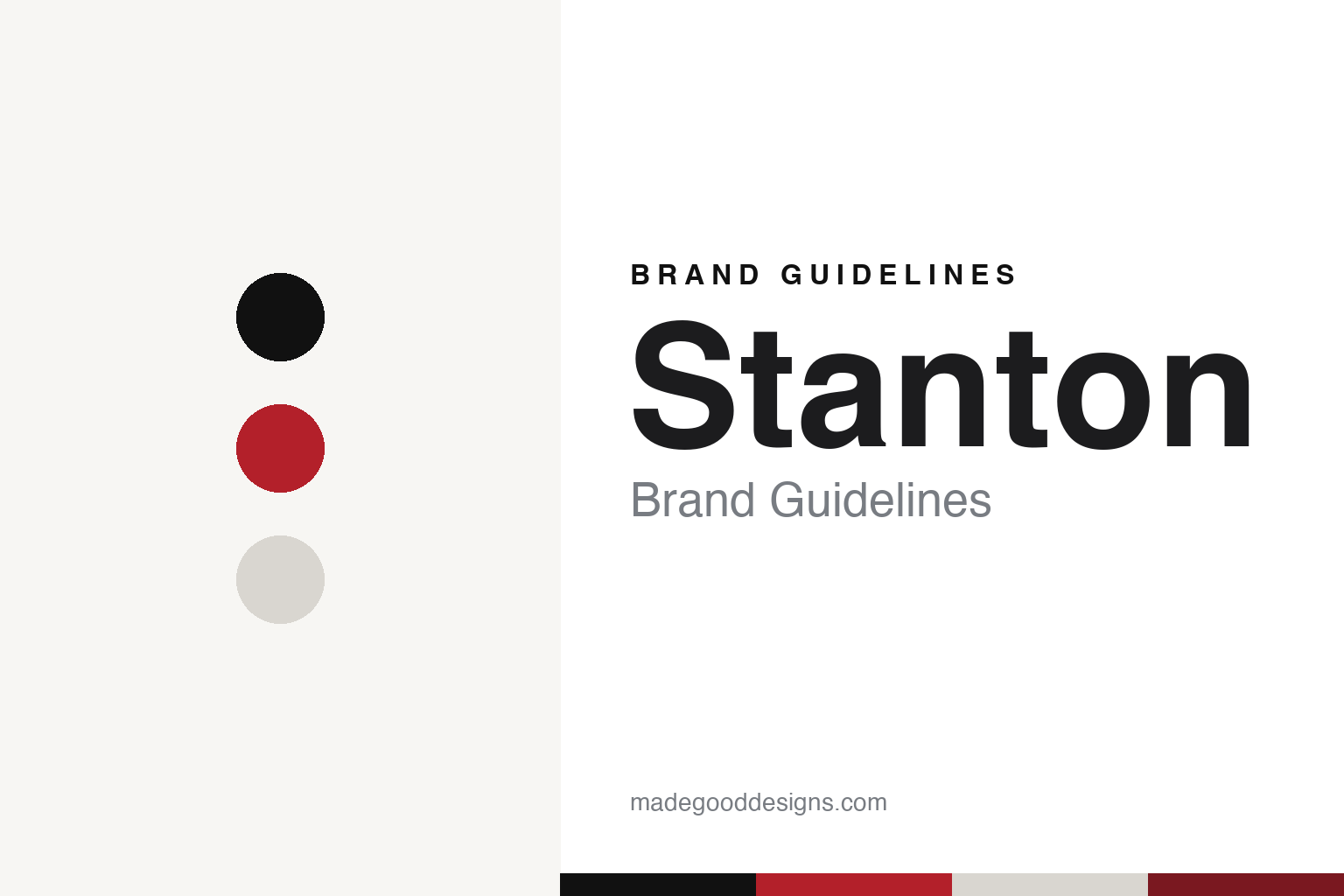
Stanton Brand Guidelines
The cartridge name that moved from hi-fi to the DJ booth.
Aa
Two constants: a Stanton black, red and grey palette and a condensed sans register. Abstract homage — not a Stanton product or mark; no cartridge, turntable, logo or nameplate is reproduced.
Pickering and Stanton
A stylus inventor and a cartridge company.
Stanton’s roots are in Pickering & Company, the phono-cartridge maker started on Long Island, New York, by the engineer and French-horn player Norman C. Pickering. English Wikipedia’s article on Pickering, citing a 1976 High Fidelity profile, dates the start to November 1945; its article on Stanton gives 1946, the year the brand itself uses. Its pickups were first sold to recording studios and radio stations.
Walter O. Stanton joined in 1948 to run sales, English Wikipedia says. The New York Times, in his 2001 obituary, credited him with inventing an easily replaceable, slide-in stylus in the late 1940s, which let listeners swap a worn needle assembly instead of returning it to the factory; the invention, the paper said, “became one of the basics in phonograph cartridge design.” In 1950 he bought Pickering & Company, the Times said, and a decade later he founded Stanton Magnetics. English Wikipedia dates the Stanton brand to 1961 and says it was aimed at professional broadcast and recording users while Pickering served the growing consumer market. Both companies had operations in Plainview, New York, and West Palm Beach, Florida, according to the Times. Stanton’s own history page, in the Gibson years, gave 1946 as the founding date and named Walter Stanton as founder.
Stanton was also an organiser of the industry. He was president of the Audio Engineering Society, helped found the Institute of High Fidelity, whose shows in Manhattan drew crowds, and pushed manufacturers toward common standards for cartridge mounting so that turntables, cartridges and electronics could be sold as separate components, the obituary says. In 1967 he set up five rooms at the New York National Design Center to show how audio equipment could be fitted into home decor. He ran both companies until he retired in 1998.
Colour
From back-cueing to battles.
The cartridge that carried the name into DJ culture was the 500 series. English Wikipedia says the 500AL of 1970 was designed to survive the back-cueing of radio disc jockeys, who turned records backwards to find a starting point, and that this toughness later made it a choice for hip-hop and club DJs and turntablists. Mixmag, tracing the history of the turntable in 2017, named Stanton with Gemini, Numark and Ortofon as brands that “suddenly found their wares in great demand” as club DJs of the 1980s hunted for tough, accurate needles.
The DJ press records the line’s reach. Reviewing Stanton’s range in January 2008, the site Skratchworx said that “at least half” of its readers had started on 500ALs, called the 680EL “the club standard for a number of years,” and noted that “a young A-trak used the 680el in his first DMC win.” English Wikipedia cites Mark Katz’s history Groove Music (Oxford University Press, 2012) for A-Trak and DJ Craze using Stanton cartridges in DMC World DJ Championship wins.
From the late 1990s Stanton added mixers, turntables and CD players. Its larger contribution was digital. FinalScratch, developed by the Dutch company N2IT with input from Richie Hawtin and John Acquaviva and first shown in 1998, let a DJ control digital music files with timecoded vinyl on ordinary turntables. Stanton bought the product from N2IT, Create Digital Music reported in 2008, and the first complete Stanton-branded version reached the market at the winter NAMM show in January 2002. From 2003 it was developed with Native Instruments; the partners announced their split in October 2006, effective at the end of that year. Stanton followed with its own controllers — the SCS.1 system with a motorised platter, the touch-controlled SCS.3 and the standalone SCS.4DJ, English Wikipedia says.
Typography
DJ hardware and documentation.
Two groups dominate DJ equipment. Pioneer DJ left Pioneer Corporation in 2014; its parent, AlphaTheta, has been owned since 2020 by the Japanese holding company Noritsu, according to English Wikipedia. inMusic Brands, of Cumberland, Rhode Island, owns Numark, Denon DJ and Rane, which it bought in 2016.
The makers here work around that pair. Reloop is a brand of Global Distribution GmbH & Co. KG of Münster, Germany, its imprint says. Ecler was founded in Barcelona in 1965 and, by its own account, was acquired by the Fordahl Capital group in 2014; it labels its products “Made in Barcelona.” Mixars calls itself an independent subsidiary of Italy’s RCF Group, run from Valsamoggia, near Bologna.
Two are older names that stopped. Rodec, of Belgium, says its production paused in 2014 and that it returned in 2022 under Tom De Ridder, its chief executive since 2021; its website names TDR Media BV of Leuven. Vestax, the Tokyo company founded by Hidesato Shiino in 1977, entered bankruptcy proceedings in December 2014, Teikoku Databank reported.
One has joined a giant. Stanton, the American phono-cartridge name built up by Walter Stanton, passed to Gibson in 2011 and to inMusic in 2020, according to English Wikipedia; its website now calls it part of “the inMusic family of brands.”
Algoriddim, the Munich maker of the djay app, makes software, not hardware; it says partners including Reloop and Pioneer DJ build controllers for it.
This guide sets out what can be checked about each brand — who founded it, who owns it, and what it says about where its products are made — and marks clearly what rests only on the company’s own word.
Aa
A condensed sans for a name printed on small cartridge bodies. (Specimen set in Barlow Condensed, a sans STAND-IN; NOT the Stanton logo.)
Stanton
From Gibson to inMusic.
Ownership then changed twice. In December 2011 Gibson Guitar Corp. bought Stanton Group, a business based in Deerfield Beach, Florida, that combined Stanton DJ with the KRK Systems studio-monitor brand and the loudspeaker maker Cerwin-Vega, for an undisclosed sum, the Sun Sentinel reported. The three became Gibson Pro Audio, run from Nashville, and the Florida office work was to move there within six months. The Nashville Post later described the purchase as part of an “ill-fated push” by Gibson beyond its instruments; Gibson filed for protection from its creditors in 2018 and emerged that autumn.
In May 2020 inMusic, the group behind Numark, Rane and Denon DJ, bought Stanton from Gibson Brands, DJ Times reported; terms were not disclosed, and KRK and Cerwin-Vega stayed with Gibson. inMusic’s announcement spoke of a legacy of more than 70 years and called FinalScratch “the industry’s first DVS solution.” inMusic says its global headquarters are in Cumberland, Rhode Island.
Today stantondj.com is a small site, “part of the inMusic family of brands.” In October 2026 it showed two products: the STX, a portable scratch turntable with a factory-fitted Innofader Nano crossfader and rechargeable batteries, and the DS4 cartridge, with a fine circular diamond stylus. We found no statement on the site about where they are made.
For a design guide, Stanton shows how a component name can move from hi-fi to the DJ booth by being tough enough for a use its makers had not planned. Compare Ortofon, another cartridge name that DJs adopted, and Native Instruments, its partner on FinalScratch. For this guide we use a cartridge black, a stylus red and a warm grey with a condensed sans, an unofficial interpretation; no product or logo is reproduced.
Explore & save
Keep Stanton’s identity on hand — save it to a board in the Made Good inspiration library.
Stanton identity set
Pin the Stanton black, red and grey palette and the condensed sans register to your own board.