CIOKS Brand Guidelines
The Danish pedal-power maker that builds its boxes in Poland.
Aa
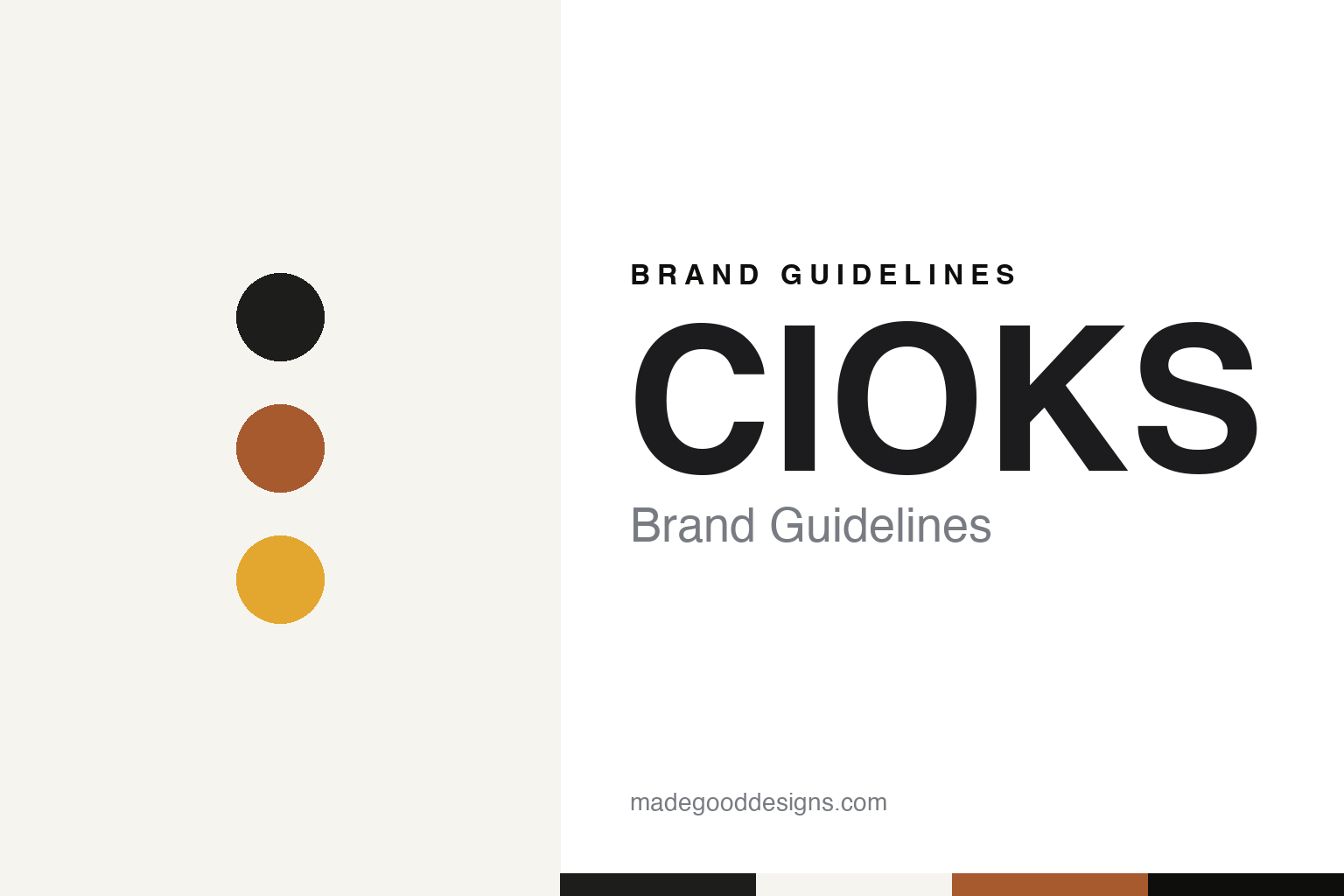
Two constants: a CIOKS black, copper and amber palette and an engineering sans register. Abstract homage — not a CIOKS product or mark; no power supply, cable, logo or nameplate is reproduced.
A pedal-power problem
A guitarist in Copenhagen builds his own supply.
CIOKS is a Danish maker of power supplies for guitar effects pedals. Its catalogue is power boxes, the cables that run from them to the pedals and the parts that hold them under a pedalboard. The company says it was formally founded in November 1991 in Copenhagen by Poul Ciok, “who still runs the company today.” A history page on its website from 2017, written in his voice, says he was a high-school guitarist with an interest in electronics who could not find a proper way to power his pedals, so he built prototypes of a small supply that could feed several 9-volt units at once.
The first product, the company says, was the Baby, with five 9-volt outlets; its current history page dates it to 1992. In 1995 came the Big John and the Double Jack, two larger supplies with seven outlets each, the second adding a 12-volt option, as digital pedals began to ask for more current. The 2017 page says those three products “almost became a standard” for powering pedals in Denmark, a claim we give as the company’s own.
The independent record starts later. The Internet Archive holds only a parked placeholder at cioks.com in 2003, and a working company site from 2010, when the firm’s contact details placed it in Gentofte, just north of Copenhagen. That 2010 site already said “CIOKS was established in 1991,” named the Baby, Big John and Double Jack, mentioned three further products added in 2007 “as the demand for special voltages and isolation of outlets rose,” and described a database of more than 600 effects pedals, with excerpts from their manuals and the company’s own measurements, that it used to advise players on how to power a given board. Today the company’s website gives its home as Køge, on the coast south of Copenhagen; we did not find when it moved.
Colour
Made in Poland, from linear to switch-mode.
For a buyer, the most useful fact about CIOKS is where the boxes are built. The company says that, after working for a few years at Siemens and Bang & Olufsen following his engineering degree, Poul Ciok went full-time on CIOKS in 2003 and began exporting, mainly to western Europe. In 2004, it says, it set up a sister company in Poland, CIOKS Enterprises, to handle manufacturing, with the engineer Tomasz Karwat, who it says is still heavily involved. Its website now says all products are “made in-house by CIOKS Enterprises” and labels them “Handmade and designed in Europe.” In 2017 the company said it had nine full-time employees and that most of its activity ran through the Polish company.
The design has moved through two technical eras. In 2010 the company introduced its Professional range, the DC10, AC10 and TC10, which it says were its first supplies with toroidal transformers in a metal enclosure, chosen “for less noise,” with a mains selector for 120 or 230 volts. The large CIOKOLATE followed in 2013. The company also says it built a co-branded supply for the effects maker Eventide, the PowerFactor, based on the DC10; Eventide sells a PowerFactor 2, but its product page does not name a maker, so we give that as the company’s claim.
The second era is switch-mode. The company says its Future Power Generation range was developed in 2017 and 2018 with the Danish switch-mode designer Mads Peter Frium. Guitar World, reviewing the five-outlet SOL in May 2025, dated the range’s launch to 2017 and explained the trade-off: switch-mode supplies are smaller, lighter and more efficient than transformer-based linear ones, at the risk of high-frequency noise. The reviewer found the SOL “introduced absolutely nothing” to his signal. Each SOL outlet can be set to 9, 12, 15 or 18 volts with recessed DIP switches, and delivers up to 660 milliamps at 9 volts.
Typography
Design and documentation.
A pedalboard gives effects pedals a fixed home and needs clean power and routing. The makers here are known for different parts of it: frames, isolated power and switching.
Some are best known for the frame. Pedaltrain calls itself an independent accessory maker based in Nashville, founded in 1999 as a one-man start-up, with a European joint venture in Belgium. RockBoard belongs to Warwick GmbH & Co. Music Equipment KG of Markneukirchen, Germany, the company named in its website’s imprint. Temple Audio Design, of Warman, Saskatchewan, in Canada, sells the Templeboard and its quick-release pedal mounting system.
Others are best known for power. Truetone started as Visual Sound, which its founder, Bob Weil, launched at the NAMM show in 1995; it introduced the 1 SPOT adapter, took the Truetone name in 2015, is based in Spring Hill, Tennessee, and says it is still family owned. CIOKS was founded in Copenhagen in 1991 by Poul Ciok, who, the company says, still runs it; it is based today in Køge, Denmark, and says its power supplies are made in-house by a sister company in Poland.
Two Californian firms make both power and switching. Voodoo Lab, of Santa Rosa, says it has designed electronics for musicians since 1986. Decibel Eleven, of Valencia, launched its Hot Stone power supplies in 2012; it is a division of the electronics maker MYE, which it says has production facilities in the USA and abroad.
This guide sets out what can be checked about each brand — who founded it, who owns it, and what it says about where its products are made — and marks clearly what rests only on the company’s own word.
Aa
An engineering sans for a maker of hidden hardware. (Specimen set in Space Grotesk, a sans STAND-IN; NOT the CIOKS logo.)
CIOKS
A connector as a signature.
The detail that makes a CIOKS supply recognisable is the connector. Instead of the round DC barrel jacks used on most pedal power supplies, its outlets are RCA jacks, and pedals connect through the company’s own Flex cables. Guitar World argued in 2025 that this is not a lock-in trick: the RCA plug makes a firmer mechanical and electrical connection and is harder to snag loose or break, and the Flex cables are colour-coded by type, which helps a player see which pedal is getting which polarity. The same review praised the SOL’s all-metal enclosure, a top plate that overhangs the mains inlet and the outlets to protect them, and pre-tapped holes for screwing the unit to a board. The company offers a five-year warranty and says its failure rate is less than one in a thousand, a figure we have not seen tested.
The current range keeps both families: the switch-mode DC7, SOL, CRUX and the 4 and 8 Expanders, and the linear CIOKOLATE, DC10 and AC10. In October 2025 Premier Guitar reported a limited Retro Series, a DC-7 styled as a VHS tape and a SOL styled as an audio cassette, priced at $294 and $219, a rare case of the brand dressing its boxes in something other than plain metal. Its slogan, “Powering Creativity Since 1991,” puts the founding date at the centre of the identity.
For a design guide, CIOKS shows how a small engineering firm can make a component that sits out of sight, under the board, carry a brand through a connector, a cable colour code and a single date. Compare Pedaltrain, whose flat boards the company said in 2017 its DC5 was a “perfect match” for, and Walrus Audio, whose Canvas Power 5 Guitar World listed as an alternative to the SOL. For this guide we use enclosure black, copper and amber with a sans, an unofficial interpretation; no product or logo is reproduced.
Explore & save
Keep CIOKS’s identity on hand — save it to a board in the Made Good inspiration library.
CIOKS identity set
Pin the CIOKS black, copper and amber palette and the engineering sans register to your own board.