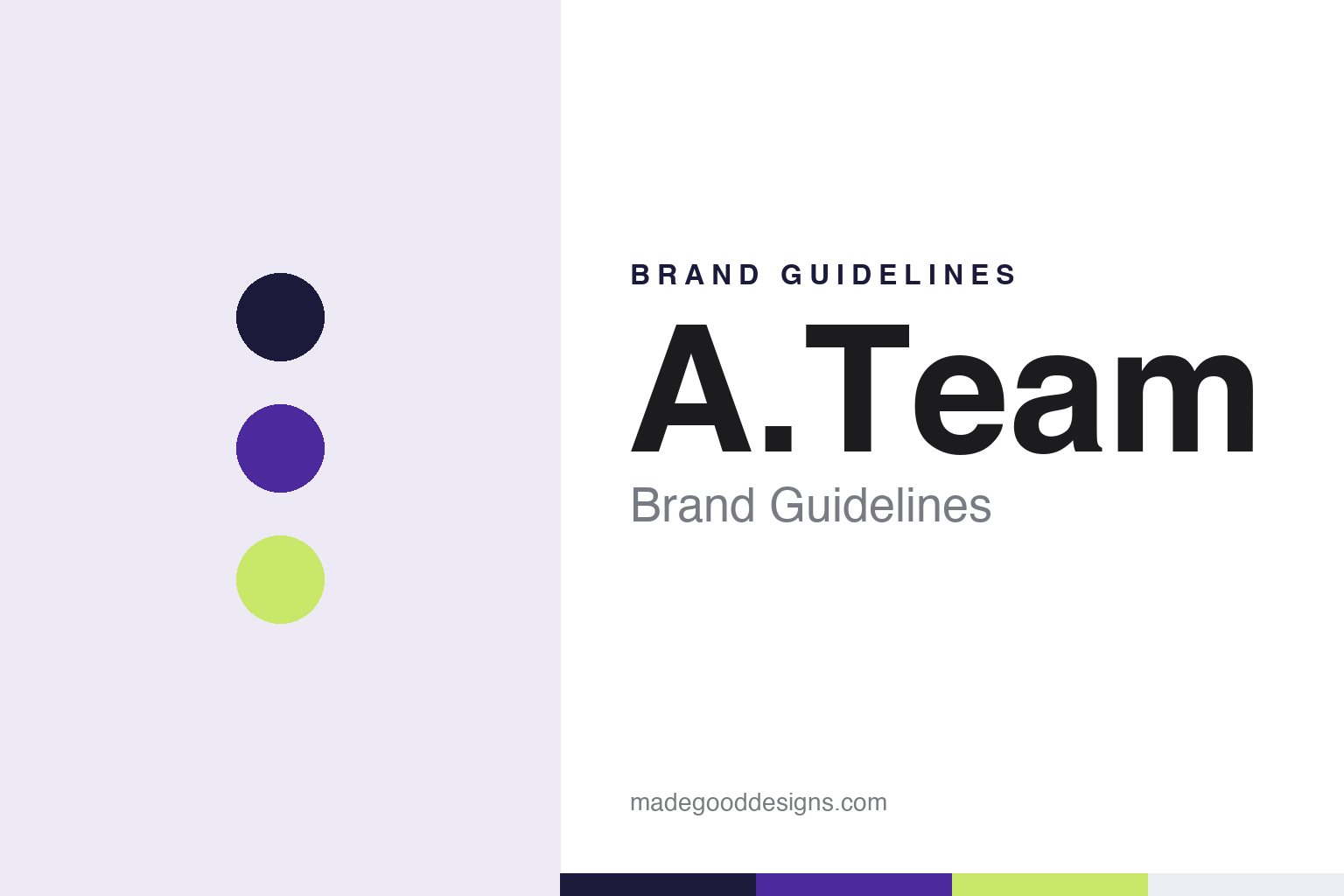
A.Team Brand Guidelines
The New York network that built its brand around the team.
Aa
Two constants: an A.Team ink indigo, violet and lime palette and a Geometric sans register. Abstract homage — not an A.Team product or mark; no logo, interface or wordmark is reproduced.
Teams Matter
A network built around the group, not the profile.
A.Team is a New York company that assembles small teams of independent technologists for client projects. It was founded in early 2020 by Raphael Ouzan, its chief executive, and Kobi Matsri, according to an interview Ouzan gave the New York technology publication AlleyWatch in May 2022. The company’s current leadership page lists both men as founders, with Matsri as chief operating officer, and the legal name in its website footer is ATeams Inc.
The company spent its first two years out of public view. AlleyWatch reported in May 2022 that A.Team had just come out of stealth, having worked with more than 250 companies since its founding while staying invite-only. Its seed round in 2020 was led by NFX, joined by BoxGroup, Village Global and firstminute capital, and the Series A announced in 2022 was co-led by Insight Partners, Tiger Global and Spruce House, the same report said.
The name puts the team, not the individual, at the centre. “A.Team was born from a very simple idea — that teams matter,” the company’s website says, and the people in its network are called A.Teamers. In 2022 Ouzan described the service to AlleyWatch as a “team formation platform” and a “members-only network” of product builders: engineers, product managers, designers, data scientists and marketers. He said the founders had seen highly skilled technology workers who wanted to leave the fixed structures of full-time jobs, but who did not want short, task-based gigs either.
Colour
Missions, members and TeamGraph.
The model, as AlleyWatch described it in 2022, rested on longer engagements than a typical freelance job. Members could join projects in groups of people they already knew or on their own, and Ouzan said those engagements, which the company calls missions, lasted 12 to 19 months on average. At the time the network counted about 4,000 builders, the report said, and Ouzan said A.Team rarely met task-based freelance marketplaces as direct competitors, because their work was short and done on the side.
Ouzan told AlleyWatch that clients ranged from early-stage start-ups and mid-sized technology and non-technology companies to large enterprises, and that the company was selective about which customers it admitted. On the builder side it welcomed product managers, designers, engineers, data scientists and growth marketers working across software, hardware and data. He also said the company wanted to support hybrid teams that mixed a client’s full-time employees with A.Teamers.
Behind the matching sat what the company called TeamGraph, which Ouzan told AlleyWatch combined skill and experience data with behavioural science to put together teams for a client’s product mission. The company said it was partly built by its own network: in 2022 its staff, the “BuildTeam,” numbered more than 75 people across 10 countries, about half of them A.Teamers. It kept an office in New York, but Ouzan said attendance would never be mandatory; instead the staff met at a recurring week-long offsite it called the “A.Summit.”
The company now gives larger numbers. Its about page, read in November 2026, lists more than 11,000 vetted experts and more than 500 clients, figures the company states itself, and its footer reads “New York | 100+ Countries.” The same page says A.Team was named in Fast Company’s World Changing Ideas list in 2023.
By late 2026 its homepage led with applied artificial intelligence. Titled “Applied AI for Consumer Brands and CPG Teams,” it describes “agentic teammates” that deliver finished work inside Teams, Slack, PowerPoint and email, drawing on a shared “intelligence layer” built on a client’s own data, with a client’s leaders approving each move. The talent business continues alongside it: the site offers forward deployed engineers, which it describes as senior engineers who embed with a client’s own customer, and technical talent placed inside a client’s team.
Typography
Design and documentation.
Tech-talent networks and developer marketplaces sell access to people, so their identities lean on a few recurring ideas: the size of a pool, the reach of a map and the rigour of a test. Andela says its network speaks more than 300 languages and that more than 650 organisations have built with it; Turing’s website counts more than 5 million domain experts. Such figures are the companies’ own, and they move quickly: in December 2021 Turing told TechCrunch it had 1 million engineers and developers, and in March 2025 it said it worked with some 4 million coders.
Vetting usually gets a name of its own. Turing called its platform the “Talent Cloud,” and Andela later launched the Andela Talent Cloud. English Wikipedia describes Andela’s technical, soft-skills and leadership assessments feeding a “match fitness score,” and Andela has bought assessment and practice tools such as Qualified and Codewars, which it presents as a source of behavioural data from millions of developers.
The matching itself tends to be described as a sequence. TechCrunch wrote in 2021 that Turing used AI to source, evaluate, hire, onboard and then manage engineers remotely, and in the same year described Andela as evaluating technical and soft skills before matching engineers with the teams they fitted most closely.
Corporate pages put founders, investors and milestones up front. Andela’s about page runs a dated timeline of funding rounds, cohorts and acquisitions, illustrated with photographs of its own events, and introduces its leadership team; Turing’s company page lists its two co-founders by title. This guide sets out what can be checked about each company, separating dated reporting from what the company says about itself.
Aa
A geometric sans — A.Team, with its full stop. (Specimen set in Space Grotesk, a sans STAND-IN; NOT the A.Team logo.)
A.Team
A full stop that runs through the vocabulary.
A.Team’s naming is its most consistent identity feature. The name keeps a full stop between the letter and the word, and the same pattern runs through the company’s vocabulary: A.Teamers for members, the A.Summit for its offsite, the BuildTeam for its staff and TeamGraph for its matching technology, all names the company used in 2022. The about page sets its figures under the line “Built for scale. Backed by results.” and opens with the heading “Great teams build great things,” followed by the line “Here, builders team up to build applications that will change the world.” On the homepage, the main call to action asks clients to “Start a lighthouse,” and numbered sections lead from the problem to the solution to the jobs its agentic teammates take on.
Its current website speaks in two registers. One is the talent network, with members, missions and a sign-up route for builders; the other is the AI business, with case files and insights drawn, as its navigation puts it, from “building AI systems that actually ship inside the Fortune 500.” Its leadership page places the two founders beside heads of marketing, finance, engineering, builder operations and community, and its newsletter is called Build Mode.
For a design guide, A.Team shows how a talent business can build its brand around a group rather than a single profile. Compare Toptal, another remote network for independent technologists, and Braintrust, a talent network from the same generation of companies. For this guide we use an ink indigo and a violet with a lime highlight and a geometric sans, an unofficial interpretation; no product or logo is reproduced.
Explore & save
Keep A.Team’s identity on hand — save it to a board in the Made Good inspiration library.
A.Team identity set
Pin the A.Team ink indigo, violet and lime palette and the Geometric sans register to your own board.