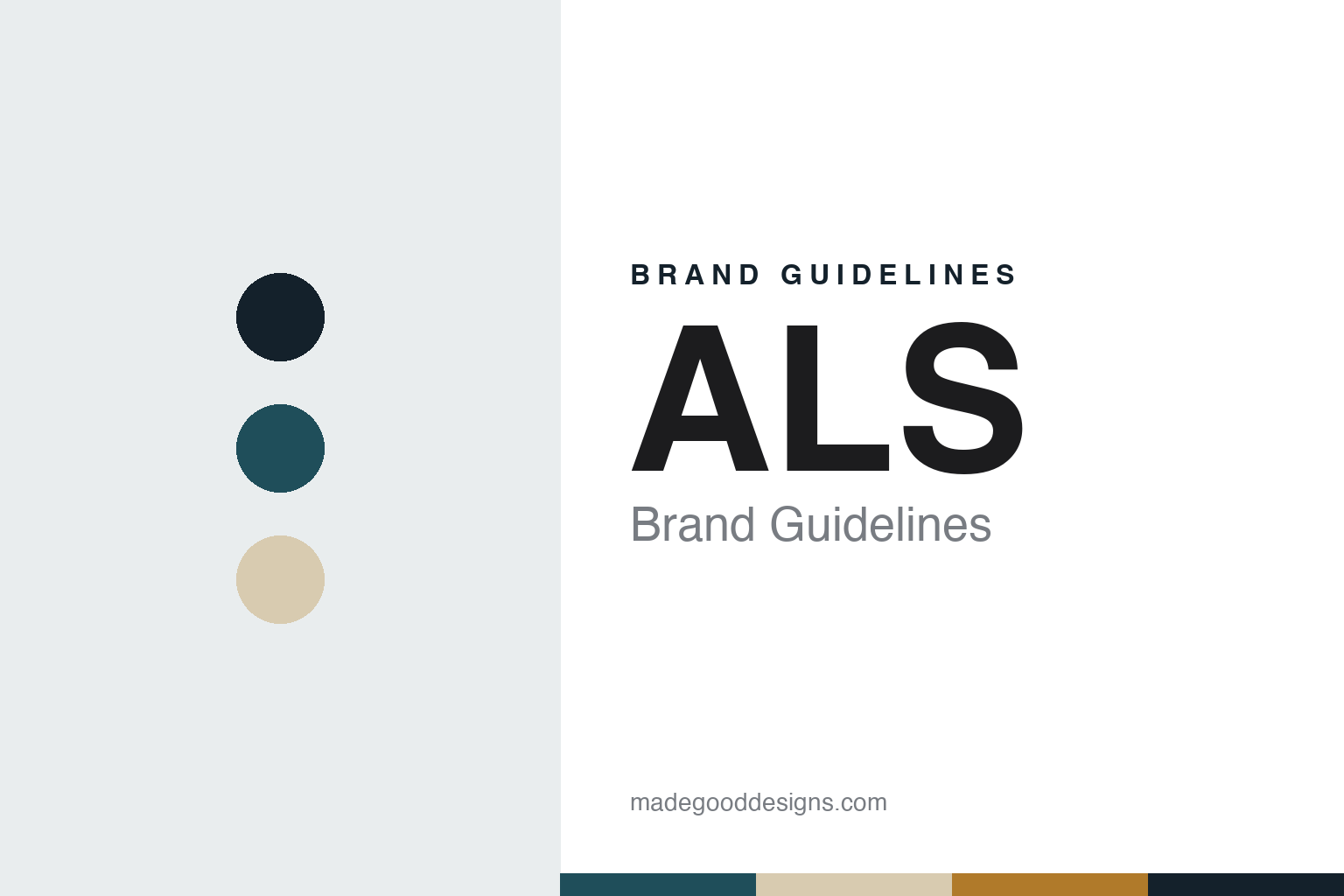
ALS Brand Guidelines
Campbell Brothers soap, a 1976 Brisbane lab and three initials.
Aa
Two constants: an ALS teal, sand and ochre palette and a plain technical sans register. Abstract homage — not an ALS asset; no logo, report or mark is reproduced.
Campbell Brothers
A soap works on the Brisbane River and a laboratory a century later.
ALS did not begin as a laboratory. English Wikipedia says the business was founded in Brisbane in 1863 by Peter Morrison Campbell, a Scottish immigrant, as Campbell Brothers, a soap maker in the riverside suburb of Kangaroo Point; the company’s own timeline describes it as a small Australia-based chemical company. In 1881, Wikipedia says, the business moved to a site at Bowen Hills, where it went on making soaps and cleaning chemicals for roughly the next hundred years.
The company was floated in 1952 and listed as Campbell Brothers Limited, Wikipedia says; the company’s timeline records the same year for its listing on the Australian stock exchange. For most of its first century, the name over the door belonged to a maker of soap and cleaning products.
The laboratory side started separately. Australian Laboratory Services opened in Brisbane in 1976 as a privately owned company, English Wikipedia says, providing analytical chemistry to the oil shale and mineral exploration industries; the ALS timeline calls it a small geochemistry laboratory serving mineral exploration companies. In 1981 Campbell Brothers bought a controlling stake, and by the mid-1980s it owned all of the shares, according to Wikipedia.
For three decades the two identities sat side by side: a listed company carrying its founder’s family name, and a laboratory business known by three initials. That arrangement ended in 2012, when Campbell Brothers Limited was renamed ALS Limited and, Wikipedia says, divested its former manufacturing businesses. The same year the company was inducted into the Queensland Business Leaders Hall of Fame, which is run by the State Library of Queensland, Wikipedia adds.
Colour
From mineral exploration to food, water and pharmaceuticals.
Growth followed the mining trade first. Wikipedia says ALS grew across Australia in the 1980s and expanded into Asia and South America in the 1990s, then into North America, Africa and Europe in the early 2000s; the company’s timeline dates the move into Asia and South America to 1990 and the push into North America, Africa and Europe to 2000. The two sources differ on the Middle East: the company gives 2010 and Wikipedia gives 2011.
Two North American purchases shaped the minerals business. English Wikipedia says ALS acquired the mineral laboratory groups Chemex Labs in December 1999 and Bondar Clegg in December 2001, and that after those deals it became one of the largest providers of laboratory analysis to the minerals industry.
From 2011 the company pushed further into what it calls life sciences. Wikipedia says ALS added pharmaceutical work and food quality testing between 2011 and 2017. The company’s timeline lists focused acquisitions and new start-up laboratories in food and pharmaceuticals in 2017, a formal sustainability commitment in 2018 and, in 2022, digital transformation work intended to strengthen its infrastructure and its corporate brand.
The website today groups the work under broad headings. Environmental testing covers site assessment, water, air and occupational hygiene. Equipment reliability covers oil analysis and coolant and transformer-fluid testing. Mining and commodities covers geochemistry, metallurgy, coal, and assay and inspection, while further headings cover food and agrisciences, beauty and personal care, and pharmaceutical services. The company says it works in more than 70 countries from more than 450 offices with over 22,000 staff, figures shown on its website in November 2026.
The website also points to long-running client work. Its case studies describe a long-standing partnership with Yorkshire Water to develop new analytical methods as the utility’s needs changed, and monitoring of landfill sites for the waste company Biffa, including tests for eluates, the substances that leach out of waste samples.
Typography
Design and documentation.
Testing, inspection and certification companies sell work that customers rarely see in full: a laboratory report, an inspector’s visit, a certificate. Their websites lean on a small set of visual and verbal devices to make that work visible. Service catalogues are often organised by industry rather than by technique, so a visitor looking for vehicle inspection, battery testing or management-system certification finds it under automotive, energy or certification headings, as the Applus+ and Element sites show.
Accreditation pages carry much of the weight. Firms list the standards their laboratories and certification bodies are accredited to, such as ISO/IEC 17025 for testing and calibration laboratories, and some publish counts of their accreditations and approvals; Element’s website, for example, gives a figure of more than 1,000. Certification marks and logos appear as the companies publish them, usually beside the scheme or standard they belong to.
Photography on these sites commonly shows people at work: technicians at laboratory benches, inspectors on site, engineers beside test rigs and proving grounds. Corporate pages add brand promises and value statements, such as the “Together beyond standards” promise Applus+ publishes, and history pages that trace how a group was assembled, often through long runs of acquisitions.
Investor and sustainability pages complete the picture. Applus+ keeps the records of its shareholder meetings online, including those of 2024, the year it left the stock market, and both Applus+ and Element publish sustainability or ESG sections beside their codes of ethics and corporate responsibility policies. The guides in this set describe each brand from those published materials and from dated independent sources; the colours and typefaces shown here are unofficial interpretations, not the companies’ own.
Aa
A plain technical sans for a group known by three initials. (Specimen set in IBM Plex Sans, a sans STAND-IN; NOT the ALS logo.)
ALS
A laboratory’s initials on a listed company.
ALS describes itself as “a global leader in testing” and says its mission is to use data-driven insights to solve complex challenges. The group is still run from Brisbane, and its shares trade on the Australian Securities Exchange under the code ALQ. Its website names Malcolm Deane as chief executive and managing director since May 2023, after about ten years in executive roles at the company, and Nigel Garrard as chairman since July 2024. The company timeline marks the appointment of Raj Naran as managing director and chief executive in 2017, and in August 2026 the website announced a new executive general manager for its minerals business.
In May 2026 the company disclosed a cyber incident. On 5 May, Reuters reported through CNA, ALS said that unauthorised third-party access to parts of its IT systems had caused a temporary disruption to some operations, that most services had been restored, and that it had informed the Australian Cyber Security Centre while it assessed any effect on data. The Motley Fool Australia reported the same announcement that day, and the ALS investor pages now carry a link to cyber incident updates.
The name is the clearest part of the identity. “ALS” stands for Australian Laboratory Services, the Brisbane laboratory of 1976, and in 2012 those initials replaced Campbell Brothers as the name of the parent company. The older name survives in the history pages, where the company still counts its story from 1863.
For a design guide, ALS shows how the initials of one Brisbane laboratory can become the name of a whole listed group once an older family name is retired. Compare Eurofins, another group built on laboratory testing, and Intertek, whose name also gathered older testing businesses under one word. For this guide we use a deep teal, ink, a sandy core-sample tone and an ochre with a sans, an unofficial interpretation; no product or logo is reproduced.
Explore & save
Keep ALS’s identity on hand — save it to a board in the Made Good inspiration library.
ALS identity set
Pin the ALS teal, sand and ochre palette and the plain technical sans register to your own board.