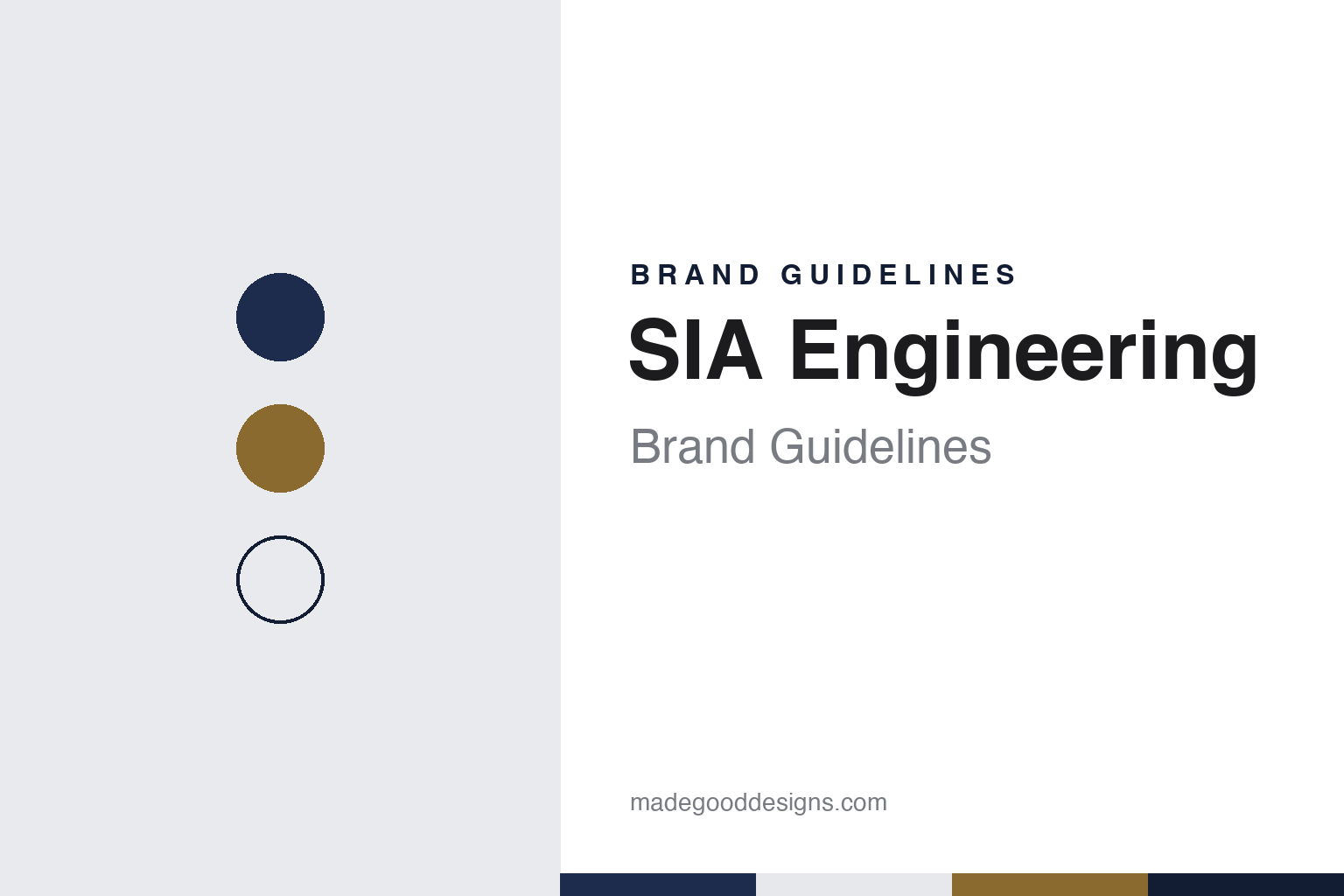
SIA Engineering Brand Guidelines
Singapore Airlines’ engineering division, spun off in 1992 and built around its Changi hangars.
Aa
Two constants: a midnight blue, steel and brass palette and an engineering sans register. Abstract homage — not an SIA Engineering asset or mark; no logo, livery or aircraft is reproduced.
An airline division
Singapore Airlines’ engineers become a company.
SIA Engineering Company, usually shortened to SIAEC, is the aircraft maintenance, repair and overhaul (MRO) company of the Singapore Airlines group, based at Singapore Changi Airport. The company says it was formed from the airline’s Engineering Division, which over the years had invested in the hangars, equipment and skills needed to look after the newest aircraft in the Singapore Airlines fleet, and so gained experience on new types early.
In 1992 that division became a separate subsidiary of Singapore Airlines. The company describes the change as a way to gain more autonomy and to pursue new business around the world, with a sharper focus on productivity, efficiency, quality and added services for customers. English Wikipedia also gives 1992 as the founding year and names the Singapore Airlines Group as the parent. In 2000, the company says, SIAEC was listed on the Singapore Exchange, where its shares still trade.
The work today is split into named service lines on the company website: base maintenance, line maintenance and technical handling, fleet management, cabin solutions, engine services and component maintenance, alongside aircraft transition services and a training academy. In a company announcement of 26 August 2026 SIAEC said it served more than 80 international carriers and aerospace equipment makers, provided line maintenance at over 30 airports in nine countries and had 26 subsidiaries and joint ventures with equipment makers and airlines. At Changi alone, its company profile says, it provides line maintenance to more than 60 airlines passing through Singapore.
Colour
Hangars, engine shops and partners.
The hangars are the most visible part of the business. The company’s facilities page lists six hangars in Singapore with a combined floor area of 56,000 square metres, which it likens to eight football pitches. Each one is assigned to particular aircraft: Hangar 1 takes heavy maintenance on the Airbus A380, A350 and A330 and the Boeing 777 and 747, Hangar 3 is given over to the Boeing 777, and Hangar 5 is a dedicated paint hangar. A further three hangars with five aircraft bays stand at Clark in the Philippines, including a narrowbody paint hangar; the company says they handle Boeing, Airbus and Embraer aircraft. English Wikipedia describes the Clark business, SIA Engineering (Philippines), as a wholly owned subsidiary.
Much of the work runs through partnerships with the firms that design engines and components. The engine shop Singapore Aero Engine Services, or SAESL, is a joint venture with Rolls-Royce that maintains Trent engines; in a media release of 23 September 2026 SAESL described itself as the largest Rolls-Royce Trent MRO provider and marked its 25th anniversary and its 5,000th engine. Other joint ventures listed on the SIAEC website include Eagle Services Asia with Pratt & Whitney, Safran Landing Systems Services Singapore and a Panasonic Avionics service centre.
Some partnerships began as experiments. In April 2017 The Business Times reported that SIAEC had signed a memorandum of understanding with the 3D-printing company Stratasys to explore a joint venture, majority owned by SIAEC, for an additive manufacturing service centre in Singapore offering design, engineering, certification support and part production. English Wikipedia lists the result as Additive Flight Solutions, held 60/40 by the two companies.
The network kept growing in 2026. In its results release of 3 November 2026 the company said its wholly owned subsidiary Base Maintenance Malaysia officially opened its facility and first hangar in May 2026, after carrying out its first maintenance check in November 2025, and in July 2026 completed its first Airbus A350 check for Air India. In August 2026 SIAEC completed the purchase of a 30% stake in Arport Aircraft Maintenance & Engineering (Fujian), which provides line maintenance and ground services at Xiamen, Fuzhou, Wuyishan and Longyan airports; the remaining shares are held by the Xiamen and Fuzhou airport companies, a company announcement of 26 August 2026 said. In June 2026 SIAEC concluded a joint venture agreement with Safran Aircraft Engines for a CFM LEAP engine shop in Singapore, which is to move into a new facility in future, and in July 2026 it signed a non-binding memorandum of understanding with Air India to explore MRO collaboration, possibly including a joint venture in India.
Typography
Design and documentation.
Aircraft maintenance, repair and overhaul companies, known in the trade as MRO providers, sell work that passengers rarely see. Their public pages tend to start with the places where that work is done: hangars photographed with aircraft inside, often in the liveries of the airlines that own the maintenance company or send their fleets to it, shown as the companies publish them.
The second common element is the capability list. Providers set out what they can handle by aircraft type and by engine type, and by level of work, from line checks between flights to heavy base checks, component overhaul and passenger-to-freighter conversion. GAMECO’s website, for example, names the Boeing, Airbus, Embraer and COMAC types it works on one by one.
Approvals are usually stated plainly rather than designed. A maintenance organisation’s certificates from the European Union Aviation Safety Agency, the US Federal Aviation Administration, the Civil Aviation Administration of China and other national authorities tend to appear as a named list, sometimes with the certificate type beside each authority. Hangar sizes, bay counts and staff numbers appear the same way, as figures in company statements that trade titles such as Aviation Week and AviTrader then report.
The rest of a typical MRO site speaks to two audiences. Airlines and aircraft lessors looking for capacity are addressed through customer, news and contact pages, where new contracts and hangar openings are announced; technicians and engineers looking for work are addressed through careers pages. Many of these companies belong to an airline, or are joint ventures with one, so the parent’s name often sits close to the provider’s own.
Aa
An engineering sans for a company named for its parent’s initials. (Specimen set in IBM Plex Sans, a sans STAND-IN; NOT the SIA Engineering logo.)
SIA Engineering
An identity told through hangars and partners.
SIAEC presents itself in the plain language of its trade. Its website is arranged as a set of service pages, a list of aircraft types, a facilities page that gives each hangar’s specialisation, a page of certifications and a long directory of its “supporting network” of joint ventures and subsidiaries, each with its own page. The company profile says it holds certifications from more than 20 airworthiness authorities and that its collaborations with aircraft, engine and component makers complement its own skills and market reach.
The name itself is descriptive: the parent airline’s initials joined to the word engineering, and the shorter SIAEC used across its press releases and filings. Recognition in 2026 came mainly from its own industry and from human-resources awards. In its November 2026 results release the company said it had been named “Asia MRO of the Year – Line Maintenance” at Aviation Week’s MRO Asia-Pacific Awards 2026, and that at the Singapore HR Awards 2026, organised by the Singapore Human Resources Institute, it received a Gold award for Excellence in Talent Strategy and a Silver award for Excellence in People Development.
For a design guide, SIA Engineering shows how an engineering company can build an identity from hangars, aircraft types and partner names rather than from consumer advertising. Compare Singapore Airlines, its parent, and HAECO, another Asian aircraft maintenance group. For this guide we use a deep midnight blue, a steel grey and a warm brass with a sans, an unofficial interpretation; no product or logo is reproduced.
Explore & save
Keep SIA Engineering’s identity on hand — save it to a board in the Made Good inspiration library.
SIA Engineering identity set
Pin the SIA Engineering midnight blue, steel and brass palette and the engineering sans register to your own board.