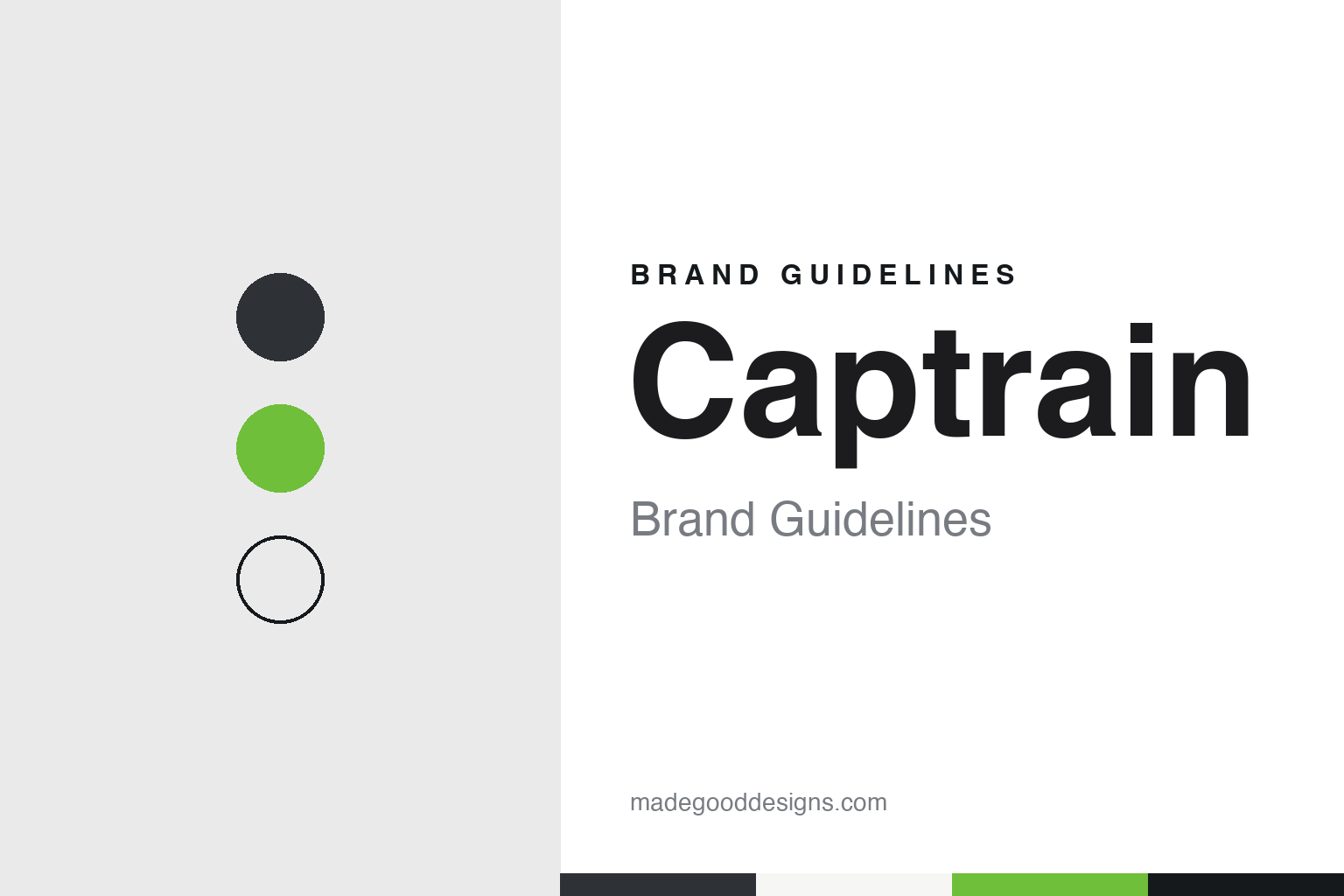
Captrain Brand Guidelines
One brand over many freight railways, from Dortmund to Lisbon.
Aa
Two constants: a graphite, grey and bright green palette and an industrial sans register. Abstract homage — not a Captrain locomotive, livery or mark; no logo is reproduced.
CapTrain, 2010
One brand for SNCF’s freight trains abroad.
Captrain is the name under which the French state railway group SNCF runs rail freight companies across Europe. It was created in February 2010: the German trade paper VerkehrsRundschau reported on 12 February 2010 that SNCF Geodis, the Paris-based freight branch of SNCF, had announced the previous week that it was grouping its freight-train businesses outside France under a new brand, then written “CapTrain.” The stated aim was to integrate the companies bought in earlier years and to serve customers whose goods flows were “more and more European.”
The pieces came from several directions. French Wikipedia says most of them reached the SNCF group when its subsidiary Transport et Logistique Partenaires bought the operations of Veolia Cargo outside France, while Veolia Cargo’s French business went to the Eurotunnel group. They were combined with Fret SNCF’s own foreign subsidiaries and with the German operator ITL of Dresden, in which SNCF had bought 75 per cent in April 2008 before taking the remaining quarter in 2010, the same article says. VerkehrsRundschau listed the first line-up: CapTrain Deutschland, joining SNCF Fret Deutschland and Veolia Cargo Deutschland; a Benelux unit with SNCF Fret Benelux, Veolia Cargo Belgium, Veolia Cargo Nederland and ITL Belgium; CapTrain Italia; CapTrain UK, the former Freight Europe UK; and CapTrain Romania, from VFLI Romania.
A feature of the model is that member companies often kept their legal names while taking the common brand. In Germany, French Wikipedia notes, the subsidiaries of the former Veolia Cargo Deutschland kept their company names, and Captrain Deutschland, based in Dortmund, works as a holding and central sales organisation rather than as a licensed railway itself. The same article says the former Rail4Chem became Rail4Captrain in March 2012, having supplied traction, crews and train paths to the German Captrain companies since 2010.
Colour
Spain, Poland, Portugal and France.
The network grew country by country. ITL Polska, founded in 2006, joined in 2011 and was renamed Captrain Polska in October 2014, according to French Wikipedia; in July 2024 VerkehrsRundschau reported that its shares were moving to Captrain Deutschland GmbH, which had held management responsibility since 2014, and that the Eisenach operator Hörseltalbahn was being merged into Regiobahn Bitterfeld Berlin. In Spain, SNCF bought 25 per cent of Comsa Rail Transport in 2013 and took full control in 2018, after which the business was renamed Captrain España, Railway Gazette reported in March 2022; French Wikipedia dates the purchase of the remaining 75 per cent to 1 November 2018.
Portugal followed. In March 2022 Rail Logistics Europe agreed to buy the private operator Takargo from the Mota-Engil construction group, subject to competition approval, Railway Gazette reported; the paper described Takargo as founded in 2006 and as the first independent operator to apply for paths on the Portuguese network after liberalisation. The Portuguese trade title Supply Chain Magazine reported in January 2024 that the purchase had been completed in June 2023 and that Takargo had taken the name Captrain Portugal at the turn of the year, a change the company said would bring a more cohesive brand across Europe.
At home, the French operator VFLI, created in 1998, became Captrain France in 2021. Its own timeline lists the takeover of the rail network of the Lorraine coalfield in 2001, its first train on the national network in 2007, its first two Euro 4000 diesel locomotives in 2011 and the integration of Ecorail Transports in 2018. Not every unit stayed in the group: French Wikipedia says Captrain Netherlands was sold to Rail Cargo Group in 2024.
Typography
Design and documentation.
Rail freight operators sell a service that most people only glimpse from a level crossing or a station platform, so their identities lean heavily on the one thing everyone does see: the locomotive. Liveries, fleet numbers and named engines carry the brand across a whole network, and operators publish photographs of their fleets on their websites, in press releases and on social channels. A repaint for a customer, a partner or an anniversary is usually announced as news in its own right.
The second visual constant is the map. Operators that sell regular routes tend to show them as network diagrams, with ports, terminals and inland hubs joined by lines, much like a passenger timetable. Those that run trains to order describe their work in service categories instead, such as intermodal container trains, block trains for bulk goods, single wagonload and first- and last-mile shunting, and the wording on those pages is the company’s own description of what it offers.
Fleet pages are a genre of their own. Many operators list their locomotive classes with build dates, power systems and the routes they work, and new orders are presented as milestones, often with the builder and the leasing company named alongside. Numbers on these pages, from staff and trainloads to tonnage and market share, are figures the companies give about themselves at a particular date, and they change from year to year.
Sustainability pages have become standard across the sector. They usually set out targets, partnerships and new traction such as electric, bi-mode or biofuel locomotives, each tied to a dated announcement. In the guides that follow, those pages are treated as statements of what each company says it is doing and when, alongside its ownership history and the names it has traded under.
Aa
An industrial sans for a freight network. (Specimen set in Barlow, a sans STAND-IN; NOT the Captrain logo.)
Captrain
Grey, black and a bright green.
Today Captrain sits inside Rail Logistics Europe, the SNCF group’s freight and rail logistics division, alongside Hexafret, Forwardis, Naviland Cargo, VIIA and the locomotive maintenance company Technis, the division’s website shows; it gives a workforce of 9,270 across Europe. Captrain France describes Captrain as the SNCF group’s European brand for rail freight, grouping several companies in domestic markets and on the main international corridors. Captrain France itself is based in Saint-Ouen-sur-Seine, just north of Paris.
The identity is most visible on locomotives. French Wikipedia says that in 2014 Captrain had 220 locomotives, most of them in a livery based on grey, sometimes black, with a fluorescent green, either owned directly or leased from companies such as Akiem and Alpha Trains; the types it lists include the Bombardier TRAXX, the Vossloh G 1206 and G 1000, the Class 66 and the Stadler Euro Dual. Captrain France says it put the Euro Dual, which it describes as the first hybrid dual-mode locomotive in France, into service in 2019.
Special liveries have joined the standard scheme. In June 2023 the Spanish designer Javier Mariscal, creator of Cobi, the mascot of the Barcelona 1992 Olympic Games, and winner of Spain’s National Design Prize in 1999, illustrated the new Euro6000 electric locomotives of Captrain España with fifteen European landmarks, among them the Sagrada Família, the Eiffel Tower and the Puerta de Alcalá in Madrid, the news agency EFE reported.
For a design guide, Captrain shows how one brand can sit over railway companies that keep their own legal names and local histories. Compare SNCF, its parent group, and Medway, another freight operator in Portugal and Spain. For this guide we use graphite, a ballast grey and a bright green with a sans, an unofficial interpretation; no product or logo is reproduced.
Explore & save
Keep Captrain’s identity on hand — save it to a board in the Made Good inspiration library.
Captrain identity set
Pin the Captrain graphite, grey and bright green palette and the industrial sans register to your own board.