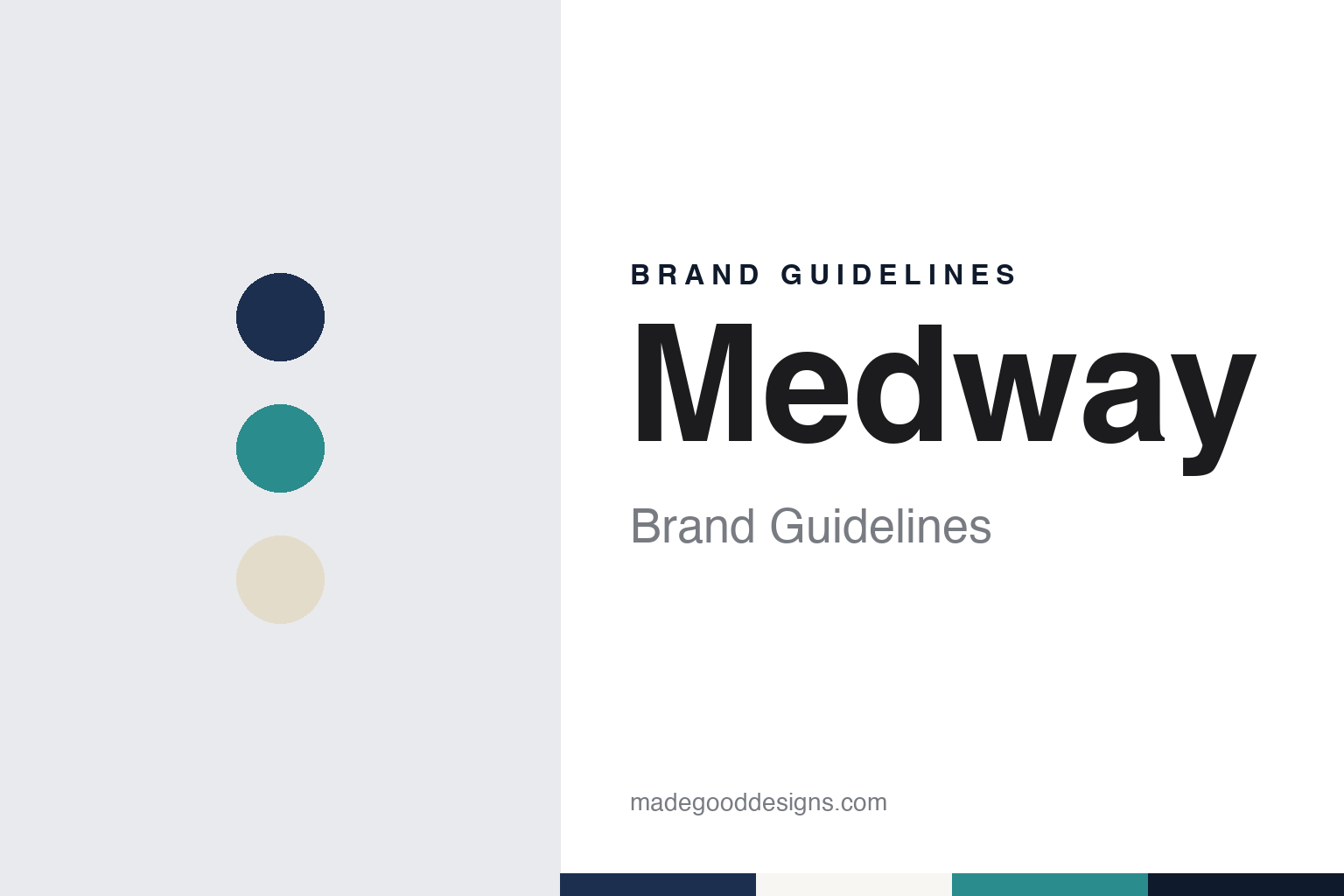
Medway Brand Guidelines
A Portuguese freight railway that turned its locomotives into moving artworks.
Aa
Two constants: an Atlantic deep blue, teal and sand palette and a grotesque sans register. Abstract homage — not a Medway locomotive, livery or mark; no logo is reproduced.
CP Carga
A freight arm of Portugal’s railway, sold in 2016.
Medway is the rail freight and logistics company that grew out of CP Carga, the freight business of the Portuguese state railway, CP – Comboios de Portugal. Portuguese Wikipedia says CP Carga was first set up as one of CP’s business areas, was privatised in January 2016 and was sold to MSC Rail, which had been its largest customer. MSC Rail is a subsidiary of the Mediterranean Shipping Company, the Swiss-based container line, and the business newspaper Dinheiro Vivo wrote in December 2025 that Medway has belonged to MSC Rail since 2016, after the privatisation process.
The company’s own history page places the purchase within a longer MSC story in Portugal. It lists the opening of MSC’s Portuguese agency in Lisbon in 1991, the first phase of a container terminal at Entroncamento in 2009 and the creation of MSC Rail in December 2012, before the privatisation of CP Carga in January 2016. It then records the launch of the Medway brand in November 2016, the start of activity in Spain in January 2018 and the launch of a maintenance and repair subsidiary in November 2018.
The sale was completed in two stages. MSC was chosen for 95 per cent of CP Carga, and the remaining 5 per cent was set aside for employees. Jornal de Negócios reported on 10 October 2025 that the public offer of that 5 per cent to workers had closed, with 23 purchase orders validated, and that the Portuguese state had thereby left the company’s capital entirely, a decade after MSC was selected. Público had reported in September 2025 that the offer was being launched as part of the privatisation begun in 2015.
Colour
Containers, bulk and terminals across Iberia.
Medway calls itself a logistics operator, and its services go beyond trains. Portuguese Wikipedia divides its rail business into multimodal traffic of containers and swap bodies and a “multi-product” line carrying minerals, sand, cement and clinker, forest products, steel, chemicals, agricultural goods, fuels and automotive parts, among others. The same article lists terminals at Aveiro, Bobadela, Entroncamento, Sines and Mérida, with Lousado in development, and workshops at Entroncamento and Poceirão, and gives a workforce of about 700 across Portugal and Spain. Medway Training, based in Madrid, began courses for train drivers and other rail staff in September 2019.
At home the company holds most of the market: Dinheiro Vivo and Portuguese Wikipedia both describe it as the largest rail freight operator in Portugal, with about 90 per cent of the market. Its main competitor, Portuguese Wikipedia says, is Takargo, the private operator that the SNCF group bought and renamed Captrain Portugal at the start of 2024.
Spain has become a second home market. The company’s timeline records terminals and fleet orders there, including the management of three terminals in Extremadura from April 2023 and the arrival of 16 Stadler Euro 6000 locomotives in August 2024. In December 2025 it went further: Dinheiro Vivo reported that Medway would begin operating in France on 14 December 2025, carrying raw materials between Caffiers and Dunkirk, a step the company said gave it direct links to nine countries, from Portugal and Spain to Germany, Italy, Switzerland and Austria. A planned joint venture with the Spanish state freight operator Renfe Mercancías had not been completed by October 2026: the Spanish trade paper El Mercantil reported on 22 October 2026 that it was still unsigned and awaiting decisions by Renfe Mercancías and the Spanish state.
Typography
Design and documentation.
Rail freight operators sell a service that most people only glimpse from a level crossing or a station platform, so their identities lean heavily on the one thing everyone does see: the locomotive. Liveries, fleet numbers and named engines carry the brand across a whole network, and operators publish photographs of their fleets on their websites, in press releases and on social channels. A repaint for a customer, a partner or an anniversary is usually announced as news in its own right.
The second visual constant is the map. Operators that sell regular routes tend to show them as network diagrams, with ports, terminals and inland hubs joined by lines, much like a passenger timetable. Those that run trains to order describe their work in service categories instead, such as intermodal container trains, block trains for bulk goods, single wagonload and first- and last-mile shunting, and the wording on those pages is the company’s own description of what it offers.
Fleet pages are a genre of their own. Many operators list their locomotive classes with build dates, power systems and the routes they work, and new orders are presented as milestones, often with the builder and the leasing company named alongside. Numbers on these pages, from staff and trainloads to tonnage and market share, are figures the companies give about themselves at a particular date, and they change from year to year.
Sustainability pages have become standard across the sector. They usually set out targets, partnerships and new traction such as electric, bi-mode or biofuel locomotives, each tied to a dated announcement. In the guides that follow, those pages are treated as statements of what each company says it is doing and when, alongside its ownership history and the names it has traded under.
Aa
A grotesque sans for a freight railway. (Specimen set in Archivo, a sans STAND-IN; NOT the Medway logo.)
Medway
Locomotives as moving artworks.
Medway’s fleet mixes locomotives inherited from CP with new purchases. Its website lists the LE5600 series built by Siemens, Krauss-Maffei and Soferame, the LE4700 series by Siemens, diesel series from Bombardier, Alsthom and English Electric, Stadler’s Euro 4000 and Euro 4001, the 333 diesel-electric for the Iberian gauge and the tri-voltage 256 “E6000.” The company sets its name in capitals, MEDWAY, throughout its website, which it publishes in Portuguese, English, Spanish and French. Its stated mission is to provide multimodal and integrated logistics services, and its stated vision is to change the supply-chain model through multimodal solutions based on the railway.
The design story that stands out is the use of locomotives as large surfaces for art. The company’s timeline records a Medway locomotive decorated by the Portuguese artist Kruella d’Enfer in September 2021 and another by the Spanish art collective Boa Mistura in February 2023. The website also carries network maps, an equipment album and an environmental simulator that estimates emissions against the same transport by road, and since May 2021 the company has issued what it calls Sustainable Transport Certificates, which it says show customers how much they reduce their environmental footprint by moving goods by train. The same timeline says Medway joined GRACE, a non-profit business association for corporate responsibility and sustainability, in March 2021 and the European coalition Rail Freight Forward the following month. Its news pages report a gala in Lisbon in 2026 to mark the brand’s tenth anniversary.
For a design guide, Medway shows how a privatised freight arm can take a new name and let its rolling stock carry art as well as cargo. Compare Captrain, its competitor in Portugal, and DB Cargo, the freight arm of another state railway. For this guide we use an Atlantic deep blue, a teal and a sand with a sans, an unofficial interpretation; no product or logo is reproduced.
Explore & save
Keep Medway’s identity on hand — save it to a board in the Made Good inspiration library.
Medway identity set
Pin the Medway deep blue, teal and sand palette and the grotesque sans register to your own board.