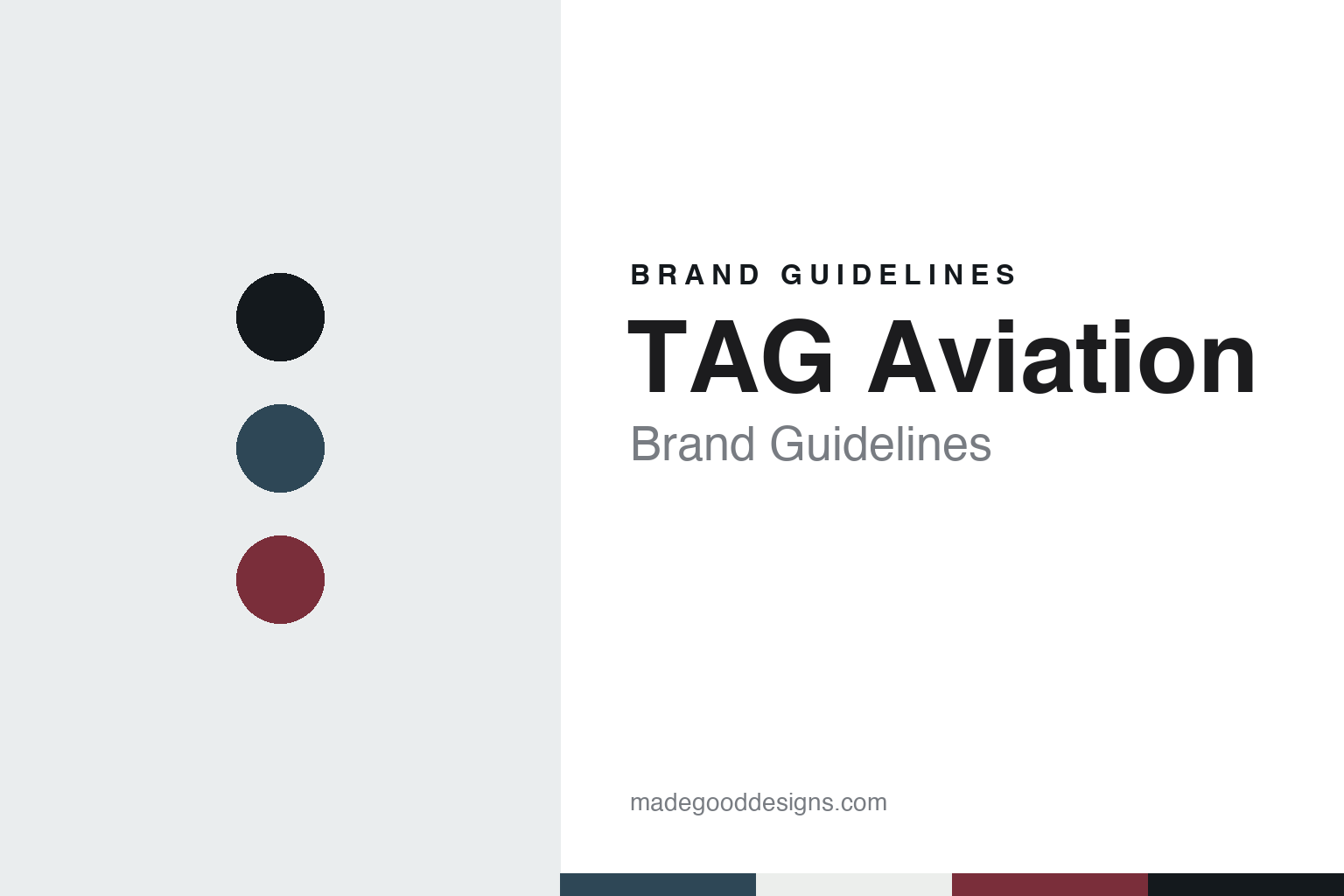
TAG Aviation Brand Guidelines
A Geneva charter firm of 1966 that kept its initials through a change of owners.
Aa
Two constants: a slate, burgundy and mist palette and a transitional serif register. Abstract homage — not a TAG Aviation product or mark; no aircraft, logo or livery is reproduced.
Aeroleasing, 1966
A Geneva charter firm and a holding company’s initials.
TAG Aviation traces its roots to Aeroleasing, a charter company created in Geneva in 1966. The company’s history page says Aeroleasing began by chartering third-party aircraft with a single twin-engine Piper Aztec, moved into business jets with an executive Convair CV-240, flew a Falcon 20 from Geneva to Singapore in 1975, and in the 1980s built up its own fleet, from Learjets to Falcons, Challengers and two DC-9s. Its website still opens its history with the line “Swiss precision since 1966.”
The initials came from elsewhere. TAG — Techniques d’Avant Garde — was formed in 1977 by the businessman Akram Ojjeh, English Wikipedia says, and grew into a Luxembourg-based holding company with interests in aviation, motorsport, consumer products and property. In 1985 it bought the Swiss watchmaker Heuer and combined the two names as TAG Heuer, then sold the watch business to LVMH in 1999. The watch brand and the aviation company took the same initials from the same holding company, but they have been separately owned since 1999.
TAG Aviation’s own timeline places the incorporation of TAG Aviation Holding in 1998, followed by the purchase of Aeroleasing, renamed TAG Aviation SA, and of AMI Aviation Methods in the United States, renamed TAG Aviation USA. In the same period TAG took on Farnborough Airport, south-west of London, under a long lease — English Wikipedia dates the lease to 1999 — and set out to develop it as a centre for business aviation.
The 2000s brought a change of focus and a move east. The company says that in 2001 it returned to a model based on managing aircraft for owners and offering them for charter. It established TAG Aviation Asia in Hong Kong in 2006, opened a crew training centre at Farnborough and an office in Singapore in 2007, and sold the fleet of TAG Aviation USA to Sentient Jet in 2008. Hong Kong’s Civil Aviation Department issued TAG Aviation Asia an air operator’s certificate in 2009, according to the company.
Colour
Management, charter, FBO and training.
TAG presents itself as a full-service business aviation company. Its website is built around five services — aircraft management, charter, maintenance, FBO handling and global training — under the heading “60 Years of Heritage.” The charter pages separate the company’s own TAG Charter Fleet from a third-party fleet arranged through its brokerage service, and sort aircraft into categories from very light jets and turboprops to ultra-long-range jets and VIP airliners.
Fleet counts change with the date and the source. Aviation International News reported in October 2022 that TAG had 80 aircraft in its global charter and management fleet, mostly large-cabin, long-range jets such as Gulfstreams and Bombardier Globals; English Wikipedia gives a fleet of around 50 aircraft, naming Gulfstream, Dassault Falcon, Pilatus PC-24 and Embraer Phenom 300E types. The company’s website says it works from 11 locations across Europe and Asia, with a workforce of 25 nationalities, and lists offices in Hong Kong, Geneva, Farnborough and Singapore.
The ground side has grown in Asia. TAG opened its first Asian FBO in Macau in 2019, the company says. In March 2026 TAG announced that the Macau FBO had taken the top “Rest of World” title in the 2026 Aviation International News FBO awards, ending another operator’s 19-year run at the head of that category. The release described a 693-square-metre facility beside Macau International Airport with on-site customs and immigration, a passenger lounge, two configurable VIP lounges and a pilot lounge, and said the FBO gained IS-BAH Stage 3 accreditation in 2024.
Earlier milestones on the company’s timeline include a Bahrain air operator’s certificate in 2010, a new Geneva headquarters in November 2010 with a 4,400-square-metre maintenance hangar, an FBO and maintenance facility at Sion in 2013, Maltese and San Marino certificates in 2017 and a Cayman Islands certificate in 2022. A sponsored scheme, TAG Trained Pilot, has taken employees from first lessons to a business jet type rating since 2015, the company says.
Typography
Ramps, fleets and lounges.
Business aviation companies sell something most visitors will never see in person, so their websites lean on photography and lists. Operators show cabins and aircraft on the ramp, as the companies themselves choose to publish them, and they tend to organise fleet pages by aircraft type — a turboprop, a super-midsize jet, a large-cabin Gulfstream or Bombardier — rather than by destination. Gama Aviation’s charter pages, for example, name individual types from the Citation Mustang to the Gulfstream G550.
FBO networks, the private terminals and hangars that serve business aircraft at airports, present themselves through places. Their websites carry location maps and airport pages that list lounges, crew rest rooms, hangarage, fuel and meeting rooms, often with airport codes and opening hours. Hangars appear as much as aircraft do, because the building is the product: Gama, for one, publishes separate pages for its facilities at Glasgow, Jersey and Sharjah.
Membership and charter programmes are a third strand. Operators describe jet cards, memberships and fixed-rate schemes in their own terms — deposit levels, guaranteed availability, capped hourly rates — and trade titles such as Private Jet Card Comparisons track and compare them. VistaJet, XO and, before its sale in 2022, Jet Edge all built consumer offers around such programmes, and Jet Edge ran branded lounges at Van Nuys and Teterboro.
Ownership changes often. Investment firms, listed groups and larger operators buy and merge these businesses, and a brand can disappear into its parent’s name, as Jet Edge’s operators did when Vista formed Vista America in 2023. This guide records who founded each company, who owns it and how it presents itself, and marks clearly what rests only on the company’s own word.
Aa
A transitional serif with a Swiss-heritage register. (Specimen set in Source Serif 4, a serif STAND-IN; NOT the TAG Aviation logo.)
After TAG Group
The same logo under new owners.
Between 2019 and 2020 the TAG holding company left business aviation. The company’s timeline says TAG sold its European maintenance activities to Dassault Aviation in 2019, while maintenance continued in Asia, and that Macquarie acquired TAG Farnborough Airport in October 2019. In August 2020 Aviation International News reported that TAG Aviation Holding had sold its remaining charter and management businesses, TAG Aviation SA and TAG Aviation Asia — in which it held a 51 percent stake — to its Asian joint-venture partner, Young Brothers Aviation, and another, unnamed private investor, ahead of winding down the holding entity. The Asian sale included the Macau FBO and the Asian maintenance operations.
The brand outlived the sale. “It’s the same TAG logo, the same heritage, the same legacy,” the company’s chief executive told Aviation International News in October 2022, describing a shareholder adjustment rather than a change of shareholders. TAG’s own timeline presents 2020 as the year TAG Aviation SA and TAG Aviation Asia were brought together under central ownership. Its March 2026 release named Steven Young as chairman and described TAG as offering aircraft management, charter, maintenance, FBO handling and crew training across Europe and Asia.
The TAG initials also stay in two other places: on the watch brand created in 1985, and in Farnborough Airport’s history as a business airport, which began under TAG’s lease and passed to Macquarie in 2019.
For a design guide, TAG Aviation shows how a set of initials can outlast its original owner. Compare ExecuJet, whose maintenance business also passed to Dassault Aviation in 2019, and Gama Aviation, another business aviation group. For this guide we use a slate blue, a burgundy and a pale mist with a serif, an unofficial interpretation; no product or logo is reproduced.
Explore & save
Keep TAG Aviation’s identity on hand — save it to a board in the Made Good inspiration library.
TAG Aviation identity set
Pin the TAG Aviation slate, burgundy and mist palette and the transitional serif register to your own board.