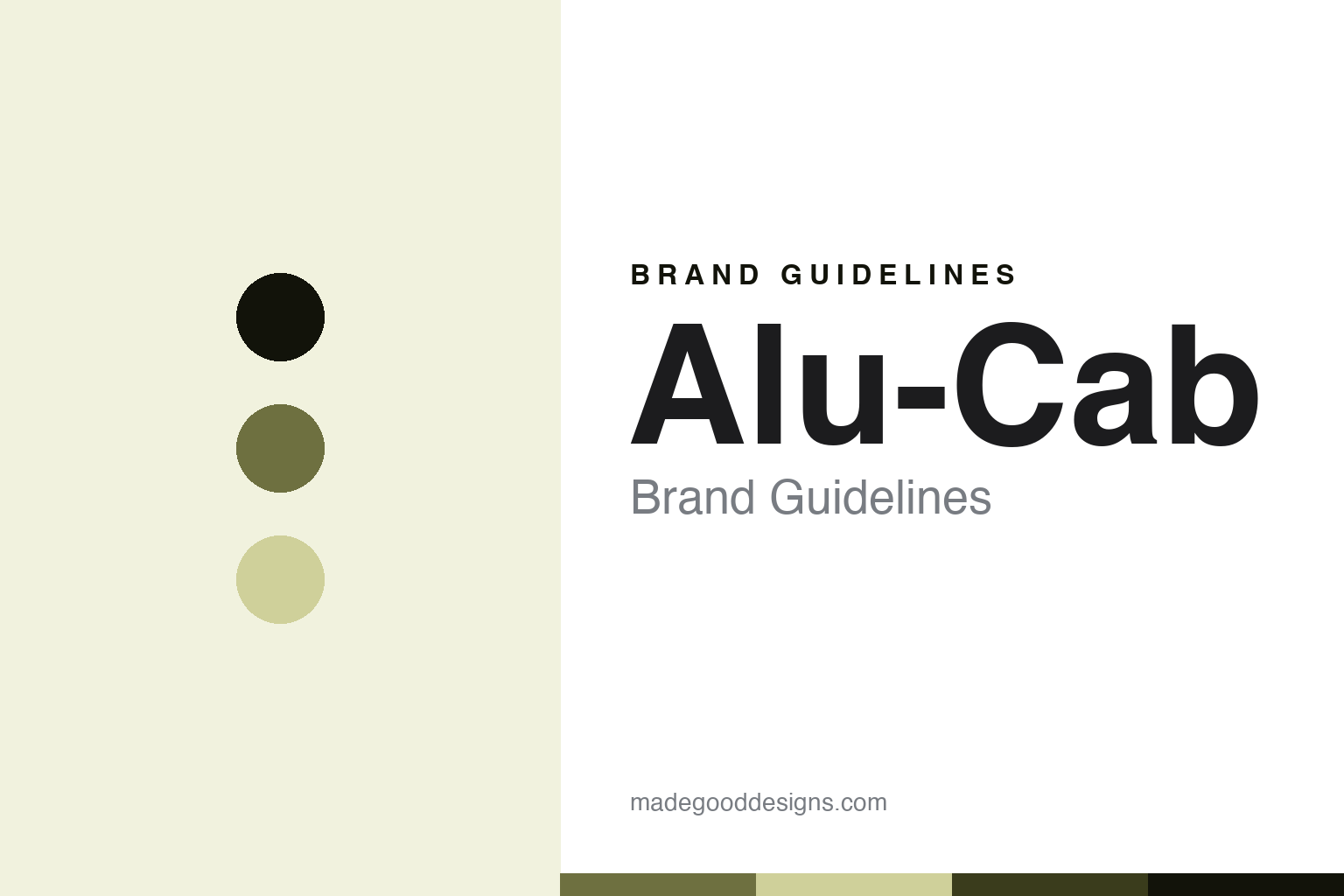
Alu-Cab Brand Guidelines
The Cape Town overland hardshell.
Aa
Two constants: a bushveld-olive palette and an overland-workshop-sans register. Abstract homage — not an Alu-Cab product or mark; no tent or shell silhouette, and no logo, is reproduced.
The Cape Town overland hardshell
Alu-Cab is the family-run South African maker crafting its aluminium hardshell rooftop tents and campers in its own Cape Town workshop.
Alu-Cab brings the round its overland maker — the family-run South African house, trading for around two decades, that crafts its aluminium hardshell rooftop tents and canopy campers in its own workshop in Cape Town. Alu-Cab makes overland shelters, and its answer to a round about the basecamp is the expedition hardshell — a rugged aluminium rooftop tent, built in a Cape Town workshop it owns, for vehicle-based travel. A brand, overland.
Its identity is the Cape Town overland hardshell. The own Cape Town workshop, the aluminium hardshell and the family independence are the story here. A brand, overland. The Cape Town overland hardshell.
(Honest notes, so the story stays precise, and the year stays approximate. Alu-Cab, at alu-cab.com, makes overland rooftop tents and canopy campers as its heroes — a Gen 3-R hardshell tent and a Canopy Camper among them — and we report its performance language as the brand’s own marketing. It was founded around 2001 — a date it gives only loosely, so we hold it approximate — in Cape Town, South Africa, by Jeremy Bergh, with Lynn Bergh, as a family business. On where it is made, the star theme of this round, it states its gear is crafted in its own Cape Town workshop, and that it is proudly South African. On its construction, its signature is an aluminium-framed hardshell with a heavy double-layer canvas. On who owns it, a theme of this round, it is independent and family-run; it has arms in other regions, whether subsidiaries or distributors we could not confirm. Its designs and model names are IP we describe but do not reproduce; there is no official brand hex; these tones are an unofficial interpretation.)
Colour
Alu-Cab lives in a bushveld olive. Click a swatch to copy the hex.
Alu-Cab’s identity is overland, Cape-Town-made and family — a bushveld olive, an ink, a pale sage, a deep moss, and a paper. The palette leans bushveld olive and pale sage: a Southern-African register that nods to an aluminium hardshell on a truck rather than a loud logo colour. It signals an overland hardshell maker. The honest caveat: with no published brand hex, these values are an original, unofficial interpretation, not first-party colours.
The lesson is a bushveld olive signals an overland, Cape-Town-made identity. Alu-Cab’s world is an aluminium, roof-mounted object. For designers, it is a reminder that a bushveld olive and a soft pale sage can carry an outdoor brand — the tone of the veld. Because these tones can fail as small text, keep type dark and let the colour live in the accents, palette and band. The takeaways: craft it in Cape Town; frame the aluminium hardshell; hold the year loosely; and treat any single hex as unofficial.
Typography
The register is an overland-workshop sans — overland, plain, crafted.
Alu-Cab’s identity carries an overland, plain, crafted spirit — a Cape Town workshop, not a graphics label. An overland-workshop sans captures the mood: clean, rugged and confident, the register of an aluminium hardshell rooftop tent. Set in a bushveld-olive palette, the overland-workshop sans feels overland and crafted — exactly the personality Alu-Cab carries. It is a roof-mounted object rather than a logo, mirroring a hardshell. (Alu-Cab’s real tents are things we describe but do not reproduce, and the exact typeface is not ours to use.) Because it is not ours to use, the honest description is “an overland-workshop-sans maker,” shown here in a stand-in. The type behaves like the brand: overland, plain and crafted.
Aa
An overland-workshop-sans maker — overland and crafted. (Specimen set in Work Sans, an overland-workshop-sans STAND-IN; NOT the Alu-Cab logo or any tent.)
The tent
Alu-Cab stands for the Cape Town overland hardshell.
Alu-Cab brings the round its overland maker. A bushveld-olive palette, an overland-workshop sans and a Cape Town workshop make one thing — the Cape Town overland hardshell — the whole identity: overland, Cape-Town-made and family. The own Cape Town workshop is the pitch, and the aluminium hardshell is the proof. The point is a rugged aluminium rooftop tent, built in a workshop it owns, for vehicle-based travel, in a round about the basecamp.
Put to work, the identity is the workshop told straight, as making — with the hardshell crafted at home and the year held loosely. A maker in this spirit would craft it in Cape Town, frame the aluminium hardshell, and hold the year loosely. A reader in this spirit would keep the facts right: Alu-Cab makes overland rooftop tents and canopy campers as its heroes, a Gen 3-R hardshell tent and a Canopy Camper among them; it was founded around 2001, held approximate, in Cape Town, by Jeremy Bergh with Lynn Bergh, a family business; it states its gear is crafted in its own Cape Town workshop and is proudly South African; its signature is an aluminium-framed hardshell with a heavy double-layer canvas; and it is independent and family-run, with regional arms of unconfirmed status. Alu-Cab sits with Autohome and James Baroud at the rooftop-tent end of the round, and at the own-workshop point of the where-made thread. The honest editorial moves are to hold the founding year approximate, to credit the Berghs, to say crafted in Cape Town, to frame the aluminium hardshell, and to leave the regional arms unconfirmed.
For designers and brand-builders, Alu-Cab continues the basecamp: craft it in Cape Town — and hold the year loosely. The lessons: let an own overseas workshop be the brand; hold a loosely-given founding year approximate; frame a construction correctly; keep it family-run; leave unconfirmed regional structures unconfirmed; and never reproduce a tent. It is also a reminder to stay precise: Alu-Cab is the family-run South African maker crafting its aluminium hardshell rooftop tents and campers in its own Cape Town workshop — with the palette here an unofficial interpretation. Read that way, Alu-Cab is less a tent than a Cape Town workshop: overland, aluminium, family. The lesson for a brand is that an own workshop and honest date-holding reinforce each other, and crafting it in Cape Town keeps the story earned. Alu-Cab made the-Cape-Town-overland-hardshell the identity — proof that an own workshop can carry a round, its overland maker.
Explore & save
Keep Alu-Cab’s identity on hand — save it to a board in the Made Good inspiration library.
Alu-Cab identity set
Pin the bushveld-olive palette and the overland-workshop-sans register to your own board.