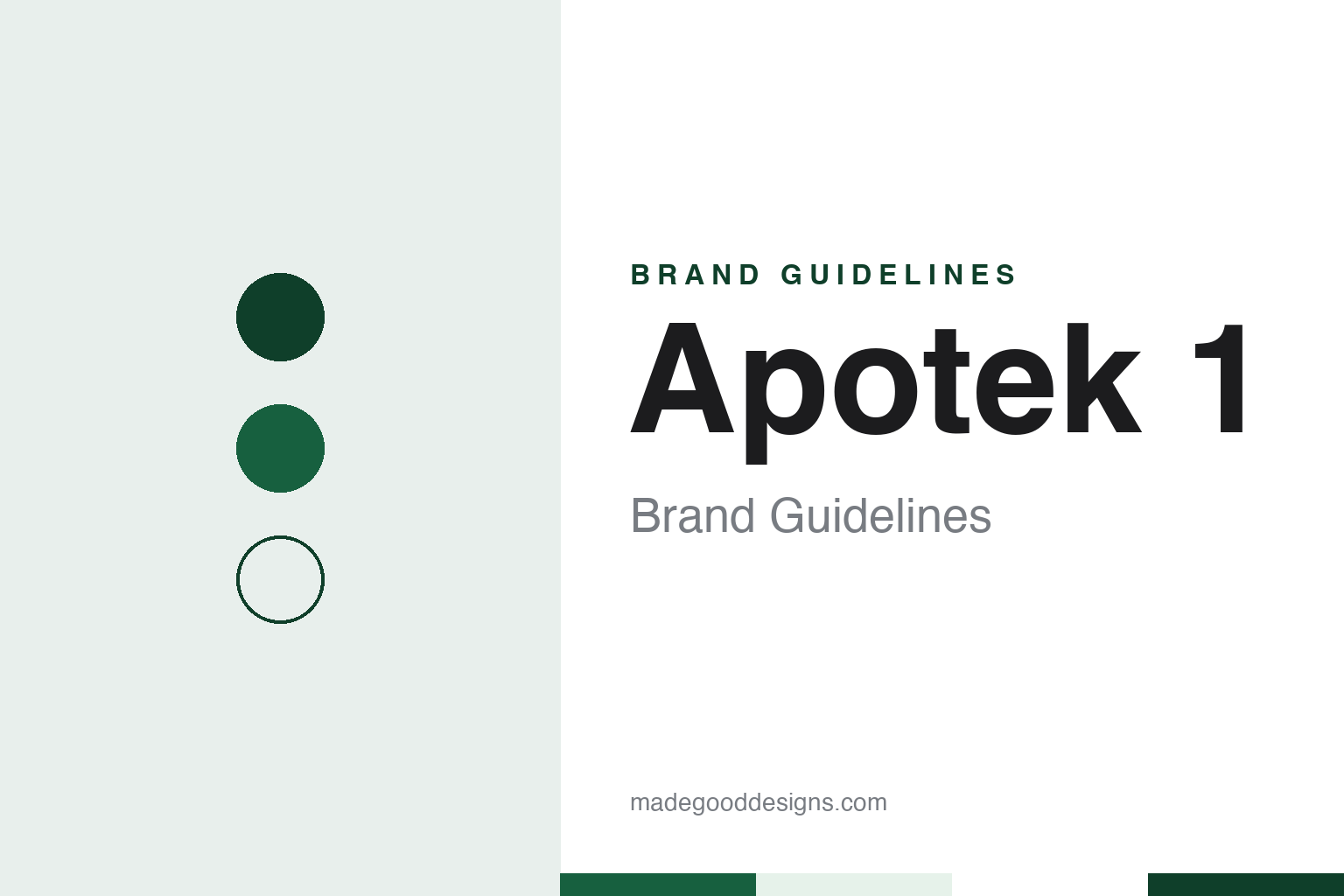
Apotek 1 Brand Guidelines
A pharmacists’ buying group that became Norway’s Apotek 1 chain.
Aa
Two constants: a green and white palette and a rounded sans register. Abstract homage — not an Apotek 1 product or mark; no logo, sign or pack is reproduced.
Apokjeden
A buying group run for independent pharmacists.
Apotek 1 is the pharmacy chain of Apotek 1 Gruppen AS in Norway, a company formerly called Apokjeden AS, Norwegian Wikipedia says. Its roots lie in a purchasing co-operative set up by independent pharmacists. Norwegian Wikipedia dates Apokjeden to 1994, when a prospectus for a limited company was drawn up and pharmacists were invited to subscribe for shares, and records its constituent general meeting in 1995. A decision by the Norwegian Competition Authority, Konkurransetilsynet, dated 23 August 2000, gives 1995 as the year the voluntary purchasing chain was established.
At that point Norwegian pharmacies were owned under licence by individual pharmacists, and the co-operative bought goods on their behalf. The competition authority’s decision says Apokjeden covered about 330 private pharmacies and 16 hospital pharmacies in 1999, out of 394 pharmacies in the whole country. The same decision notes that about 85 percent of a Norwegian pharmacy’s sales then came from medicines, with the rest from retail goods such as toiletries and hygiene products, which supermarkets and perfumeries could also sell.
A branded format came before the Apotek 1 name. Norwegian Wikipedia says the group created its first profiled chain concept, the Plussapotekene, in 1997, giving member pharmacies a new logo along with campaign and sales material, and that its first television advertising ran on TVNorge the same year. In 1999 the group began to map out a more binding form of chain co-operation.
The Apotek 1 name followed in October 1999, when the opening pharmacy under the new concept was launched at the Manglerud shopping centre in Oslo, according to Norwegian Wikipedia; English Wikipedia also dates the chain to 1999. The competition authority’s 2000 decision describes Apotek1 as a newly developed concept running alongside the Plussapotekene, which represented the existing member pharmacies.
Colour
A wholesaler, a new law and a German owner.
In 2000 Apokjeden tied itself to a wholesaler. Under agreements approved at an extraordinary general meeting on 25 February 2000, the Finnish group Tamro — founded in 1895 by Finnish pharmacists and listed in Helsinki — was to receive 23 percent of Apokjeden, while Apokjeden took 49 percent of Tamro’s Norwegian wholesaler, Tamro Distribusjon, the competition authority recorded. After the deal Apokjeden would be owned 23 percent by Tamro, 26 percent by the Norwegian pharmacists’ association and 51 percent by its member pharmacies. The decision adds that Tamro’s biggest single shareholder at the time, according to Tamro’s own website, was the German wholesaler Phoenix Pharmahandel. In August 2000 the authority decided not to intervene against the share purchases, pointing to a pharmacy market in rapid change.
That change came with a new pharmacy law. Free ownership and free establishment of pharmacies were introduced in Norway from 1 March 2001, the Norwegian encyclopaedia Store norske leksikon says, and three chains formed within a short time through purchases and new openings: Apotek 1, Ditt apotek, run by Norsk Medisinaldepot, and Boots apotek. Norwegian Wikipedia says the 2001 law allowed Apokjeden to own pharmacies itself, turning a voluntary buying group into an integrated chain, and that the chain’s head-office functions moved from Fyrstikktorget in Oslo to Skårersletta in Lørenskog.
Ownership has since settled with the German partner. Store norske leksikon, in an article revised in September 2026, describes Apotek 1 as part of Apotek 1 Gruppen, owned by the German PHOENIX group. PHOENIX says on its own website that it is present in Norway with the Apotek1 pharmacy chain, and in Finland, Sweden and the Baltic states with the wholesaler Tamro. Norwegian Wikipedia says Apotek 1 Gruppen also owns the wholesaler Apokjeden Distribusjon AS, which had warehouses at Narvik and Skårer as of 2019.
The Norwegian Medical Products Agency (DMP), in pharmacy statistics for 2024 dated April 2026, lists Apotek 1 Gruppen alongside Alliance Healthcare Norge and Norsk Medisinaldepot among the vertically integrated groups that combine wholesale and pharmacy businesses, and counts 1,049 pharmacy licences in Norway at the end of 2024. The other chains have changed hands too: Store norske leksikon says Norsk Medisinaldepot sold Vitus to NorgesGruppen in 2025.
Typography
How pharmacy chains present themselves.
The guides in this group cover drugstore and pharmacy chains in Europe, Asia and the Americas. Their public face is mostly built from the same parts: a name over the door, a logo on store signs and shopping bags, and own-label beauty and household ranges named as the companies name them. The Austrian chain Bipa, for example, lists own labels such as BI CARE, BI HOME and LOOK BY BIPA on its company page.
Store formats differ more than the signs suggest. Some chains run compact neighbourhood shops; others mix several trades under one roof. German Wikipedia lists the departments of Müller, the Ulm-based chain, as running from drugstore and perfumery to toys, stationery, books and media. Store networks are published by the companies themselves or counted in dated press reports, so every number in these guides carries its year and its source.
Ownership is often less visible than the brand. Many chains sit inside larger retail groups: Bipa has belonged to the German REWE Group since 1996, and REWE International now lists it in Austria, Croatia and Romania. Others are still run by the company of the person who founded them, as German Wikipedia records for Müller. Corporate pages on founders, owners and retail groups are the starting point for these structures, and they are read here alongside encyclopaedias, registers and the trade press.
Identities change too. In January 2026 the Austrian trade site Leadersnet reported a new corporate design for Bipa, developed by BBDO Wien and built around a single capital B. Each guide sets out what can be checked about a chain — its founder, its owner, its network and its look — and marks clearly what rests only on the company’s own word.
Aa
A rounded sans — plain lettering beside a cross. (Specimen set in Figtree, a sans STAND-IN; NOT the Apotek 1 logo.)
Apotek 1
A white cross on a green ground.
The chain’s growth is recorded in round numbers. Norwegian Wikipedia says Apotek 1 opened its 300th pharmacy at Elverum in 2014 and its 400th at Moi in 2019, and gives a count of more than 400 pharmacies in 2020; English Wikipedia also gives more than 400 locations. Sales online came in stages: the apotek1.no website launched in 2005, a web shop for retail goods followed in 2011, and an online pharmacy in 2016. In 2017 the chain opened a pharmacy at Oslo Airport, Norwegian Wikipedia says.
Apotek 1 also operated in Sweden for a time. In May 2010 the Swedish chain Apotek Hjärtat bought Apotek 1’s 32 Swedish pharmacies, Swedish Wikipedia says.
The visual identity rests on one familiar sign. Norwegian Wikipedia describes the Apotek 1 logo as a white cross on a green ground, derived from the green cross that is widely used as a symbol for pharmacies around the world. The name pairs the Norwegian word for pharmacy with the numeral one, and the earlier Plussapotekene concept had already given member pharmacies a shared logo and campaign material two years before the Apotek 1 name appeared.
For a design guide, Apotek 1 shows how a pharmacists’ buying group turned into a national chain under one short name and a version of the pharmacy cross. Compare Apotek Hjärtat, the Swedish chain that took over its Swedish pharmacies, and Boots, whose name also appeared on Norwegian pharmacies after 2001. For this guide we use a deep pharmacy green, white and a pale mint with a sans, an unofficial interpretation; no product or logo is reproduced.
Explore & save
Keep Apotek 1’s identity on hand — save it to a board in the Made Good inspiration library.
Apotek 1 identity set
Save the Apotek 1 green and white palette and the rounded sans register to your own board.
Source & notes
Frequently Asked Questions
What font can I use to match the Apotek 1 look?
This guide describes Apotek 1’s type as “A rounded sans — plain lettering beside a cross”. Its type specimen is set in Figtree from Google Fonts as a stand-in; Figtree is not Apotek 1’s own lettering.
What colours are in the Apotek 1 palette?
This guide’s Apotek 1 palette is Pharmacy green #17603F, Fjord ink #0F3F2A, Pale mint #E6F2EA, Cross white #FFFFFF and Paper #F7F8F6. The tones are the guide’s own unofficial interpretation, not official Apotek 1 hex codes.
When was Apotek 1 founded?
Apotek 1 was founded in 1994–1995 (as Apokjeden); first Apotek 1 in 1999, in Norway.
Who owns Apotek 1?
Apotek 1 today: Apotek 1 Gruppen AS, owned by the PHOENIX group.