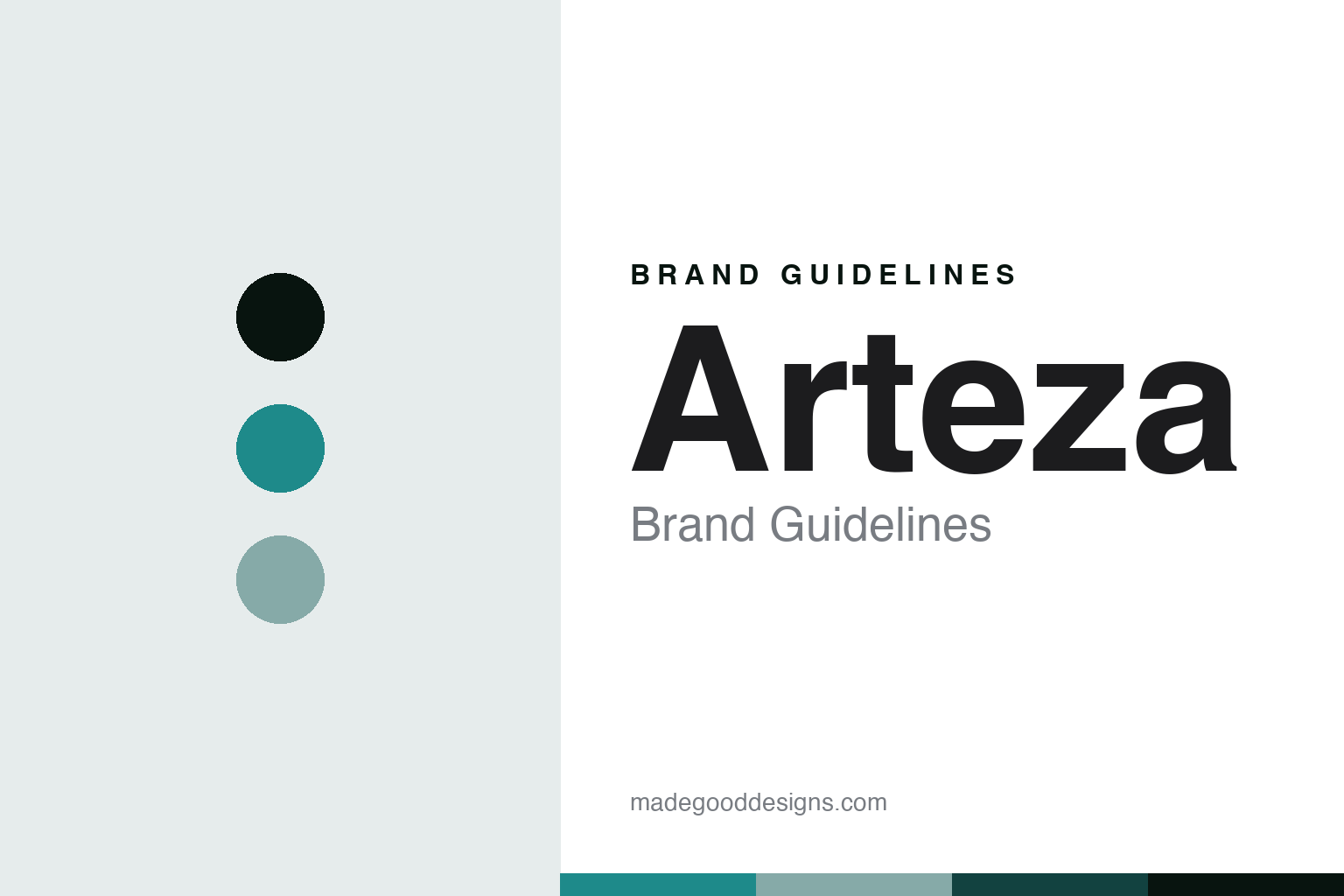
Arteza Brand Guidelines
The e-commerce art brand.
Aa
Two constants: a teal palette and an e-commerce-sans register. Abstract homage — not an Arteza colour, label or barrel.
The e-commerce art brand
Arteza is the modern American direct-to-consumer art brand, affordable and online-first, whose supplies are designed in the US and made in China.
Arteza is a lesson in how a colour core reaches artists without a shop or a century behind it. A modern, online-first American brand, Arteza sells affordable art supplies — including its Expert coloured pencils — direct to hobbyists and emerging artists through its own site and Amazon. Its answer to how a colour is made a business is contemporary: design a broad, affordable range, contract-manufacture it overseas, and sell it straight to the customer online. A colour core built for the e-commerce age.
Its identity is the direct-to-consumer art brand. Arteza’s Expert coloured pencils and watercolour pencils, alongside its wide paint and marker range, are the work it is known for. A core, sold online and in volume. A modern brand that skipped the art-store shelf.
(Honest notes, so the story stays precise, because this is a modern brand with a modern structure. Arteza is an American-owned company, founded around 2015 by Mike Koshatko and Jurgis Plikaitis (not, as sometimes stated, by a “Jean Zhou”), and originally based in Florida. Two honest points. First, ownership: it is no longer independent — its assets were acquired by Plaid Enterprises, the Georgia craft company behind Mod Podge, in March 2025, and its site now sits within Plaid’s. Second, and importantly, where it is made: Arteza is designed and marketed in the US but its products are manufactured in China — its packaging even pairs a US flag with a “Made in PRC” mark — so we never imply “Made in USA.” It is a modern DTC brand, not a heritage maker, and it does not run its own factories; it contract-manufactures overseas. Its coloured pencils are genuine — the Expert lines. Its name and line names are its IP, described but never reproduced, and there is no official brand hex — these tones are an unofficial interpretation. This is design commentary and does not promote any product.)
Colour
Arteza lives in a teal palette. Click a swatch to copy the hex.
Arteza’s identity is modern, bright and accessible — a teal, an ink, an aqua, a pine, and a paper. The palette leans teal and aqua: the register of a fresh online brand and an affordable art set. It signals accessibility and volume over prestige. The honest caveat: with no published brand hex, these values are an original, unofficial interpretation, not first-party colours.
The lesson is a teal palette signals a modern, DTC identity. Arteza’s world is an affordable, online-first, overseas-made object. For designers, it is a reminder that a fresh teal and a soft aqua can carry a brand built on the internet, not the art store — the colour of a modern set and the calm of a clean site. Because these tones can fail as small text, keep type dark and let the colour live in the accents, palette and band. The takeaways: design the range; sell it direct; be honest about where it is made; and treat any single hex as unofficial.
Typography
The register is an e-commerce sans — clean, modern, friendly.
Arteza’s identity carries a clean, modern, friendly spirit — an online-first brand, not a heritage marque. An e-commerce sans captures the mood: even, current and approachable, the register of a direct-to-consumer art brand. Set in a teal palette, the e-commerce sans feels clean and modern — exactly the personality Arteza carries. It is friendly rather than storied, mirroring an affordable modern set. (Arteza’s real labels and line names are things we describe but do not reproduce, and the exact typeface is not ours to use.) Because it is not ours to use, the honest description is “an e-commerce-sans spirit,” shown here in a stand-in. The type behaves like the brand: clean, modern and friendly.
Aa
An e-commerce-sans spirit — clean and modern. (Specimen set in Space Grotesk, an e-commerce-sans STAND-IN; NOT the Arteza wordmark or any label.)
The pencil makers, old and new
Arteza stands for the modern, online-first art brand.
Arteza is a lesson in how a colour core reaches artists through the internet. A teal palette, an e-commerce sans and an affordable set make one thing — art supplies sold direct and online — the whole brand: modern, bright and accessible. The DTC model is the differentiator, and the affordability is the meaning. The point is a young American brand that reached a huge audience of hobbyists not through art stores but through its own site and Amazon, with a broad, cheap range.
Put to work, the identity is the DTC model as design. A brand in this spirit would design a wide, affordable range, sell it direct, and be honest about the modern realities of that model — overseas manufacture, a recent acquisition, no heritage to lean on. A brand learning from it would see that the direct-to-consumer approach is a real, current identity — that reaching artists online with volume and value is a legitimate strategy, not a lesser one — and that being precise, founded around 2015 by Koshatko and Plikaitis, American-owned but made in China, acquired by Plaid in 2025, keeps the story honest. A brand learning from it would also never dress overseas manufacture as domestic: pairing a flag with a “Made in PRC” label is exactly the kind of ambiguity honest branding avoids. The lesson Arteza teaches is that the DTC model can hold an identity: the online reach gives it scale, and the honesty about origin keeps it credible. The accessibility is the personality, and the affordable colour is the proof.
For designers and brand-builders, Arteza opens this round of the pencil makers, old and new on the “new” side, from the United States: sell direct, and be honest about origin. The lessons: design a broad range; reach artists online; disclose where it is made and who owns it; never blur overseas manufacture with domestic; and never reproduce a protected label. It is also a reminder to stay precise: Arteza is a modern American DTC art brand, affordable and online-first, designed in the US and made in China — with the palette here an unofficial interpretation. Arteza made the DTC model the identity — proof that reaching artists online, honestly told, can be the difference.
Explore & save
Keep Arteza’s identity on hand — save it to a board in the Made Good inspiration library.
Arteza identity set
Pin the teal palette and the e-commerce-sans register to your own board.