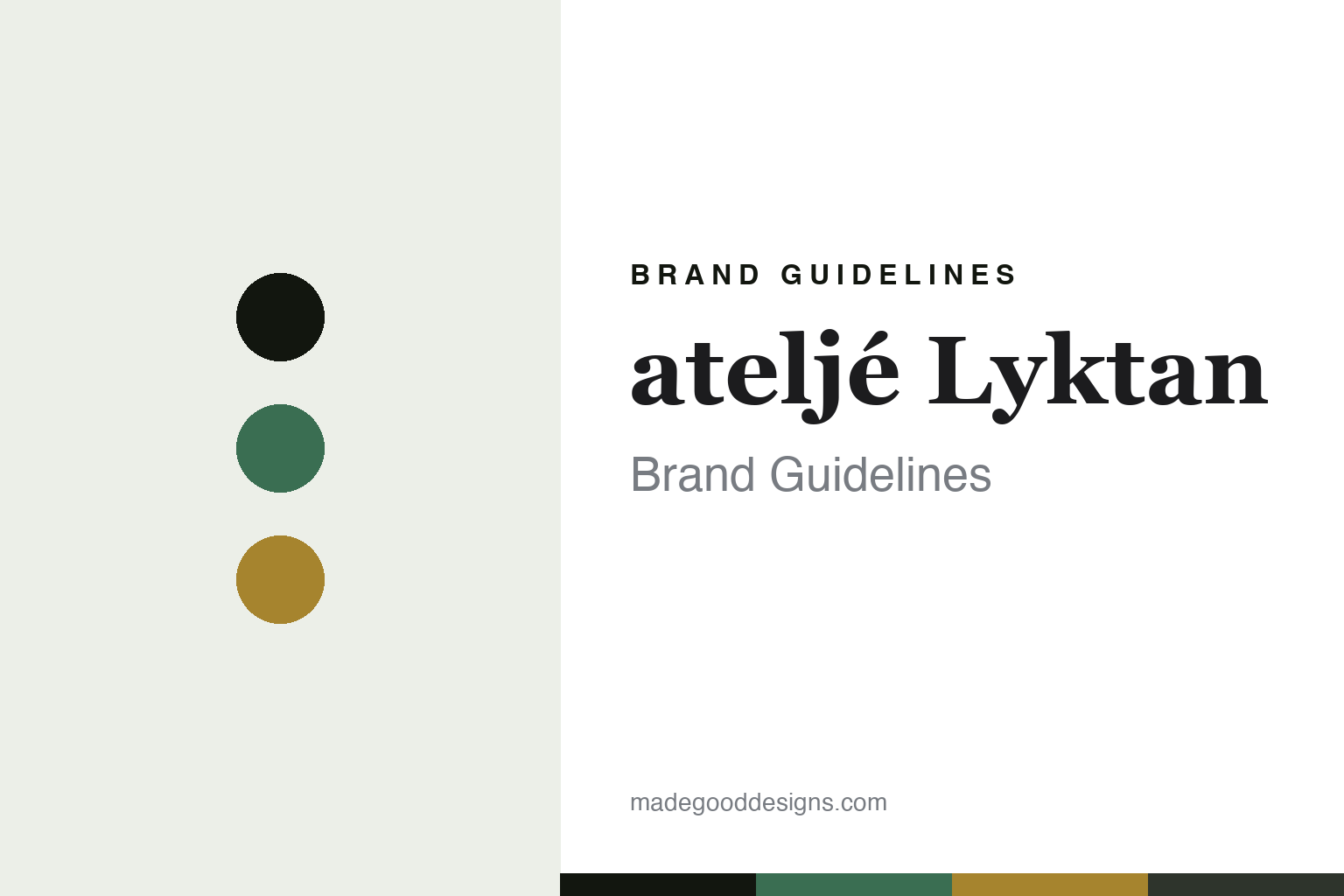
ateljé Lyktan Brand Guidelines
The boulder light.
Aa
Two constants: a racing-green-and-brass palette and a mid-century serif register. Abstract homage — not an ateljé Lyktan piece or wordmark.
The boulder light
ateljé Lyktan has made Swedish design lighting since 1934 — and the 1968 Bumling.
ateljé Lyktan is a lesson in a mid-century archive as the identity. A Swedish house from Åhus, it has made design lighting since 1934 — and produces enduring mid-century icons, above all the boulder-like Bumling pendant.
Its identity is the boulder light. ateljé Lyktan’s Bumling — a spherical shade nicknamed for a boulder — and its wider mid-century catalogue are the work it is known for. Swedish light, mid-century made. A classic, still lit.
(Honest notes: ateljé Lyktan is a Swedish lighting house based in Åhus, in Skåne, founded in 1934 by the architect-designer Hans Bergström and his wife. A key handover: Anders Pehrson took over the business in 1964 — so Pehrson is a later owner-designer, not the founder — and it was Pehrson who designed the Bumling pendant in 1968, its shade nicknamed “bumling,” Swedish for a boulder. The Bergström era produced poetic modern lamps; the firm supplied thousands of luminaires for the 1972 Munich Olympics, and a Bumling sits in the Nationalmuseum. On the making, it is genuinely manufactured at its own factory in Åhus, Sweden. On ownership, the honest and important point: it is not independent — it has been part of the publicly-listed Fagerhult Group since 1974. On attribution, the designs are the designers’ IP: the Bumling is Anders Pehrson’s, the mid-century models are Hans Bergström’s, so we say “designed by Pehrson, produced by ateljé Lyktan,” never “designed by ateljé Lyktan.” Its model names and silhouettes are IP we describe but don’t reproduce, and there’s no official brand hex, so these tones are an unofficial interpretation. This is design commentary and does not promote any product.)
Colour
ateljé Lyktan lives in a racing-green-and-brass palette. Click a swatch to copy the hex.
ateljé Lyktan’s identity is mid-century, warm and Swedish — a racing green, an ink, a brass, a graphite, and a cream. The palette leans racing green and brass — a nod to the Bumling’s original British-racing-green and mid-century warmth. It signals heritage and craft rather than novelty. The honest caveat: with no published brand hex, these tones are an original, unofficial interpretation, not first-party values.
The lesson is a racing-green-and-brass palette signals a mid-century icon. ateljé Lyktan’s world is a mid-century, warm, Swedish object. For designers, it is a reminder that a mid-century archive — icons kept in production — can be the whole identity, and that a heritage palette signals that lineage. Because a mid green can fail as small text, keep type dark and let the colour live in the accents, palette and band. The takeaways: keep the icons alive; credit the designers; make it well; and treat any single hex as unofficial.
Typography
The register is a mid-century serif — heritage, warm, Swedish.
ateljé Lyktan’s identity carries a heritage, warm, Swedish spirit — a mid-century, enduring object. A mid-century serif captures the mood: it is classic and calm, the register of a heritage Scandinavian house. Set in a racing-green-and-brass palette, the mid-century serif feels heritage and warm — exactly the personality ateljé Lyktan carries. It is timeless rather than trendy, mirroring an enduring icon. (ateljé Lyktan’s real fixtures, the Bumling silhouette and its wordmark are things we describe but do not reproduce, and the exact typeface is not ours to use.) Because it is not ours to use, the honest description is “a mid-century serif spirit,” shown here in a stand-in. The type behaves like the brand: heritage, warm and Swedish.
Aa
A mid-century serif spirit — heritage and warm. (Specimen set in EB Garamond, a mid-century serif STAND-IN; NOT the ateljé Lyktan wordmark.)
A mid-century archive as identity
ateljé Lyktan stands for the boulder light.
ateljé Lyktan is a lesson in making a mid-century archive the identity. A racing-green-and-brass palette, a mid-century serif and an enduring pendant make Swedish design heritage the whole brand — heritage, warm, timeless. The archive is the differentiator. The differentiator is longevity: mid-century icons like the Bumling, kept in production for decades and still recognised.
Put to work, the identity is a mid-century archive as design. A house building in this spirit would keep its best designs alive — producing them faithfully, crediting the designers who made them — while holding the craft that made them worth keeping. The lesson ateljé Lyktan teaches is that a mid-century archive plus real manufacture can build a brand: recognised icons, an own Swedish factory, and a heritage design language give it an authority a new label can’t. The archive is the trust, and the making is the proof.
For designers and brand-builders, ateljé Lyktan offers a clear takeaway: keep the icons alive, and credit their makers. The lessons: keep the archive in production; credit the designers; make it well; and be honest about the story. It is also a reminder to stay accurate: it was founded by Hans Bergström in 1934, Anders Pehrson took over in 1964 and designed the Bumling in 1968 — Pehrson is not the founder — and the company has been part of the publicly-listed Fagerhult Group since 1974, so it is not independent; the Bumling is Pehrson’s design, produced by ateljé Lyktan — the palette here is an unofficial interpretation. ateljé Lyktan made the boulder light the brand — proof that a mid-century archive can be the difference.
Explore & save
Keep ateljé Lyktan’s identity on hand — save it to a board in the Made Good inspiration library.
ateljé Lyktan identity set
Pin the racing-green-and-brass palette and the mid-century-serif register to your own board.