Poya Brand Guidelines
The Taiwanese beauty and daily-goods chain founded in Tainan in 1985.
Aa
Two constants: a plum, blush and coral palette and a soft display serif register. Abstract homage — not a Poya asset or mark; no logo, shop sign or product is reproduced.
Tainan, 1985
One shop, then a trademark and a listing.
Poya is a Taiwanese chain that sells cosmetics, skincare and everyday goods under the Chinese name 寶雅. The company behind it is Poya International Co (寶雅國際), as the Taipei Times writes it. Poya’s own corporate timeline says its founder, 陳建造, opened the first store in Tainan in 1985, in the south of the island.
The same timeline traces a slow build in the south before the chain spread. It says Poya set up its first corporate identity system in 1994, opened a branch in Kaohsiung in 1997, formally adopted 寶雅 as its trademark in 1998 and completed a second-generation identity in 1999. In 2000 it began opening in medium-sized cities, and in 2002 its shares were listed on Taiwan’s over-the-counter market, the same year it issued a co-branded credit card. In 2005 it reached the east coast with a store in Hualien, and in 2009 it set up an operations headquarters in Taipei.
Outside reporting confirms the listing and gives a sense of scale at the time. A Taipei Times article of 11 March 2014 quoted shares in Poya trading on the GreTai Securities Market, Taiwan’s over-the-counter exchange, and counted 88 Poya stores selling cosmetics, beauty products, personal goods, lingerie and household groceries. In the same piece, quoting the companies’ websites, the paper put Watsons at 471 stores and Cosmed at more than 355, and named Sasa, J-mart and Seasons among the other chains in a crowded Taiwanese cosmetics market.
Colour
Store generations and a second banner.
Poya describes its growth partly through store generations. Its timeline says it introduced a fourth-generation store format in 2013, built around one-stop shopping, and a fifth-generation format in 2016. The company says its shops carry more than 60,000 items across cosmetics and skincare, hats and socks, underwear, accessories, homeware, snack foods and drinks, and branded counters.
The Taipei Times has tracked the count. On 8 July 2019 it reported 208 outlets selling cosmetics, lingerie and stationery, and said the company was preparing a hardware banner, Poya Home (寶家). Poya’s timeline records the first Poya Home store opening in 2019 in Chaozhou, Pingtung County. By 25 April 2023 the paper counted 323 namesake stores, including seven “Poya Beauty” flagships, plus 40 Poya Home hardware outlets. On 30 July 2024 it reported 380 namesake stores at the end of June, including 50 Poya Beauty flagships and 22 “store-in-store” concept shops, with 10 Poya Home outlets. On 29 April 2025 it gave 419 namesake stores at the end of March 2025, across Poya Beauty flagships, standard Poya stores and shop-in-shop formats, and described the range as beauty, cosmetic and skincare products along with textiles, household accessories, food, groceries and hardware items. Poya’s own timeline gives a total of 470 stores in 2025.
The shop-in-shop idea, as the Taipei Times explained it, is a separate area inside a larger store that features one brand’s products, with cost and product arrangements shared between Poya and that brand. Poya’s timeline adds one notable building: in 2020 it opened a Taichung store, Zhongzheng, inside a renovated historic building in the city’s Central District.
Digital services arrived in stages, again by the company’s account. Poya launched an app in 2014, the online store POYA BUY and the payment service POYA Pay in 2021, merged the shopping and payment apps into one in 2023, built its own e-commerce warehouse in 2024 and added self-checkout machines with Chinese, English, Japanese and Korean screens in 2025. Its first own-brand product, the company says, was a skincare line made with the biotech firm TCI (大江生醫) in 2021.
Typography
Shop signs and shop floors.
Hong Kong and Taiwanese retailers and fashion chains present themselves in at least two languages at once. A shop sign, a website header or a stock-exchange filing will often pair an English name with a Chinese one, and the two are not always translations: Baleno writes its Chinese name as 班尼路, and Bossini’s holding company appears in Chinese as 堡獅龍. Logos and colour schemes are rarely set out in public brand rules, so what can be documented is how each company writes its own name, in which case and in which script.
The formats vary widely. This group runs from mall fashion stores and multi-brand boutiques to cosmetics and drugstore chains, electrical and camera retailers and online marketplaces. Many sell through a mix of shops they run themselves, franchised or consignment counters and online stores on large platforms, and several have left markets where they once traded.
Ownership is just as varied. Some chains are family businesses that grew into listed companies; some sit inside larger groups whose main trade is something else, such as a textile maker that owns a clothing brand; and some have been taken private after years on the stock exchange. Filings with the Hong Kong stock exchange and Taiwan’s exchanges record many of those changes with dates, and they are used here alongside dated reports in the trade and business press.
Collections and own brands are given as the companies name them, from children’s and sports lines to streetwear labels, and corporate pages on founders and owners are treated as the company’s own account. This guide sets out what can be checked about each chain — who founded it, who owns it and how it presents its name — and marks clearly what rests only on the company’s word.
Aa
A soft, high-contrast display serif — a register for beauty aisles and seasonal catalogues. (Specimen set in DM Serif Display, a serif STAND-IN; NOT the Poya logo.)
Poya
Three identity systems in three decades.
Poya writes its name two ways: POYA in Latin capitals and 寶雅 in Chinese, often side by side, as on its own website, while English-language press such as the Taipei Times uses Poya. The second banner follows the same pattern, pairing POYA HOME with 寶家.
Membership is part of how the chain presents itself. Poya’s timeline says it passed 5.8 million members in 2020, and its website today asks visitors to register as members, collect Poya points and download the POYA app. The same pages group shoppers’ routes into a store finder, a current catalogue, member terms and a co-branded card, each carrying the POYA name.
Identity work runs through the company’s own timeline. It lists a first corporate identity system in 1994, a second-generation system in 1999 and, in 2011, a new-generation identity it named 花漾女神, roughly “blooming goddess”. The timeline does not describe the colours, typefaces or drawing of these systems, and no outside source used here does either, so this guide does not reproduce or guess at them.
What the record does show is a retailer that labels its formats plainly. Store generations are numbered, the flagship format is called Poya Beauty, the hardware chain is Poya Home, and the online and payment services are POYA BUY and POYA Pay. The Taipei Times coverage from 2014 to 2025 places the chain among Taiwan’s major beauty and cosmetics retailers alongside A.S. Watson and Japan’s Tomod’s, and between those dates its namesake store count rose from 88 to 419.
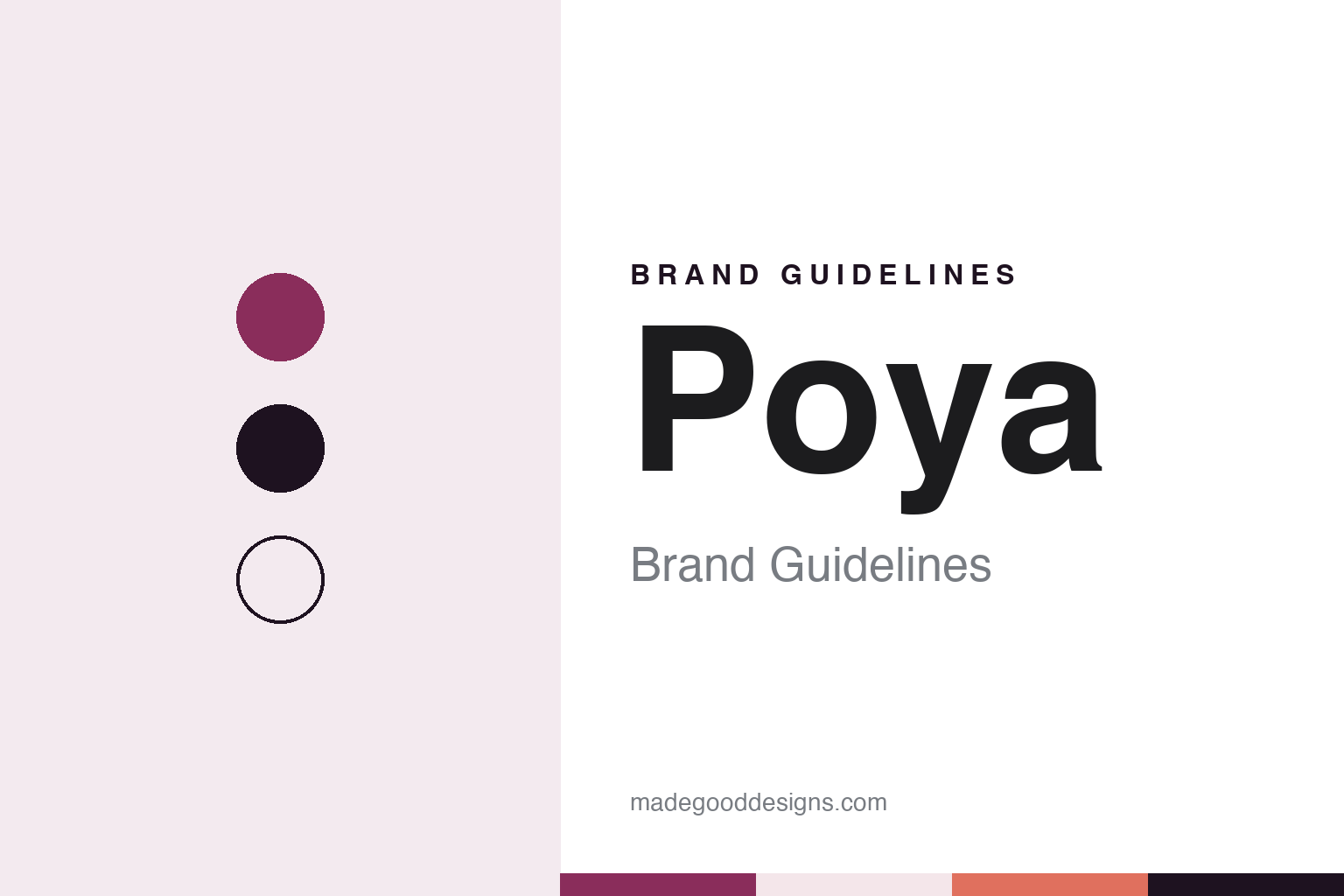
For a design guide, Poya shows how a bilingual name, POYA and 寶雅, can carry a growing family of plainly named formats, from beauty flagships to a hardware banner and an app; compare Cosmed and PX Mart. For this guide we use plum, ink, blush white and coral with a soft display serif, an unofficial interpretation; no product or logo is reproduced.
Explore & save
Keep Poya’s identity on hand — save it to a board in the Made Good inspiration library.
Poya identity set
Pin the Poya plum, blush and coral palette and the soft display serif register to your own board.
Source & notes
Frequently Asked Questions
What font can I use to match the Poya look?
This guide describes Poya’s type as “A soft, high-contrast display serif — a register for beauty aisles and seasonal catalogues”. Its type specimen is set in DM Serif Display from Google Fonts as a stand-in; DM Serif Display is not Poya’s own lettering.
What colours are in the Poya palette?
This guide’s Poya palette is Plum #8A2D5B, Ink #1E1220, Blush white #F4E6EA, Coral #E0705E and Paper #FAF7F6. The tones are the guide’s own unofficial interpretation, not official Poya hex codes.
When was Poya founded?
Poya was founded in 1985 (first store, per the company), in Tainan, Taiwan.