Auralex Brand Guidelines
The Indianapolis foam-panel maker born in a garage.
Aa
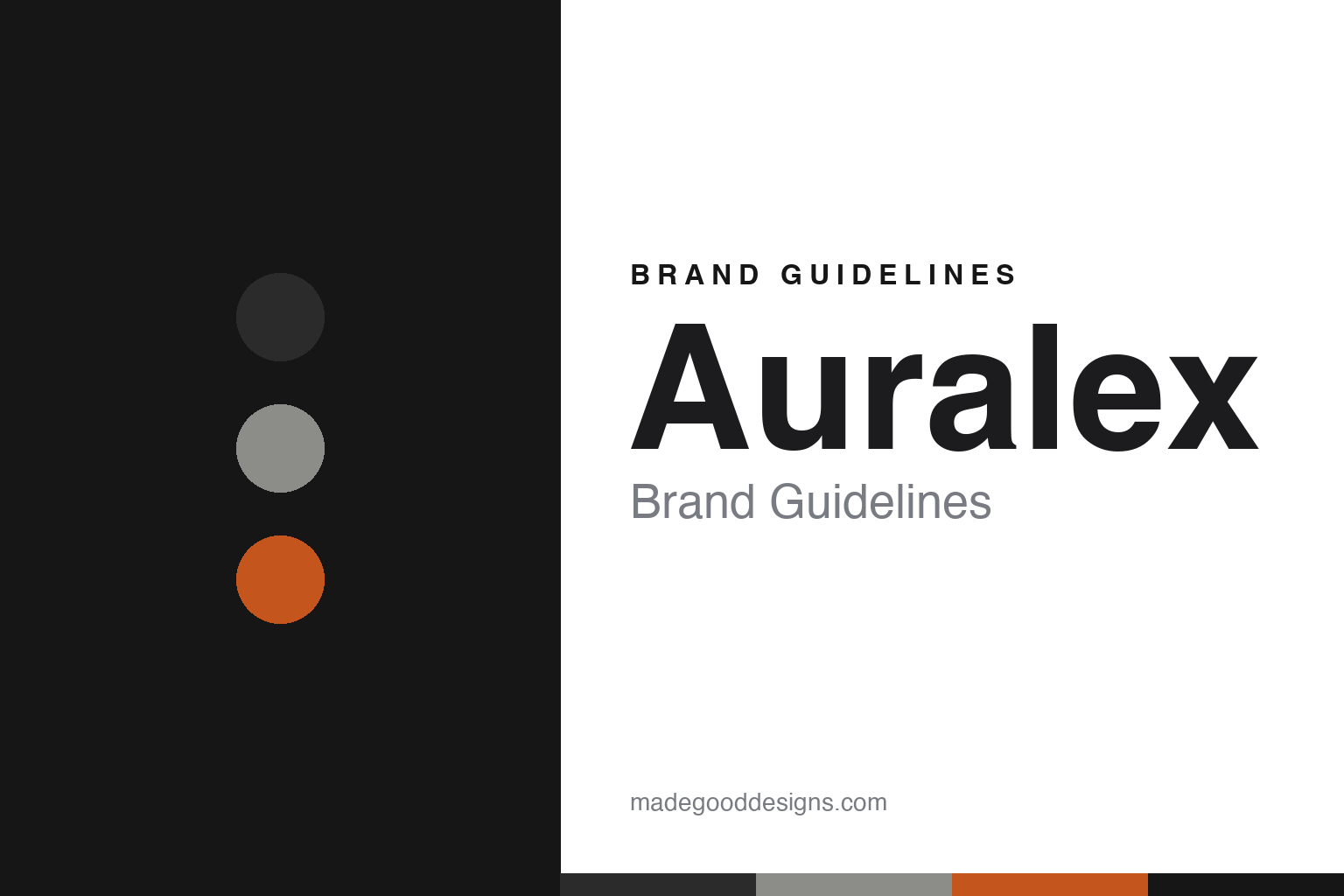
Two constants: an Auralex charcoal, foam grey and burnt orange palette and a workshop sans register. Abstract homage — not an Auralex product or mark; no panel, logo or packaging is reproduced.
Out back in the garage
A founder’s letter that has not changed in decades.
Auralex Acoustics began in 1977, according to the company, and it has always told that story in its founder’s voice. The letter that opens its About page, signed by Eric Smith as founder and president, says the acoustical products of the time “were way too expensive and had important disadvantages,” so expensive “that even the big-budget broadcast and recording facilities I worked in said they couldn’t afford them.” The answer, the letter says, was a company “born out back in my garage.” The same letter was on the company’s website in 2002, when it spoke of “more than two decades,” and it is still there in 2026.
A biography the company published until at least 2021 adds detail. It says Smith founded “the company that would become Auralex” in the late 1970s while studying broadcasting at Butler University in Indianapolis, and that he had worked at Indiana radio stations and as a mobile and nightclub DJ. The same page described him as a member of the Industry Advisory Board at the Purdue School of Engineering & Technology at IUPUI. We found no independent account of the founding, so these are the company’s own words; there was no English Wikipedia article on Auralex when we checked.
The firm has stayed in Indianapolis. In December 2021 it announced a move to a new global headquarters in the city, saying it had outgrown its old building; the announcement quoted Dave Pedigo as chief executive and said the new site would include dedicated research and development space. Website footers from 2015 give the company name as Auralex Acoustics, Inc. and carry the line “Real-World Acoustics®.” We found no record of a sale or acquisition in the sources we checked, and the company does not publish its ownership.
Colour
Studiofoam, LENRDs and the MoPAD.
The product that made the name was Studiofoam, the company’s acoustic foam panel. Auralex says its early success “quickly led to other innovations”: the LENRD and Venus bass traps, the T’Fusor and GeoFusor diffusors, the portable MAX-Wall system, and construction products such as SheetBlok sound barrier and U-Boat floor floaters. An archived 2002 version of its website already listed Studiofoam wedges, pyramids and Metro panels, LENRD and Venus traps, the T’Fusor, U-Boats, Sheetblok, MAX-Wall models, Roominators room kits and the MoPAD monitor isolation pad.
The MoPAD became the starting point for what the company calls its ISO-Series of isolation products, which now includes the ProPAD for monitors, the GRAMMA platform for amplifiers, the SubDude for subwoofers and the ISO-Tone for turntables. Sound On Sound reviewed the ProPad in December 2013. Paul White described the MoPad as a shaped foam block and the ProPad as a three-layer platform: a base of the company’s Platfoam, a black melamine-finished MDF slab and a dense, rubbery top layer. With a pair of seven-inch monitors on his desk shelf, he wrote, “the bass sounded tighter,” and his advice was to skip plain foam pads and go straight to a rigid platform.
Later lines moved toward finished interiors. At InfoComm 2018 the company showed new fabric colours for its ProPanel fabric-wrapped absorbers, drawn from acoustical fabric lines including Guilford of Maine, audioXpress reported; the panels carry a Class A fire rating and come in sizes from two-by-two to four-by-eight feet. In 2019 it released Room Layout eXpress, a phone app that suggests treatment kits by room type and size. In 2015 it shipped v2 versions of its Sustain bamboo diffusors. More recent press releases cover Synergy panels, custom-printed EcoPrint absorbers and Fusion24 faceplates.
Typography
Design and documentation.
The seven brands here make the same kind of thing: objects that change how a room sounds. Absorbers soak up reflections, bass traps tame low frequencies, and diffusers scatter sound rather than remove it. Customers run from recording studios to home cinemas.
Four are North American. GIK Acoustics was founded in Atlanta, Georgia, in 2004 by the musician Glenn Kuras; it says its panels are built to order in Atlanta and, for the EU, in Kielce, Poland, with UK orders fulfilled from Bradford, England, where its European arm started in 2008. Auralex, which Eric Smith says he founded in his garage in 1977, is based in Indianapolis. Primacoustic, in Port Coquitlam, British Columbia, began in 2000 as a division of Radial Engineering; Radial says its founder, Peter Janis, sold the company to Regimen Equity Partners in 2018.
RPG, which Peter D’Antonio founded in 1983 around what it calls Reflective Phase Grating diffusors, now trades as RPG Acoustical Systems, LLC, from Passaic, New Jersey, its website says.
Three are European. Vicoustic was founded in Portugal in 2007 and has its headquarters and research centre in Paços de Ferreira; the brand is owned by Visound Acústica SA, and in 2026 it said it had joined forces with United Acoustic under the name UniVicoustic. Artnovion is run by Artnovion Lda, a Portuguese company whose EU-funded projects are registered in the country’s Norte region. t.akustik is the house label of Thomann, the family-owned music retailer in Treppendorf, Bavaria.
This guide sets out what can be checked about each brand — who founded it, who owns it, and what it says about where its products are made — and marks clearly what rests only on the company’s own word.
Aa
A plain, workshop-style sans for a company that writes like its founder talks. (Specimen set in Archivo, a sans STAND-IN; NOT the Auralex logo.)
Auralex
Advice sold alongside the foam.
The company has long sold advice alongside foam. The founder’s letter compares its pricing to Henry Ford’s preference for selling “a million cars for a dollar apiece,” and calls the Golden Rule “alive and well at Auralex.” The company says Smith wrote a primer, Acoustics 101, which it sold for years before publishing it free (by 2002 it ran sister websites called Acoustics101.com and AuralexUniversity.com); it also runs a free Room Analysis service and says its product specialists are practising musicians. It claims more than 700 authorised dealers worldwide, a figure we could not check. In December 2021 it announced a reciprocal deal with Imperative Audio, the British maker of a portable vocal booth: Auralex became Imperative’s distributor in the United States and Canada, and Imperative’s parent, Studiospares, began distributing Auralex in the UK.
Where the products are made is not stated on the company’s current About, product or FAQ pages, so we do not say. Nor has the company published a brand book, logo history or colour standard that we could find. What it does document is materials: it says Studiofoam comes in three colours, and its ProPanels come in standard Sandstone and Obsidian fabrics, with a range of premium colours.
For a design guide, Auralex shows how a founder’s voice can carry a brand for almost fifty years. Compare Primacoustic, another maker of studio acoustic treatment, and Barefoot Sound, an American studio-monitor maker with garage beginnings. For this guide we use charcoal, foam grey and a burnt orange with a sans, an unofficial interpretation; no product or logo is reproduced.
Explore & save
Keep Auralex’s identity on hand — save it to a board in the Made Good inspiration library.
Auralex identity set
Pin the Auralex charcoal, foam grey and burnt orange palette and the workshop sans register to your own board.