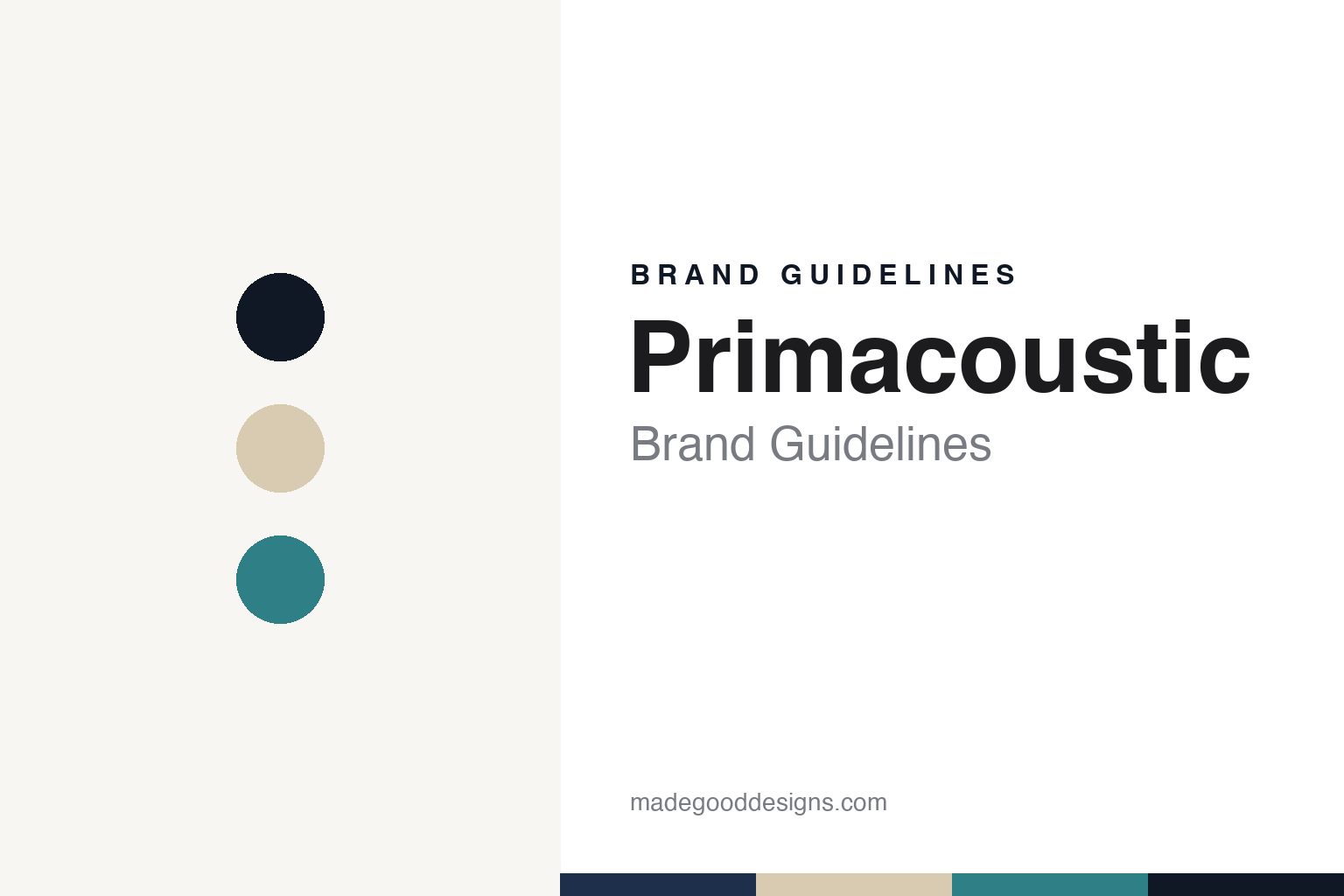
Primacoustic Brand Guidelines
The Radial sister brand that went from studio foam to Broadway panels.
Aa
Two constants: a Primacoustic navy, beige and teal palette and an Architectural sans register. Abstract homage — not a Primacoustic product or mark; no panel, logo or nameplate is reproduced.
A Radial idea
A direct-box maker turns to the room.
Primacoustic was started in 2000 by the company behind Radial Engineering, the British Columbia maker of direct boxes and other pro-audio tools. Radial’s own history says it was founded in Vancouver by the musician and entrepreneur Peter Janis, and that its first product, the JDI passive direct box, appeared in 1996; it adds that “in 2000, Radial branched out, launching its sister company, Primacoustic.” Primacoustic’s about page says the brand “was formed in 2000 as a division of Radial Engineering Ltd.”
The archived record adds detail. Early versions of the Primacoustic website, captured by the Internet Archive in 2001 and 2003, carried the line “Primacoustic is a division of JP CableTek Electronics Ltd.” and gave an address in Port Coquitlam, east of Vancouver, with pages in English and French; by 2006 its press releases called it “a division of Radial Engineering Ltd.” An archived about page from 2011 tells the origin story in the company’s words: Radial had imported a European brand of acoustic panels for its customers, grew frustrated that the product was expensive and that its maker was heading towards industrial noise control — “not music” — and created Primacoustic to offer simple solutions for studios, churches, broadcasters and other music venues.
Ownership changed in 2018. Radial’s history says Janis sold the company that year to Regimen Equity Partners, a Canadian private-equity firm. Regimen’s portfolio page lists Radial Engineering, based in Port Coquitlam, as an investment made in 2018, naming Primacoustic among its brands alongside Radial, Tonebone, Reamp and Jensen Transformers; Regimen says it runs a 30-year fund meant to hold businesses for more than 20 years. Radial says it opened a warehouse in Loveland, Colorado, in 2019 and moved to a larger facility in Port Coquitlam in 2021.
Colour
From foam wedges to Broadway.
Primacoustic’s first products were foam. The 2001–2003 website sold a modular system of pre-cut urethane foam shapes with travel-poster names — the Europa Flutter Wall, Scandia Scatter Blocks, the Orientique Washboard and the Australis Bass Trap, a corner wedge — packaged as London studio kits, New York voice-over booths, Rio video suites and Montreal studios, with the glue included. Sound On Sound’s Paul White reviewed the London systems in January 2003, describing “a modular acoustic treatment system based on pre-cut blocks and wedges of high-density, open-cell polyurethane foam,” remarking that “everything in the system has rather a strange name,” and putting the cost of treating a typical project studio at £600 to £1,200.
The turn came with Broadway. A press release dated September 13, 2006, announced the panels at the CEDIA home-technology show: encapsulated fiberglass with resin-hardened edges, covered in an acoustically transparent fabric in black, grey or beige. Janis, then company president, said Primacoustic had built “a strong following” for its urethane foam products, but that most people “do not want their home theatres to look like a high-tec recording studio.” By limiting sizes and colours, he said, the company could mass-produce and treat a home theatre for as little as $399. Radial’s current history calls Broadway Primacoustic’s first product line; the archived site and the 2006 release show that the foam range came first.
Broadway became the core of the studio range. The company describes the panels today as high-density glass wool with resin-hardened edges under polyester fabric, sold singly and in London Room Kits — London 8, 10, 12 and 16 — sized for rooms from up to 100 square feet (London 8) to larger spaces, with Nimbus and Stratus ceiling clouds above the mixing position. Accessories have included the Recoil Stabilizer, IsoPads and the Vox Guard microphone shield, which Sound On Sound’s Matt Houghton found “very effective at keeping vocal recordings nice and dry” in January 2011.
Typography
Rooms as instruments.
The seven brands here make the same kind of thing: objects that change how a room sounds. Absorbers soak up reflections, bass traps tame low frequencies, and diffusers scatter sound rather than remove it. Customers run from recording studios to home cinemas.
Four are North American. GIK Acoustics was founded in Atlanta, Georgia, in 2004 by the musician Glenn Kuras; it says its panels are built to order in Atlanta and, for the EU, in Kielce, Poland, with UK orders fulfilled from Bradford, England, where its European arm started in 2008. Auralex, which Eric Smith says he founded in his garage in 1977, is based in Indianapolis. Primacoustic, in Port Coquitlam, British Columbia, began in 2000 as a division of Radial Engineering; Radial says its founder, Peter Janis, sold the company to Regimen Equity Partners in 2018.
RPG, which Peter D’Antonio founded in 1983 around what it calls Reflective Phase Grating diffusors, now trades as RPG Acoustical Systems, LLC, from Passaic, New Jersey, its website says.
Three are European. Vicoustic was founded in Portugal in 2007 and has its headquarters and research centre in Paços de Ferreira; the brand is owned by Visound Acústica SA, and in 2026 it said it had joined forces with United Acoustic under the name UniVicoustic. Artnovion is run by Artnovion Lda, a Portuguese company whose EU-funded projects are registered in the country’s Norte region. t.akustik is the house label of Thomann, the family-owned music retailer in Treppendorf, Bavaria.
This guide sets out what can be checked about each brand — who founded it, who owns it, and what it says about where its products are made — and marks clearly what rests only on the company’s own word.
Aa
A clean architectural sans for a brand that now sells to specifiers. (Specimen set in Manrope, a sans STAND-IN; NOT the Primacoustic logo.)
Primacoustic
From the studio to the specification.
Today Primacoustic leans towards architecture. Beside the studio range it sells EcoScapes panels made of PET from recycled plastic bottles, the TelaScapes fabric track system, GridWay ceiling tiles and the made-to-order Archadia clouds and baffles, introduced in the early 2020s, which it describes as Class A fire-rated and designed with the LEED and WELL building standards in mind. It offers BIM data and continuing-education credits for architects, an online room designer and a three-year warranty against manufacturing defects, and its slogan is “Be Heard.”
Its about page names artists including John Rzeznik of the Goo Goo Dolls and Tommy Lee of Mötley Crüe, and companies including Electronic Arts, Cisco Systems and Sony, as users. An archived 2011 page said Broadway panels had been used in the International Broadcast Centre at the Vancouver 2010 Winter Olympics by NBC and CTV, and described the brand’s method as a “Model T Ford approach” of mass-producing a limited selection. We give these as the company’s claims. Primacoustic’s website, as we read it in October 2026, does not say where its panels are made.
For a design guide, Primacoustic shows how a brand born inside a pro-audio company can move from studio foam to architects’ specifications under one name. Compare GIK Acoustics, the Atlanta maker that sells direct and builds to order, and ADAM Audio, a monitor brand that also sits inside a larger group. For this guide we use navy, glass-wool beige and a teal with a sans, an unofficial interpretation; no product or logo is reproduced.
Explore & save
Keep Primacoustic’s identity on hand — save it to a board in the Made Good inspiration library.
Primacoustic identity set
Pin the Primacoustic navy, beige and teal palette and the Architectural sans register to your own board.