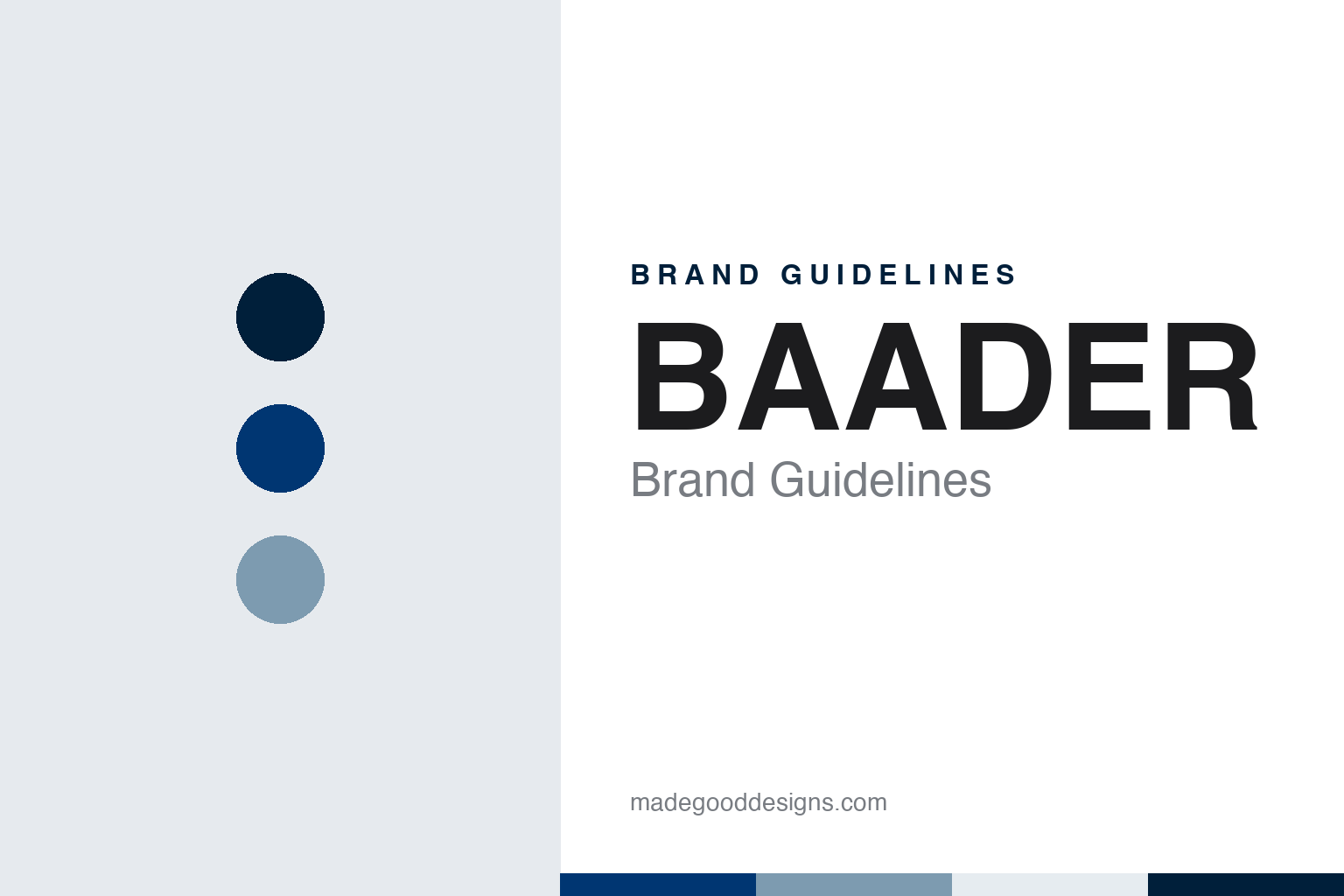
BAADER Brand Guidelines
The Lübeck fish machinery maker that moved from fin to wing.
Aa
Two constants: a BAADER Baltic navy and silver palette and a Hanseatic sans register. Abstract homage — not a BAADER product or mark; no machine, logo or nameplate is reproduced.
Nordischer Maschinenbau
A canner’s son-in-law and a problem of transport.
BAADER began as Nordischer Maschinenbau, entered in Lübeck’s commercial register on 29 July 1919, according to German Wikipedia and World Fishing. Its founder was the engineer Rudolph Max Joseph Baader; the company uses that spelling, while the Max Rubner-Institut and the Lübeck-Lexikon write Rudolf. The company says he had worked as an engineer in Chemnitz, Switzerland, France and Hamburg before his father-in-law, Paul Lohrmann, owner of a fish-canning factory in Lübeck, invited him to develop machines. Its first premises were on Lübeck’s old-town island.
The problem was movement. BAADER says earlier attempts at mechanising fish processing had foundered on how to carry the fish between the units of a machine, and that Baader’s answer, patented in April 1921, was to hold each fish by a tail clip. The company dates its first herring filleting machines to 1921. In 1922 the BAADER 450 was shown at the Lübeck fisheries exhibition, where, World Fishing reported in 2019, it drew interest and was also pelted with stones by fish workers who saw it as a threat to their livelihoods. German Wikipedia calls it the world’s first heading and boning machine for fish.
Baader looked beyond his own factory floor. On 1 October 1920 he set up a technical advisory service for fish processing on the company’s site, the Max Rubner-Institut records, which became a research institute for the fish industry in 1921 and which the institute treats as the start of German research on fish quality. In 1922, German Wikipedia says, he founded a publishing house, Der Fisch. In 1925, the company says, he set up Fischfilet GmbH and a distributor, Tütenfisch AG, whose name means “fish in a bag,” to sell filleted herring as “Breakfast Fish.”
Selling followed the catch. In 1927 BAADER named its first agency abroad, in Aberdeen, and in 1929, the company says, Baader stopped selling his seasonal herring machines and began hiring them out with servicing included. BAADER calls this the invention of leasing and carefree service, which is its own description.
Colour
From fin to wing.
The machine that made the name international was the BAADER 99. The company says its cam disks let it judge the size of each fish and adjust itself, handling whitefish between 50 and 120 centimetres; it was tried on British trawlers in 1950 and small-scale production began in 1951. World Fishing called it the company’s star product, fitted on many factory trawlers as processing at sea grew in the 1950s. In 1953 leadership passed to the founder’s son, Rudolf G. T. Baader. He took the company to a new factory on the outskirts of Lübeck in 1959, the year, BAADER says, that the writer Siegfried Lenz published “Der Amüsierdoktor,” a satirical story set in a factory that it reads as unmistakably its own.
Growth then came by widening the line. BAADER-Anlagenbau opened in Bremerhaven in 1965 to build washing, cooling and steaming equipment around the Lübeck machines; packaging machines followed. In 1969 BAADER entered the separator business, machines that divide soft from hard material, and German Wikipedia says the process became known as Baadern. The company now sells that technology as BAADERING and its Refiner series. In 1992 BAADER formed a service joint venture with Russian shareholders at Vladivostok. In the same year, German Wikipedia says, it bought the Bremerhaven machine maker Schlotterhose.
Poultry is where sources differ. World Fishing placed the move into poultry equipment in the 1960s; BAADER’s own timeline dates its first poultry filleting machine, the BAADER 640, to 1984, and says the aim was to offset the seasons of the fish business. It calls the story “From Fin to Wing.”
Petra Baader took over in 1995, the third generation of the family to lead the company. Both BAADER and World Fishing describe a difficult moment, with Russian deliveries halted and fish quotas depressing demand. She invested in the United States and in poultry: BAADER bought Johnson Food Equipment in 1997 and took over the Danish poultry specialist LINCO Food Systems in 2007, completing that purchase in 2009. In salmon, World Fishing credited the BAADER 142 and its automated “princess cut” with a boom from the mid-1990s.
Typography
Lines, steel and test kitchens.
Makers of food processing machinery tend to show the work itself. Stainless lines are photographed under cool light, fillets move along white belts, sausage ropes curve out of a filler, slicers fan portions onto a conveyor, and fryers and seasoning drums turn snacks in close-up. The BBC opened a 2017 report on Marel in just that way, with cod on a conveyor and a machine cutting each fillet into portions.
Steel carries much of the imagery. Wash-down surfaces, welded seams and the curve of a hopper recur in close-up, and the machines are shown at close range.
Test kitchens and technology centres are the sector’s showrooms. JBT Marel lists Customer Technology Centers on several continents where customers can run their own product through the equipment, and Handtmann describes its Forum in Biberach as a technology and customer centre. Websites often follow the customer’s food rather than the machine: JBT Marel sorts its site by poultry, meat, seafood, prepared foods and beverages, and Handtmann’s regional sites by meat and sausage, baked goods, pet food and dairy.
The trade fairs set the calendar. IFFA in Frankfurt, SÜDPACK in Friedrichshafen, Anuga FoodTec in Cologne, Seafood Processing Global in Barcelona and PACK EXPO in the United States are regular venues for the sector, alongside bakery and ingredient shows: vegconomist reported that Handtmann took new bakery processes to iba in 2025, and JBT Marel’s news page reported on CibusTec in 2026. This guide sets out what can be checked about each maker: who founded it, who owns it, and where its machines are made, marking clearly what rests on the company’s own word.
Aa
A plain Hanseatic sans, for a name the company sets in capitals. (Specimen set in Barlow, a sans STAND-IN; NOT the BAADER logo.)
BAADER Global
A family company buys into software.
Acquisitions continued. BAADER bought Trio Food Processing of Stavanger, a skinning and pin-boning specialist, in 2012, and the Swedish small-fish machinery maker SEAC in January 2021; both remain Group brands. In 2023 RTÉ reported that it had taken a majority stake in EMYDEX, the Irish maker of manufacturing software for food processors.
One purchase did not last. BAADER took a majority stake in the Icelandic equipment maker Skaginn 3X and took full ownership in February 2022. In July 2024 World Fishing reported that Skaginn 3X had filed for bankruptcy, and in October 2024 SalmonBusiness reported that the Icelandic firm KAPP had acquired its assets, to operate as KAPP Skaginn.
The company’s legal shape has also changed. BAADER says the BAADER Group was founded in 2022, with an executive board over its companies, and its releases now name BAADER Global SE, headquartered in Lübeck. Petra Baader remains chief executive. Fish Focus described the company as still family owned in 2019, and BAADER called itself family-run in its centenary year. On 4 November 2026 it announced that Thomas Frank had joined the board and would become chief financial officer on 1 January 2027.
Its production reached Asia in 2025. That May BAADER opened BAADER Food Systems Asia at Shah Alam in Malaysia, which it calls its first production facility in Asia, in Petra Baader’s words “made in Malaysia, by Malaysians.” In 2025 the magazine Markt und Mittelstand included it in a ranking of Germany’s 50 most significant mechanical engineering companies, BAADER says.
The identity was last reset for the centenary. BAADER says that in 2019 it renewed itself “with a new appearance and brand promise,” “We Innovate Food Value Chains,” which it explains through four cornerstones, including “One BAADER.” Its website writes the name in capitals, and its code in November 2026 leans on a deep navy with Roboto as a typeface.
For a design guide, BAADER shows how a company can keep one family name in capitals while its work moves from a herring clip to factory software. Compare JBT Marel, another maker of fish and poultry lines, and Handtmann, a German family company in food machinery. For this guide we use a Baltic navy and a herring silver with a sans, an unofficial interpretation; no product or logo is reproduced.
Explore & save
Keep BAADER’s identity on hand — save it to a board in the Made Good inspiration library.
BAADER identity set
Pin the BAADER Baltic navy and silver palette and the Hanseatic sans register to your own board.