Barker and Stonehouse Brand Guidelines
The Teesside furniture retailer founded by two former RAF men in 1946.
Aa
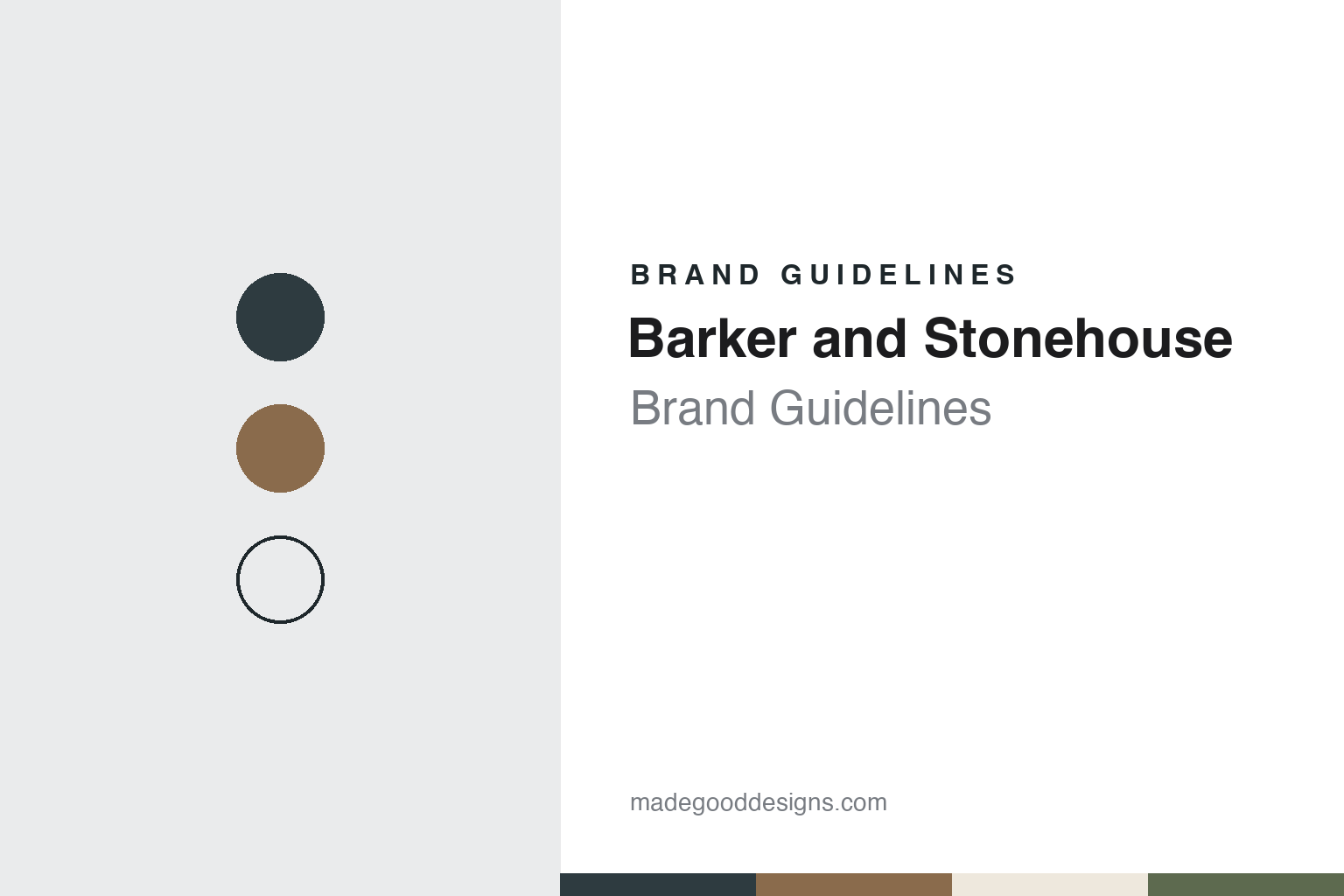
Two constants: a slate, oak and linen palette and a bookish serif register. Abstract homage — not a Barker and Stonehouse product or mark; no logo, sign or furniture design is reproduced.
Two RAF men
A furniture shop in Stockton, opened as the war ended.
Barker and Stonehouse began in Stockton-on-Tees in 1946. The company says its founders, Charles Barker and Alex Stonehouse, were two young RAF men who had both worked at Binns, a department store in the region, before they opened a furniture shop of their own. English Wikipedia places that first shop on Bishopton Lane in Stockton and dates its opening to early 1946. The Eastern Daily Press, writing in March 2026, described the firm as founded on Teesside in 1946, and Teesside Live, in December 2025, as established in 1946 and still operated by the Barker family.
A second store followed on Newport Road in Middlesbrough. The company dates it to 1947; English Wikipedia gives late 1946. Charles Barker’s brother Frank Barker joined at that point, and the company credits him with a background in advertising and a gift for writing copy. Darlington followed in 1953, and Redcar, the company says, in 1961, when Charles Barker’s son Richard Barker joined to manage it. By 1974 Richard Barker had bought out Frank Barker’s and Alex Stonehouse’s shares and become managing director, according to both the company and English Wikipedia.
The third generation came in 1991, when Richard Barker’s son James Barker joined, English Wikipedia says; he was managing director when the Eastern Daily Press quoted him in March 2026. English Wikipedia credits him with the advertising line “is your house a Barker & Stonehouse?”, which turned the company name into a question about the customer’s home. Advertising had been part of the story from the start: the company says some of Frank Barker’s early newspaper advertisements survive.
Colour
From the high street to retail parks and beyond Teesside.
The shop map grew outwards from Teesside. The company lists Hartlepool in 1978, Bishop Auckland in 1979 and a store on Newgate Street in Newcastle in 1983; the company says Callers, a large Newcastle furniture store, closed at about the same time, and that Richard Barker hired many of its experienced staff. In 1987 its Middlesbrough branch left the high street for a former bakery on Cannon Park, which the company describes as an out-of-town showroom with a large warehouse behind it; that site was also its head office until 2015. A move to Leazes Park Road in Newcastle followed in 1998, which the company says gave it room to stock Italian designer brands.
Yorkshire and the Midlands came next. The company dates its first website and a store in Knaresborough to 1996, then Leeds in 2002, Hull in 2005 and Nottingham in 2008. In December 2012 it opened a purpose-built store in Knaresborough with a living roof planted with grass, which English Wikipedia also describes. In 2013 it reached London, opening in Battersea in a building the company says was once a candle factory dating from 1830. English Wikipedia adds a store in Hove, opened in April 2017 by the television presenter George Clarke, and one in Guildford in December 2017.
In 2015 the company returned to its roots with a three-floor store and head office at Teesside Park, which the company says covers more than 48,000 square feet and uses reclaimed wood in its walls; English Wikipedia says Mary Berry opened it, and that the store has a café, Chadwick & Co, on its second floor, while the Knaresborough store houses Stanley’s Coffee House & Kitchen. As for what it sells, English Wikipedia lists sofas, beds, dining tables, chairs, office and children’s furniture, along with names such as Timothy Oulton, Stressless, Tempur and Ercol.
Typography
How the category presents itself.
British sofa, furniture and bed retailers sell large, slow purchases, and most of them present themselves through the showroom before anything else. Several chains grew on out-of-town retail parks, where a single unit can hold many sofas set out as room sets, and their websites send shoppers back to those floors with store finders, appointment booking and the offer of a specialist who will walk them through sizes, fabrics and leathers.
The fabric swatch sits at the centre of the sale. Many ranges are made to order, so one sofa design is shown in a single cover on the shop floor and offered online and in store in a long list of fabrics and finishes; one UK chain’s website, for example, lists more than 200 fabrics and leathers. Alongside in-house ranges, several retailers sell collections made with magazine titles, fashion labels or long-established furniture makers, and credit those partners by name.
Advertising is seasonal and public. Television campaigns have been part of the category’s face for decades, and retailer websites carry named sale events in the same banner space as their ranges. The store fascia, the advert and the website usually share one short brand name, often a set of initials or a plain phrase about sofas or beds.
Behind the shop window sits a separate corporate voice. Listed groups publish investor sites with dated history timelines, founder stories, the brands they own and the number of showrooms each one runs; private-equity and overseas owners enter the same record through takeovers, administrations and changes of name. This guide follows that record: who founded each company, who owns it now, and how its name and look have changed along the way.
Aa
A bookish serif for a family firm with eight decades of advertising. (Specimen set in Libre Baskerville, a serif STAND-IN; NOT the Barker and Stonehouse logo.)
Barker and Stonehouse
Stores, concessions and a family name.
The recent story is one of fewer large city-centre buildings and more space inside other shops. Teesside Live reported in December 2025 that the company had sold its Newcastle city-centre store, which was being converted into student housing, and kept a presence in the city through a concession in Fenwick, the department store, where it doubled its floor space in autumn 2024. The same report said it had agreed to open a concession in Jarrolds, the independent department store in Norwich, in December 2025, that its head office was in Stockton, and that it had 386 employees at the end of its financial year.
The Eastern Daily Press visited the Norwich space in March 2026. It described a refurbished second floor at Jarrolds given over to Barker and Stonehouse upholstery, dining and bedroom furniture, with ranges including English Heritage, Orla Kiely and Pure Home, and furniture laid out as it might be at home. The paper presented the space as a partnership between the two businesses. The paper said the company would mark its 80th anniversary on 29 May 2026.
Counts differ by date and by what is counted. Teesside Live gave 18 outlets in December 2025; the Eastern Daily Press gave 15 in March 2026; and the company’s own site, in November 2026, listed 10 stores, 3 concessions and 2 outlets, plus sales through online marketplaces.
For a design guide, Barker and Stonehouse shows how a regional, family-run retailer can carry its founders’ two surnames for 80 years while its shops move from high streets to retail parks and into department stores. Compare Furniture Village and Oak Furnitureland, two other British furniture retailers. For this guide we use slate, weathered oak and linen tones with a serif, an unofficial interpretation; no product or logo is reproduced.
Explore & save
Keep Barker and Stonehouse’s identity on hand — save it to a board in the Made Good inspiration library.
Barker and Stonehouse identity set
Pin the slate, oak and linen palette and the bookish serif register to your own board.