Furniture Village Brand Guidelines
A 1989 Abingdon start, an investor and a return to family hands.
Aa
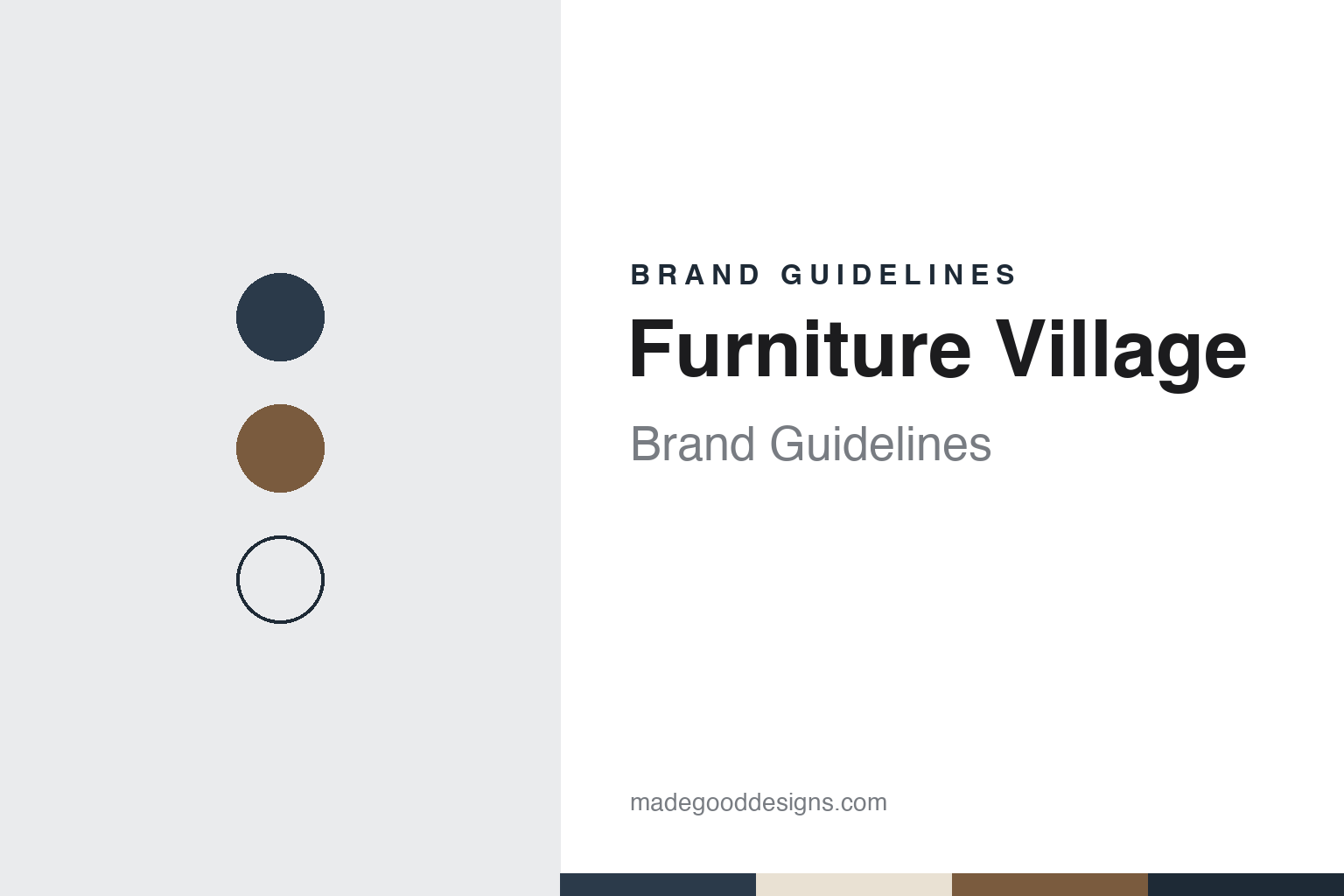
Two constants: an ink blue, oak and linen palette and a room-set serif register. Abstract homage — not a Furniture Village product or mark; no logo, store or product is reproduced.
From Abingdon
Two founders, an estate partner and an investor.
Furniture Village is a British furniture retailer with its head office in Slough. English Wikipedia says it was established in 1989 by Peter Harrison and David Imrie in partnership with Cadogan Estates, and that its first store opened in Abingdon, Oxfordshire. The trade magazine Furniture News reported in August 2014 that the business was marking 25 years of trading that month. Companies House records show that the limited company behind it was incorporated in October 1988 under another name, Kiteshield, and took a new name that December.
Ownership has moved in stages. English Wikipedia says Cadogan Estates sold its 70% stake to the management, led by Harrison, in December 2001. In August 2002 the company bought three Conroys stores from administrators, which gave it a presence in North East England, and in the same year it launched a separate upmarket fascia, the London Furniture Company, which closed in 2005, English Wikipedia says.
In August 2014 Furniture News reported that the investor BGF, then called the Business Growth Fund, had taken a minority stake; at that point the retailer had 40 stores across the UK and employed 760 people. BGF invested again in 2015, Furniture News reported in December 2022, and during the partnership the store count rose from 40 to 55. That month BGF exited through a share buyback. According to Furniture News, the Harrison family became the sole shareholder, aside from a substantial holding by the company’s employee benefit trust; Retail Gazette reported in January 2023 that the retailer had used its cash reserves to buy out BGF.
The board changed soon after. Retail Gazette reported on 24 January 2023 that Peter Harrison had become executive chairman and his son Charlie Harrison managing director, after 20 years at the retailer, the last three as commercial director. Companies House listed the company as active in November 2026.
Colour
Big rooms, named concessions and a move north.
Furniture Village sells through large stores and online. In January 2023 Peter Harrison described a business of around 1,200 employees, 55 stores and 17 fulfilment centres, in a statement quoted by Retail Gazette. Store counts in this guide are given with the date of the report they come from.
The chain stayed in England until December 2024. Furniture News reported on 2 January 2025 that the retailer had opened its first store in Scotland, at Straiton Retail Park outside Edinburgh, on 20 December 2024, taking it from 56 stores in England to 57 in all. That store has 25,780 square feet over two floors, a ground floor and a mezzanine, the magazine said, with dedicated spaces for brands including Tempur, Duresta, G Plan and Hypnos alongside the retailer’s own exclusive collections.
A second Scottish store followed. In June 2025 Furniture News reported the opening of a store on Hillington Road in Glasgow, near Junction 26 of the M8, with close to 50,000 square feet of selling space. The magazine described it as the chain’s 58th store and its second in Scotland, and said it was twice the size of a typical Furniture Village store and around 30% larger than the previous record holder, in Croydon. It listed more than 90 upholstery groups, more than 90 dining ranges and more than 70 beds, with brands such as Tempur, G Plan, Laura Ashley and Hypnos, and collections from Marinelli, Italia Living and Bontempi shown only in Glasgow.
Branded concessions sit alongside the company’s own ranges online too. As of November 2026, its website sorted sofas by size, material, type and style, from corner and recliner sofas to Chesterfield and modular designs, and offered planning tools named Sofa sizer, Sofa finder and Create your room. Its menu ran from sofas and armchairs through dining to beds and accessories.
Typography
Showrooms, swatches and sale seasons.
British sofa, furniture and bed retailers sell large, slow purchases, and most of them present themselves through the showroom before anything else. Several chains grew on out-of-town retail parks, where a single unit can hold many sofas set out as room sets, and their websites send shoppers back to those floors with store finders, appointment booking and the offer of a specialist who will walk them through sizes, fabrics and leathers.
The fabric swatch sits at the centre of the sale. Many ranges are made to order, so one sofa design is shown in a single cover on the shop floor and offered online and in store in a long list of fabrics and finishes; one UK chain’s website, for example, lists more than 200 fabrics and leathers. Alongside in-house ranges, several retailers sell collections made with magazine titles, fashion labels or long-established furniture makers, and credit those partners by name.
Advertising is seasonal and public. Television campaigns have been part of the category’s face for decades, and retailer websites carry named sale events in the same banner space as their ranges. The store fascia, the advert and the website usually share one short brand name, often a set of initials or a plain phrase about sofas or beds.
Behind the shop window sits a separate corporate voice. Listed groups publish investor sites with dated history timelines, founder stories, the brands they own and the number of showrooms each one runs; private-equity and overseas owners enter the same record through takeovers, administrations and changes of name. This guide follows that record: who founded each company, who owns it now, and how its name and look have changed along the way.
Aa
A room-set serif for a retailer of furnished rooms. (Specimen set in Lora, a serif STAND-IN; NOT the Furniture Village logo.)
Furniture Village
One name since 1989, with the family back in charge.
The Furniture Village name has stayed the same since 1989 while the estate has grown from one store to more than fifty. English Wikipedia says the company aims at the upper end of the price range and that its advertising has tried to make quality, rather than price, the point of difference from DFS.
The stores carry much of the identity. The formats described by Furniture News are large retail-park showrooms laid out as rooms: the Edinburgh store spreads its ranges across two styled floors, and the Glasgow store gathers upholstery, dining and beds into named groups, with areas given to bed and upholstery makers whose own names appear on the shop floor.
Ownership is part of how the company presents itself. When BGF exited in December 2022, the Harrison family became the main shareholder, with a holding kept by the employee benefit trust. Furniture News described the retailer as family-run when it reported the Edinburgh opening in January 2025, and Retail Gazette framed the 2023 board changes as the first major move after the return to full family ownership.
For a design guide, Furniture Village shows how a founder-led retailer can keep one plain, descriptive name for more than three decades while its ownership moves from an estate partner to an investor and back to a family. Compare DFS, the sofa chain English Wikipedia sets it against, and John Lewis, another British retailer of furniture. For this guide we use an ink blue, an oak brown, linen and a sage green with a serif, an unofficial interpretation; no product or logo is reproduced.
Explore & save
Keep Furniture Village’s identity on hand — save it to a board in the Made Good inspiration library.
Furniture Village identity set
Pin the Furniture Village ink blue, oak and linen palette and the room-set serif register to your own board.