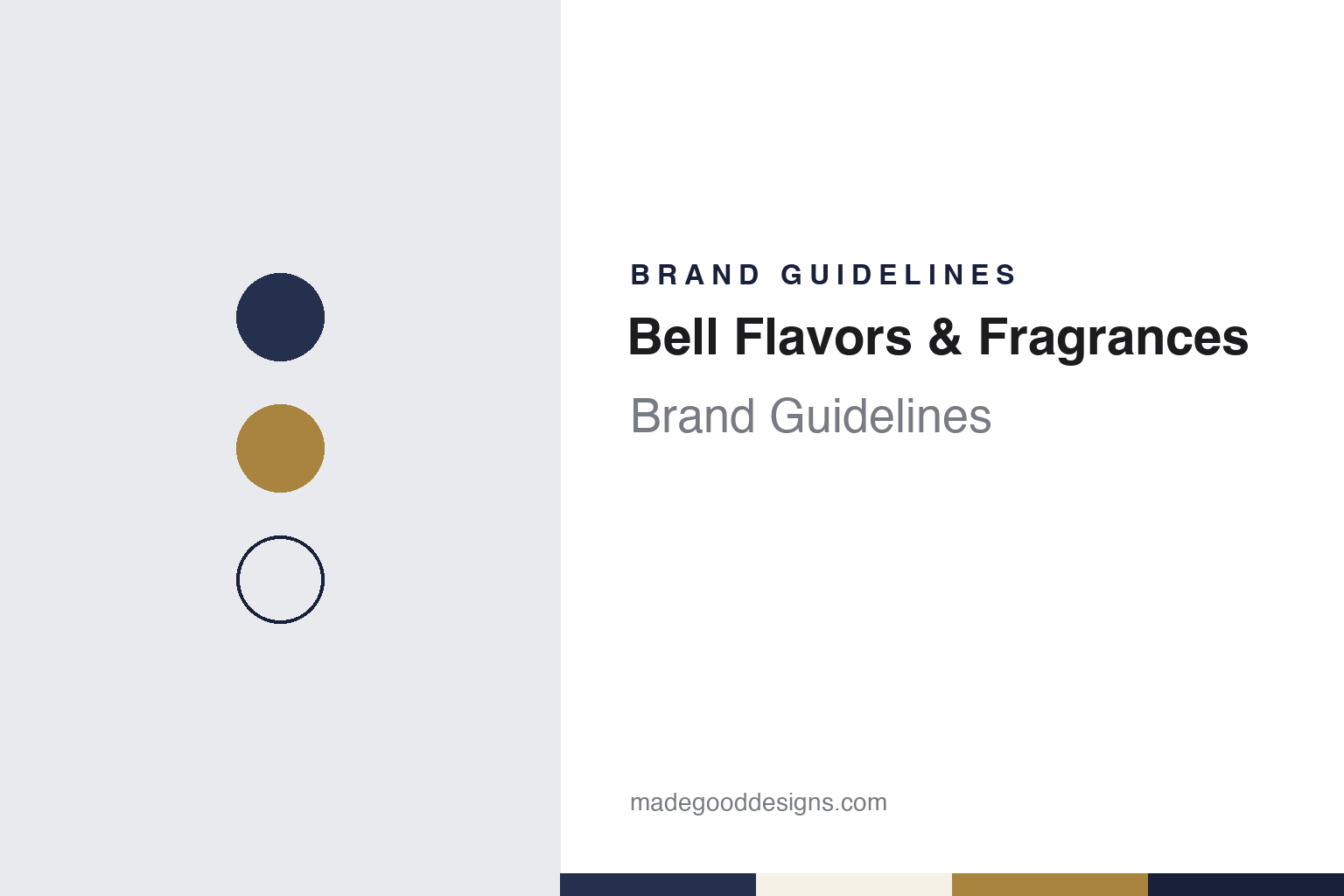
Bell Flavors & Fragrances Brand Guidelines
A Chicago flavour house of 1912, family-owned since 1968, with a Leipzig library.
Aa
Two constants: a deep deep blue, brass and rose palette and a rounded geometric sans register. Abstract homage — not a Bell Flavors & Fragrances product or mark; no logo, label or packaging is reproduced.
William M. Bell Company
A Chicago flavour chemist, 1912.
Bell Flavors & Fragrances began in Chicago in 1912 as the William M. Bell Company. English Wikipedia describes its founder, William M. Bell, as a flavour chemist with experience in confectionery, and the company’s history page says he first sold his flavours to local ice cream parlours, grocery stores and soda shops. The company dates its first manufacturing facility, on West Grand Avenue in Chicago, to 1930, when the city was building its name as a centre of the American candy trade.
In the early 1950s the business was sold to Theonett & Company, a Chicago flavour house that worked mainly for the beverage industry and kept the Bell business separate, the company says. In 1968 Edward N. Heinz, a flavour chemist who had worked for Food Materials Corporation and had served as president of the Flavor Extract Manufacturers Association, bought the William M. Bell Company from Theonett and became its president. At the time of the purchase, the company says, it had two employees. English Wikipedia says it has remained privately owned by the Heinz family ever since.
Growth came through moves and acquisitions, with Edward Heinz’s three sons involved, the company says. The business moved to Melrose Park, a Chicago suburb, in 1974. In 1976 it bought Maumee Flavors & Fragrances of Danbury, Connecticut, which made anthranilate ingredients used in berry and grape flavours. In 1979 it bought the Chicago fragrance company Roubechez, which supplied scents for candles, soaps, detergents and household products, and took the name Bell Flavors & Fragrances. In 1981 it bought the flavour division of the Stepan Company and moved its headquarters to Northbrook, Illinois, where it remains.
Colour
Schimmel, Miltitz and a library.
The company widened its range in the 1980s. Its history page lists the 1983 purchase of Synfleur, the flavour and fragrance division of Nestlé. In 1985 it bought American Brosynthetics of Milwaukee, a maker of heliotropin, and the Ritter Company of California, which made butter acids and esters and extracts of yucca and quillaia; the company calls this its first main entry into the ingredient side of the trade.
Bell says its expansion outside the United States began in 1993, when it took over the former Schimmel works at Miltitz, on the western edge of Leipzig. German Wikipedia says Bell bought the former VEB Chemisches Werk Miltitz from the Treuhandanstalt, the agency that privatised East German state firms, and that the site now trades as Bell Flavors & Fragrances Duft und Aroma GmbH. The works had a long past. Schimmel & Co. grew out of a Leipzig drug-trading business founded in 1829 and opened the Miltitz plant in 1901; German Wikipedia says that for periods it led the global market in essential oils and aroma materials. Its chemists published the annual Schimmel Reports and worked with Otto Wallach, who received the Nobel Prize in Chemistry in 1910. Bell now presents Schimmel as its predecessor in Germany.
That past includes the war years. German Wikipedia says the firm’s foreign business fell sharply from 1934, raw materials became harder to obtain and it turned more to synthetic products; the Miltitz works came through the Second World War largely intact, and US forces allowed production to restart on 30 April 1945. The Leipzig Memorial for Forced Labour (Gedenkstätte für Zwangsarbeit Leipzig), citing company files in the Saxon State Archives, records that during the war forced labourers from the Soviet Union, Czechoslovakia and France, as well as French prisoners of war, worked at the plant and were housed in two camps near the site. After the war the company was expropriated and in 1948 nationalised as VEB Schimmel Miltitz, later renamed VEB Chemische Fabrik Miltitz, where, German Wikipedia says, the recipe for Vita Cola was developed in 1958.
Bell’s Leipzig site keeps the Schimmel Library, founded in 1878. Bell says it holds about 30,000 volumes, the oldest from 1739, and German Wikipedia says the company restored it in 1998. The reports the library grew around were published in English from 1890 and in French from 1896, and from 1956 to 1986 went out as the “Miltitzer Reports,” Bell says.
Typography
Houses behind the label.
Flavour and fragrance houses sell to other companies, so their public identity is built for buyers, investors and future staff more than for shoppers. Their websites tend to divide the business into a few lines: flavours for food and drink, fragrances for fine perfumery and consumer goods, and ingredients sold in their own right. Mane groups its pages under flavours, fragrances and ingredients, for example, and Robertet adds natural raw materials and natural actives.
Creation is shown through people and places. Houses publish pages on their perfumers and flavourists, their training schools and their creation centres: Mane describes a perfumery school where apprentices train for at least two years, and Robertet lists a New York creation centre opened in 2006.
Natural materials are the other recurring story. Houses around Grasse lean on the region’s flower and plant heritage and on extraction methods: Robertet frames its sourcing as “Seed to Scent,” from the field to the finished creation, while Mane presents named extraction technologies and, in 2026, an experimental garden. Sourcing pages often pair those stories with certifications and supplier assessments, stated in the companies’ own words.
Ownership is part of the identity too. Some houses stress family control and independence; listed ones publish regulated announcements on shareholders and acquisitions. Robertet, listed in Paris since 1984, set out a change of shareholders in November 2024, and Mane’s change of chief executive in February 2025 kept the group in family hands, WWD reported. This guide sets out what can be checked about each house: who founded it, who owns it and what it says about where its materials come from.
Aa
A rounded geometric sans for a family company name. (Specimen set in Outfit, a sans STAND-IN; NOT the Bell Flavors & Fragrances logo.)
BELL
A family company with a Northbrook campus.
Expansion continued after Leipzig. In 1994 Bell bought a plant in Middletown, New York, which English Wikipedia says became a production site for fragrances and botanical extracts. In 1995 it acquired Naturome of Brossard, Quebec, and set up a business in Hong Kong, later moving its operations to Shanghai, where the company says it runs separate flavour and fragrance plants. In 2001 it bought EIGSA of Guadalajara, Mexico, a flavour and fragrance maker established in 1952, and in 2013 the flavour division of Iceberg Industries in São Paulo. English Wikipedia lists a culinary centre at Ketton, England, opened in 2019, and a production facility at Sri City, India, commissioned in 2023. The company says it registered Belltanicals as the trademark for its botanical extracts in 2007.
The Northbrook campus combines manufacturing, research, consumer testing and offices. In 2023 Bell opened a Technology and Innovation Center there, and in October 2024 a Consumer Science Sensory Center of about 6,500 square feet, with testing booths, a viewing area and a kitchen, English Wikipedia says. Bell describes itself as having more than 1,000 employees, operations in 20 countries and 12 manufacturing facilities, serving food and beverage, pet care, personal care, household and fine fragrance markets. The family remains involved: English Wikipedia names Jim Heinz as chairman and Ron Stark, formerly of Givaudan, as president and chief executive. In October 2025 the company named Kelli Heinz its chief marketing officer, with a remit that includes a rebranding and a new digital platform for customers.
For a design guide, Bell Flavors & Fragrances shows how a privately held American house can carry a nineteenth-century German archive alongside a Chicago family story. Compare Sensient, another American ingredients company from the Midwest, and IFF. For this guide we use a deep deep blue, brass and a soft rose with a sans, an unofficial interpretation; no product or logo is reproduced.
Explore & save
Keep Bell Flavors & Fragrances’s identity on hand — save it to a board in the Made Good inspiration library.
Bell Flavors & Fragrances identity set
Pin the Bell Flavors & Fragrances deep deep blue, brass and rose palette and the rounded geometric sans register to your own board.