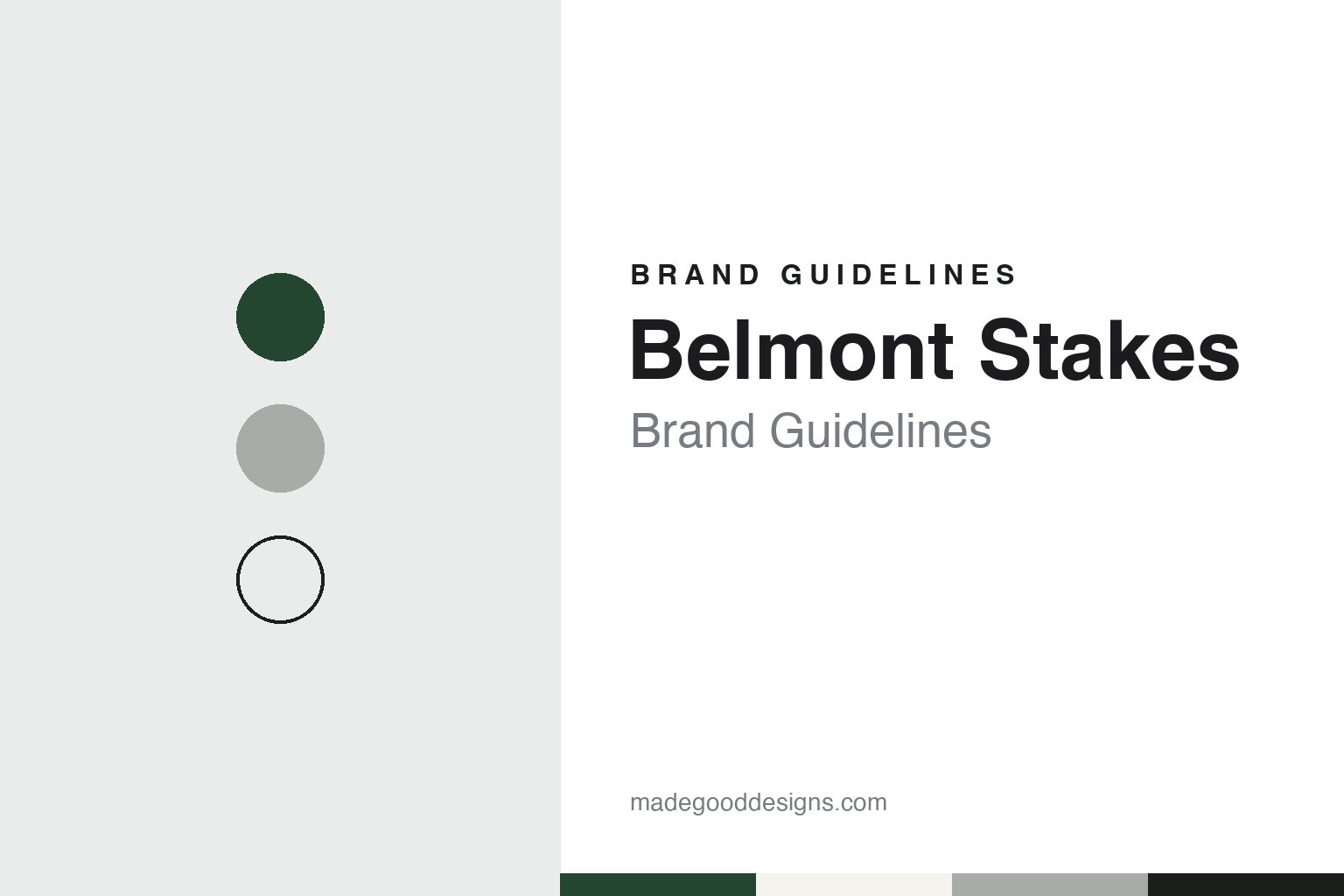
Belmont Stakes Brand Guidelines
The Triple Crown finale of white carnations and Tiffany silver.
Aa
Two constants: an infield green, carnation white and trophy silver palette and a trophy serif register. Abstract homage — not a Belmont Stakes asset; no trophy, logo or sign is reproduced.
Jerome Park, 1867
A race named after a financier.
The Belmont Stakes is a Grade I race for three-year-old thoroughbreds and the traditional third and final leg of the American Triple Crown. Its home is Belmont Park in Elmont, New York, just outside the New York City borough of Queens, and its standard distance is 1 1/2 miles, one full lap of the main track, English Wikipedia says. It is nicknamed “The Test of the Champion” and “The Run for the Carnations”, and is usually run in early June, five weeks after the Kentucky Derby.
It began at Jerome Park in the Bronx, a racetrack built in 1866 by Leonard Jerome and financed by August Belmont Sr., after whom the race is named. The first Belmont was run in 1867 and won by a filly, Ruthless. The first post parade in the United States took place at the 14th running, in 1880, English Wikipedia says.
The race moved several times. It stayed at Jerome Park until 1890, then moved to the nearby Morris Park Racecourse, and in 1905 to the new Belmont Park, which opened on 4 May that year. English Wikipedia says the park was built by August Belmont Jr., William Collins Whitney and other investors, with Arthur Underhill as engineer and landscape architect. The race was not run in 1911 and 1912, when state legislation closed racing in New York. Until 1921 it was run clockwise, in the English manner; since then it has been run counter-clockwise, in the American direction. Since 1900 it has been run, with one exception, at a level weight of 126 pounds, with an allowance for fillies.
The race is run by the New York Racing Association (NYRA), the not-for-profit corporation that operates both Belmont Park and Saratoga Race Course, English Wikipedia says.
Colour
Carnations, silver and a song.
Where the Kentucky Derby has roses and the Preakness has black-eyed Susans, the Belmont has white carnations. The winner is draped with a blanket of them after the race; English Wikipedia says it takes about 700 carnations to make, and that the origin of the carnation as the race’s flower is unknown.
The trophy is silver. Designed by Paulding Farnham for Tiffany & Co., it was first presented to August Belmont Jr. in 1896 and donated by the Belmont family for annual presentation in 1926, English Wikipedia says. The winning owner keeps it for a year and receives a silver miniature to keep for good.
The music has changed more than the flowers. Until 1996 the post parade song was “The Sidewalks of New York”; from 1997 a Frank Sinatra recording of “Theme from New York, New York” was used, replaced for one year in 2010 before returning in 2011, English Wikipedia says. The official drink has changed too, from the White Carnation to the Belmont Breeze in 1997 and to the Belmont Jewel in 2011.
The racecourse carries its own names and relics. Belmont Park’s main dirt track is nicknamed “the Big Sandy” for its size, and the park is also called “The Championship Track”. English Wikipedia notes two features kept from the original park: four stone pillars, a gift from Charleston, South Carolina, that once stood at the entrance of the Washington Course there, and racing-motif iron railings from the old grandstand, salvaged when it was demolished in 1963.
Typography
Design and documentation.
Horse races, race meetings and racecourses present themselves through a small set of lasting things: a race name, a place and a date in the calendar. Many of the oldest names come from people or places. English Wikipedia says the Derby at Epsom took its name from the 12th Earl of Derby in 1780, and that the name was later borrowed by races in Ireland, France, Germany, Italy, the United States and Japan. Other names record a sponsor, a patron or a change of venue, and renamings and moves are part of each event’s history.
The racecourse is the main stage. Grandstands are often named, rebuilt and renamed over the decades: at Cheltenham the Princess Royal Stand opened in 2015, and at Epsom the main stand was renamed the Queen Elizabeth II Stand in 2022, according to English Wikipedia. The ground matters too, from Cheltenham’s amphitheatre under the Cotswold escarpment to the open downs at Epsom, where part of the crowd has always watched for free.
Objects carry the rest of the identity, and a trophy can become an emblem of a race: The Jockey Club says the original 1924 Cheltenham Gold Cup returned to the course in 2018 and is now presented as a perpetual trophy. Racecards, posters and paintings add a printed and painted record, as William Powell Frith’s The Derby Day of 1858 shows.
Behind each event stands an organiser or owner. In Britain, The Jockey Club owns and operates both Cheltenham and Epsom Downs. This guide describes each race or racecourse through dated facts: when it was first run, who organises it, where it has been held and how its name and buildings have changed.
Aa
A trophy serif for a race of silver and white carnations. (Specimen set in Cormorant Garamond, a serif STAND-IN; NOT the Belmont Stakes logo.)
Belmont Park
Three summers at Saratoga, then a new grandstand.
Belmont Park has been rebuilt twice. The original grandstand was demolished in 1963, and the race was held at Aqueduct Racetrack from 1963 to 1967 while a new grandstand, designed by Arthur Froehlich, was built; it opened on 20 May 1968. That second grandstand held its last day of racing on 9 July 2023 and was demolished between March and June 2024, English Wikipedia says. In 2020 the race was an exception of another kind: the 152nd Belmont was run on 20 June 2020 without spectators, as the opening leg of the Triple Crown for the first time, over a shortened 1 1/8 miles.
During the latest rebuild NYRA moved the race north to Saratoga Race Course in Saratoga Springs. The 2024 and 2025 editions were run there over 1 1/4 miles, because Saratoga’s dirt track is smaller, and in June 2025 it was announced that the 2026 race would also be held at Saratoga, English Wikipedia says. The 158th Belmont, on 6 June 2026, was the third and final Belmont at Saratoga, the Associated Press reported. Golden Tempo won from a field of nine, ridden by Jose Ortiz and trained by Cherie DeVaux, five weeks after winning the Kentucky Derby; the AP noted that DeVaux was the first woman to train a Kentucky Derby winner and the second in four years to train a Belmont winner.
The new Belmont Park opened on 18 September 2026. New York State said that day that its centrepiece is a new five-storey grandstand and clubhouse of about 300,000 square feet, designed by the architecture firm Populous in conjunction with NYRA, and that NYRA had built four new racing surfaces: the traditional 1 1/2-mile dirt track, two turf courses and a one-mile Tapeta oval. The opening day drew a sold-out crowd of 6,000, the state said, with the upper floors of the grandstand still being fitted out.
For a design guide, the Belmont Stakes shows how a race can keep a steady identity — a Tiffany trophy, a carnation blanket, a family name — through five racecourses and two rebuilt grandstands. Compare Saratoga Race Course, which hosted the race from 2024 to 2026, and Preakness Stakes, the Triple Crown’s middle leg. For this guide we use an infield green, carnation white and trophy silver with a serif, an unofficial interpretation; no product or logo is reproduced.
Explore & save
Keep Belmont Stakes’s identity on hand — save it to a board in the Made Good inspiration library.
Belmont Stakes identity set
Pin the Belmont Stakes infield green, carnation white and trophy silver palette and the trophy serif register to your own board.
Source & notes
Frequently Asked Questions
What font can I use to match the Belmont Stakes look?
This guide describes Belmont Stakes’ type as “A trophy serif for a race of silver and white carnations”. Its type specimen is set in Cormorant Garamond from Google Fonts as a stand-in; Cormorant Garamond is not Belmont Stakes’ own lettering.
What colours are in the Belmont Stakes palette?
This guide’s Belmont Stakes palette is Infield green #24452F, Carnation white #F5F3EE, Trophy silver #A8ABA6, Paddock ink #1B1F1C and Racecard paper #FAF9F6. The tones are the guide’s own unofficial interpretation, not official Belmont Stakes hex codes.
Where is Belmont Stakes based?
Belmont Stakes is based in Belmont Park, Elmont (reopened 18 September 2026).