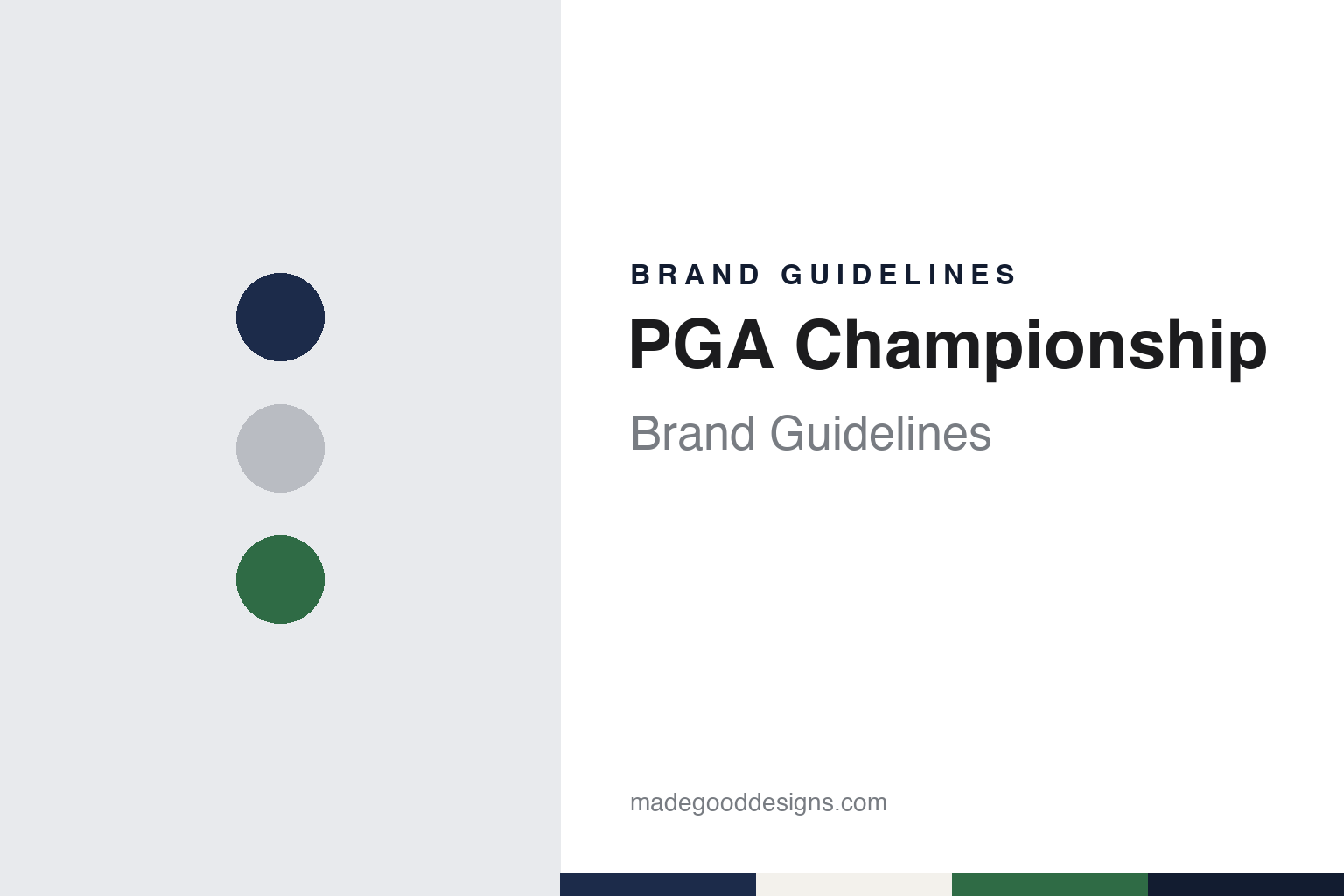
PGA Championship Brand Guidelines
The professionals’ major, played since 1916 for the Wanamaker Trophy.
Aa
Two constants: a navy, silver and fairway green palette and a classic serif register. Abstract homage — not a PGA Championship asset; no trophy, logo or mark is reproduced.
Founded 1916
A professionals’ championship from New York.
The PGA Championship is run by the Professional Golfers’ Association of America, the body for club and teaching professionals. English Wikipedia describes it as one of the four men’s major championships and the only one of the four that is exclusively for professional players; outside the United States it is often called the US PGA or USPGA. The tournament and its organiser were born in the same year. In January 1916, according to English Wikipedia, the department store owner Rodman Wanamaker hosted a luncheon for leading golf professionals at the Wykagyl Country Club in New Rochelle, New York, where the agenda for a professional association was drawn up; the PGA of America was established in New York City in February 1916, with Robert White, a Wykagyl professional, as its first president.
The first championship followed that autumn. Golf Monthly, in a 2012 history, records that England’s Jim Barnes won the inaugural PGA Championship at Siwanoy Country Club in New York, and won again when the event returned to the schedule after the First World War. The magazine calls the PGA the third oldest of the four majors, after the Open (1860) and the US Open (1894). English Wikipedia dates the first edition to October 1916 and places Siwanoy in Bronxville.
For four decades it was a match-play event. Golf Monthly says the competition was played as match play until 1958; English Wikipedia adds that after the 1957 edition the PGA voted in November to change to stroke play, with the standard 72 holes over four days, Thursday to Sunday, from 1958, and that television broadcasters had pressed for the change. The organisations around the event have since separated: English Wikipedia notes that the PGA Tour has been independent of the PGA of America since December 1968, while the championship is still run by the PGA of America.
Colour
The Wanamaker Trophy and a moving date.
The tournament’s central object is the Wanamaker Trophy, which Golf Monthly says Wanamaker donated for the inaugural event. English Wikipedia describes it as standing nearly 75 centimetres tall and weighing about 12 kilograms. The champion keeps the trophy for one year and also receives a smaller keeper replica, according to the same article.
The trophy has its own story. English Wikipedia says it went missing for several years in the 1920s while in the care of Walter Hagen, who said he had entrusted it to a taxi driver, and that it turned up in 1930 in the cellar of L.A. Young and Company, the firm that made Hagen’s clubs. The original must be returned each year, the article adds, so the cup handed over on the final green travels from champion to champion.
The calendar has moved several times. English Wikipedia records that the championship varied between May and December in its match-play years, was first held in August in 1965, moved to late February in 1971 for an edition played in Florida, and was held in late July in 2016. For years it was promoted as the season’s last major under the slogan “Glory’s Last Shot,” which was dropped in 2013; for a time afterwards it used “This is Major.”
A further change was announced in August 2017. Sky Sports reported on 8 August 2017 that PGA Tour and PGA of America officials had confirmed the PGA Championship would move from August to May from 2019, with Bethpage Black hosting that year’s edition from 16 to 19 May and The Open becoming the season’s final major. Sky Sports noted that, since becoming a stroke-play event in 1958, the championship had only once been held outside July or August. English Wikipedia says the event is now played on the weekend before Memorial Day, as the second major of the season after the Masters, and that the PGA of America cited golf’s place in the Summer Olympics and cooler weather, which widens the choice of host courses.
Typography
Professional golf tournaments and team cups.
Professional golf tournaments and team cups present themselves through a small set of recurring elements: an event name, often joined to a title sponsor’s name, a trophy, a host course and a date in the season’s calendar. The organiser behind each event is usually named plainly, whether a professional association, a tour or a governing body, and sponsors and organisers can change over the decades while the event name carries on.
Trophies do much of the visual work. Many events are identified with a single cup that passes from one champion to the next, with a smaller replica kept by the winner, and the trophy’s history, from its donor to its travels, often becomes part of the event’s own story. Team cups add the colours of the sides that contest them.
The course is the other constant. Some events rotate between host clubs, so their identity has to travel from venue to venue; others have a permanent home, where a single hole, a clubhouse or a stretch of water becomes the image most closely tied to the event. On site, the look carries through tee markers, flags, scoreboards, grandstands and hospitality areas, all sharing the event’s name and colours during tournament week.
The events’ own histories are written as dated records: the year and venue of the first edition, changes of format such as the move from match play to stroke play, changes of date in the calendar, and the list of past host courses. This guide sets out what can be checked about each event from dated sources — who organises it, where it is played and how its format has changed — and describes the identity in words, with an unofficial palette and stand-in typefaces rather than any official mark.
Aa
A classic serif for a championship founded in 1916. (Specimen set in Libre Caslon Text, a serif STAND-IN; NOT the PGA Championship logo.)
PGA Championship
A championship without a fixed home.
The PGA Championship has no permanent venue. English Wikipedia says it has normally been played in the eastern half of the United States, with New York the most frequent host state at thirteen editions, followed by Ohio with eleven and Pennsylvania with nine. Recent editions show the spread: Bethpage Black in Farmingdale, New York, in 2019; TPC Harding Park in San Francisco in 2020, the first edition in the Bay Area; the Ocean Course at Kiawah Island Golf Resort in South Carolina in 2021; and Southern Hills Country Club in Tulsa, Oklahoma, in 2022.
The field still reflects the tournament’s origins. English Wikipedia says the championship was set up to give professionals a high-profile event at a time when the sport was largely run by wealthy amateurs, and that it reserves 20 of its 156 places for club professionals, decided by the PGA Professional Championship held in late April. It is the only major that does not explicitly invite leading amateurs, according to the same article, and it is an official money event on the PGA Tour, the European Tour and the Japan Golf Tour.
For a design guide, the PGA Championship shows how a travelling event can build its identity around one trophy and a club-professional story rather than a single course. Compare The Players Championship, which moved from May back to March in the same 2017 calendar change, and the Masters Tournament, the major that now comes before it each spring. For this guide we use a deep navy, a trophy silver and a fairway green with a serif, an unofficial interpretation; no product or logo is reproduced.
Explore & save
Keep PGA Championship’s identity on hand — save it to a board in the Made Good inspiration library.
PGA Championship identity set
Pin the PGA Championship navy, silver and fairway green palette and the classic serif register to your own board.
Source & notes
Frequently Asked Questions
What font can I use to match the PGA Championship look?
This guide describes PGA Championship’s type as “A classic serif for a championship founded in 1916”. Its type specimen is set in Libre Caslon Text from Google Fonts as a stand-in; Libre Caslon Text is not PGA Championship’s own lettering.
What colours are in the PGA Championship palette?
This guide’s PGA Championship palette is Championship navy #1C2B4A, Night ink #121C30, Trophy silver #B9BCC2, Fairway green #2F6B45 and Paper #F6F4EF. The tones are the guide’s own unofficial interpretation, not official PGA Championship hex codes.