Solheim Cup Brand Guidelines
Europe against the United States, a crystal trophy and a new course every time.
Aa
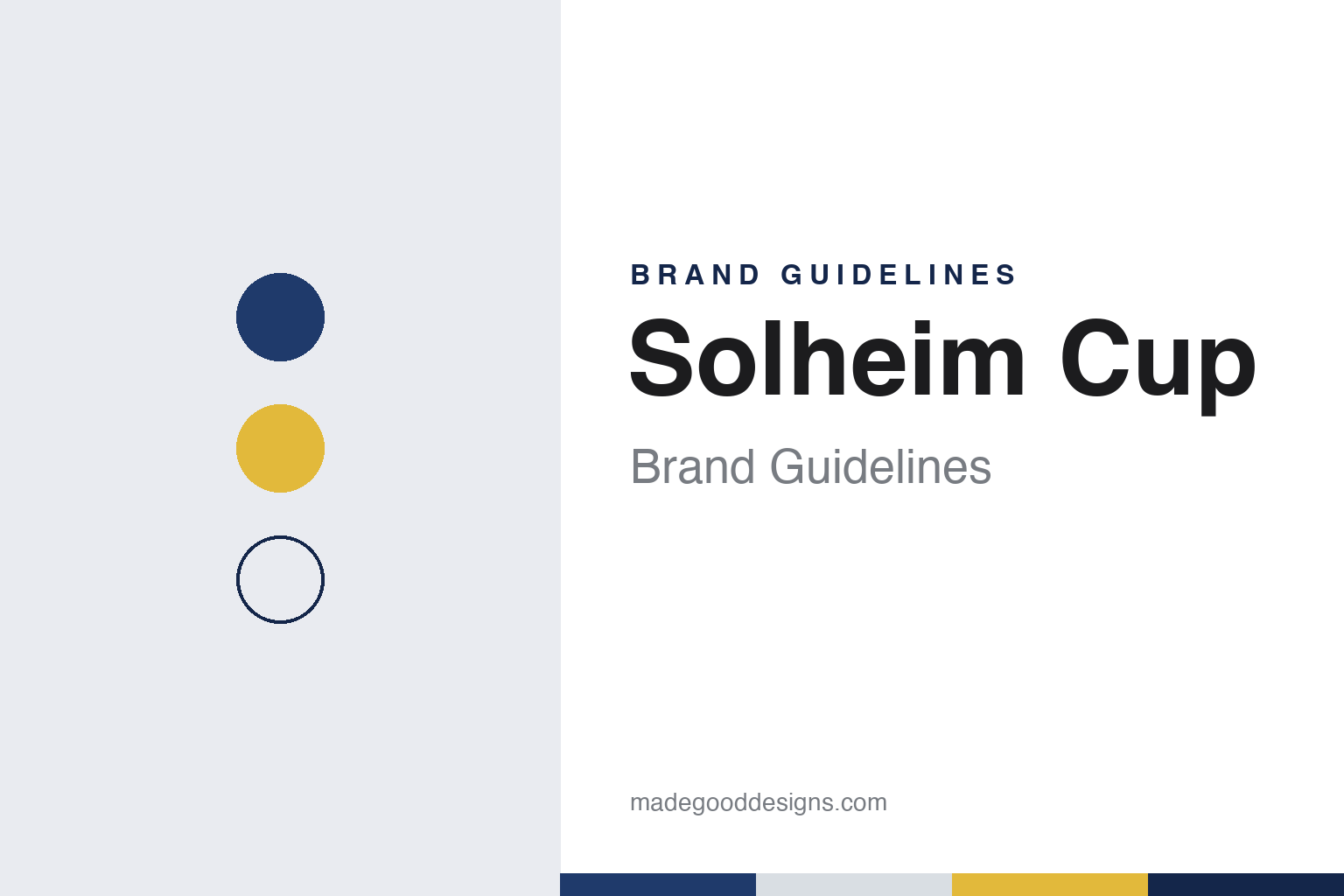
Two constants: a blue, crystal grey and yellow palette and a crystal serif register. Abstract homage — not a Solheim Cup asset or mark; no trophy, logo or flag is reproduced.
Lake Nona, 1990
A club maker’s name on a women’s team match.
The Solheim Cup is a biennial team match for professional women golfers, played between Europe and the United States. It was established in 1990 and first played that year at Lake Nona Golf & Country Club in Orlando, Florida, Golf Monthly reported in August 2023. The event takes its name from Karsten Solheim, the Norwegian-American founder of the golf-club maker PING, and his wife Louise Solheim; English Wikipedia describes Karsten Solheim as a driving force behind its creation.
According to Golf Monthly, the Solheims had sponsored LPGA events since 1975 before the idea of a women’s match in the style of the Ryder Cup was put to them, and PING has remained the sponsor of both the Solheim Cup and the Junior Solheim Cup. Their son John Solheim, who succeeded his father as chairman and chief executive of PING, told the magazine that the first match played in Europe, at Dalmahoy near Edinburgh in 1992, was an early turning point: Europe won it, and from then on the contest was closely fought.
English Wikipedia lists the LPGA Tour and the Ladies European Tour as the organisers. The match was played in even-numbered years until 2002, alternating with the men’s Ryder Cup. When the 2001 Ryder Cup was put back a year, the Solheim Cup moved to odd-numbered years from 2003, Golf Monthly explains; after the 2020 Ryder Cup was moved to 2021, the two matches shared a year in 2021 and 2023, and the Solheim Cup returned to even-numbered years from 2024.
The course changes every time. Golf Monthly notes that the match has never been held at the same venue twice, and that its European hosts have been Scotland, Wales, Sweden, Ireland, Germany, Spain and, for the first time in 2026, the Netherlands, with Scotland hosting three times. English Wikipedia’s list of venues alternates between the two sides of the Atlantic, running from Lake Nona and Dalmahoy through The Greenbrier in West Virginia, Loch Lomond, Barsebäck in Sweden, Killeen Castle in County Meath, the PGA Centenary course at Gleneagles and Finca Cortesin in Andalusia to the Robert Trent Jones Golf Club in Virginia in 2024.
Colour
Twelve a side, 28 matches, one crystal cup.
The format follows the Ryder Cup. Each side fields 12 players, with a captain and assistant captains who do not play. Since 2002 there have been 28 matches over three days, English Wikipedia says: eight foursomes and eight four-ball matches across the first two days and 12 singles on the last; before 1996, and again in 2000, a shorter version was used. Golf Monthly explains that the home captain decides whether foursomes or four-balls are played in each morning session. Every match is worth one point, a halved match gives half a point to each side, and the first team to reach 14½ points wins. If the score finishes 14–14, the holders keep the cup.
Selection mixes tour points with world rankings. For 2026 Golf Monthly described Team Europe as the two highest-ranked players on the LET Solheim Cup rankings, the top six eligible players in the Rolex Women’s World Golf Rankings and four captain’s picks, and Team USA as the top seven on the US points list, the two highest-ranked eligible players in the world rankings and three captain’s picks. English Wikipedia adds that the American points list is built from top-twenty finishes on the LPGA Tour, and that eligibility for the US side was widened from 2015.
The trophy is a large part of the event’s image. English Wikipedia describes it as cut-glass Irish Waterford Crystal, designed in 1990 by the Waterford designer Billy Briggs, standing about 19 inches tall including its mahogany base; Golf Monthly gives the same crystal and mahogany. In its report on the 2026 match, the Associated Press called it simply “the crystal trophy.”
The 2026 match was played at Bernardus Golf in Cromvoirt, in the Dutch province of North Brabant, the first Dutch host. The AP reported on 14 September 2026 that Europe, captained by Anna Nordqvist, regained the cup by 15 points to 13 after the teams went into the Sunday singles level at 8–8, with those singles played in heavy rain. The same report gave the all-time series as 11 wins for the United States and eight for Europe, with one tie: the 2023 match at Finca Cortesin, after which Europe kept the cup as holders, Golf Monthly notes.
Typography
How golf’s tournaments and team cups present themselves.
Professional golf tournaments and team cups present themselves through a small set of recurring elements: an event name, often joined to a title sponsor’s name, a trophy, a host course and a date in the season’s calendar. The organiser behind each event is usually named plainly, whether a professional association, a tour or a governing body, and sponsors and organisers can change over the decades while the event name carries on.
Trophies do much of the visual work. Many events are identified with a single cup that passes from one champion to the next, with a smaller replica kept by the winner, and the trophy’s history, from its donor to its travels, often becomes part of the event’s own story. Team cups add the colours of the sides that contest them.
The course is the other constant. Some events rotate between host clubs, so their identity has to travel from venue to venue; others have a permanent home, where a single hole, a clubhouse or a stretch of water becomes the image most closely tied to the event. On site, the look carries through tee markers, flags, scoreboards, grandstands and hospitality areas, all sharing the event’s name and colours during tournament week.
The events’ own histories are written as dated records: the year and venue of the first edition, changes of format such as the move from match play to stroke play, changes of date in the calendar, and the list of past host courses. This guide sets out what can be checked about each event from dated sources — who organises it, where it is played and how its format has changed — and describes the identity in words, with an unofficial palette and stand-in typefaces rather than any official mark.
Aa
A crystal serif — formal, engraved, trophy-like. (Specimen set in Cormorant Garamond, a serif STAND-IN; NOT the Solheim Cup logo.)
Blue on the board
Two team colours, one trophy, a moving stage.
The Solheim Cup’s look is built from team colours, flags and a single trophy rather than from one fixed course. In the AP’s account of the 2026 finish, Europe went out fast in the singles, “putting blue all over the scoreboard,” and the captain lifted the cup on a podium “to a backdrop of blue-and-yellow smoke” in front of a first-tee grandstand, while players and staff draped flags over their shoulders. That first-tee grandstand, the scoreboard and the trophy presentation are the recurring set pieces; the course around them is new each time.
The name itself carries a company story. The cup is named after the founders of PING, and Golf Monthly reports that the company has continued as sponsor into a third decade; the match, though, is organised with the two women’s tours, and a club maker’s own identity is a separate subject from the event’s. The same holds for the trophy: its Waterford Crystal maker and designer are part of the event’s record, not of its branding.
The calendar is part of the identity too. Because the Solheim Cup sits in alternate years to the Ryder Cup, its dates have moved twice since 1990, and each move was announced as a plain change of schedule.
For a design guide, the Solheim Cup shows how a team event can hold its identity in colour, a trophy and a format while the setting changes completely every two years. Compare the Ryder Cup, the men’s Europe v United States match whose calendar it mirrors, and the Presidents Cup, another biennial team match. For this guide we use a deep lake blue, a crystal grey and a smoky yellow with a serif, an unofficial interpretation; no product or logo is reproduced.
Explore & save
Keep Solheim Cup’s identity on hand — save it to a board in the Made Good inspiration library.
Solheim Cup identity set
Pin the Solheim Cup blue, crystal grey and yellow palette and the crystal serif register to your own board.
Source & notes
Frequently Asked Questions
What font can I use to match the Solheim Cup look?
This guide describes Solheim Cup’s type as “A crystal serif — formal, engraved, trophy-like”. Its type specimen is set in Cormorant Garamond from Google Fonts as a stand-in; Cormorant Garamond is not Solheim Cup’s own lettering.
What colours are in the Solheim Cup palette?
This guide’s Solheim Cup palette is Lake blue #1F3A6B, Night blue #14264A, Crystal grey #D9DEE3, Smoke yellow #E2B93B and Paper #F7F6F2. The tones are the guide’s own unofficial interpretation, not official Solheim Cup hex codes.