Evian Championship Brand Guidelines
The Lake Geneva major that began as the Evian Masters.
Aa
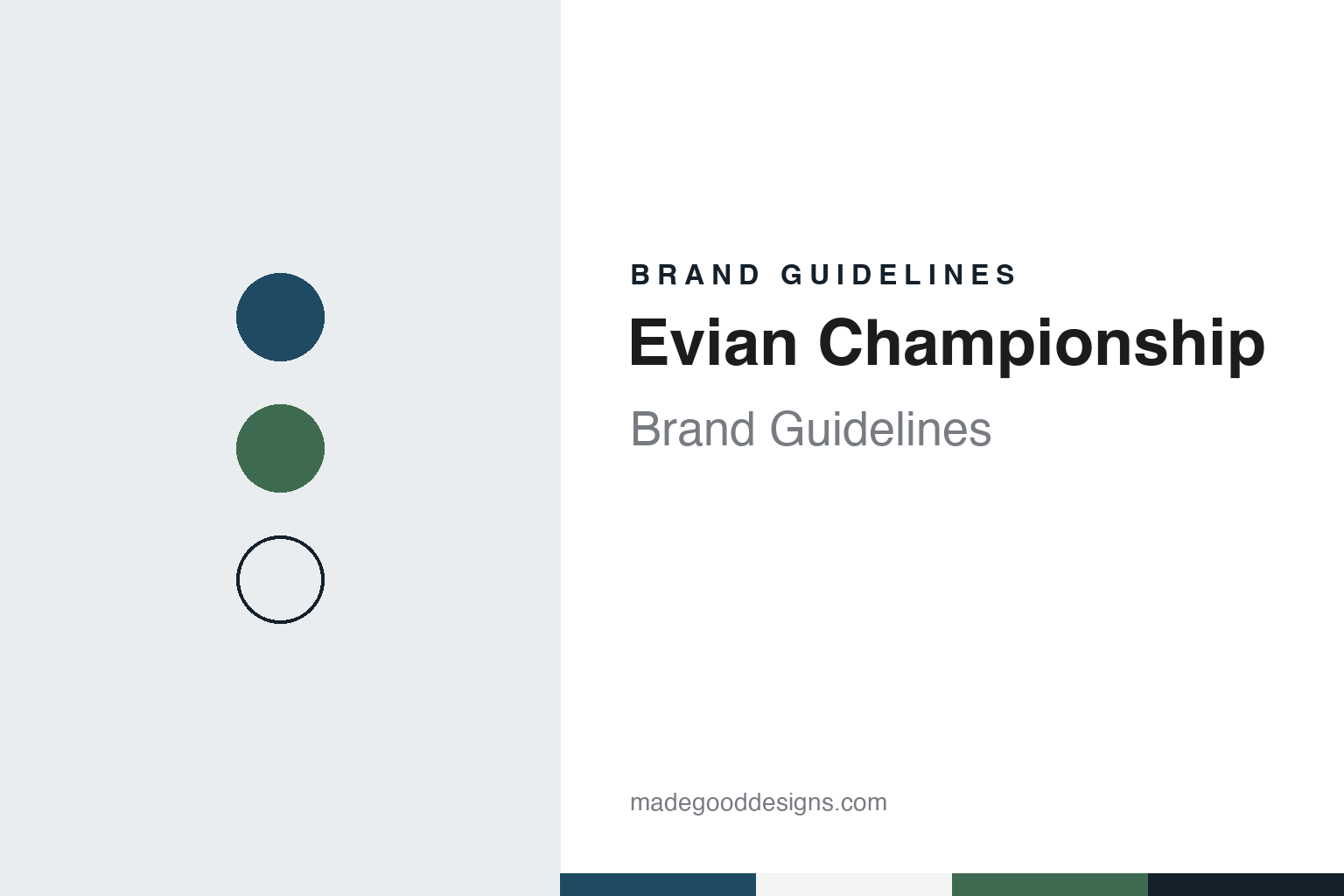
Two constants: a lake blue, alpine green and snow palette and a lakeside serif register. Abstract homage — not an Evian Championship asset or mark; no trophy, logo or flag is reproduced.
Evian Masters
A Ladies European Tour event above Lake Geneva, 1994.
The Evian Championship began in 1994 as the Evian Masters, a tournament on the Ladies European Tour played at Évian-les-Bains in Haute-Savoie, on the French shore of Lake Geneva. English Wikipedia and National Club Golfer, in a history of the event published in June 2025, agree on that starting point. Sweden’s Helen Alfredsson won the first edition, National Club Golfer says, and won again in 1998 and 2008, which makes her the only three-time winner of the Evian Masters.
For its first six years the event belonged to the Ladies European Tour alone. From 2000 it was co-sanctioned by the LPGA Tour as well, so that it sat on the schedules of both the European and the American women’s tours. The calendar moved over the same period: English Wikipedia records the tournament in June from 1994 to 2002 and in late July from 2003 to 2012.
The field grew too. Before 2007 the event had 78 players, about half the size of a full LPGA field, and no cut, so every player completed all four rounds, English Wikipedia says. From 2007 the field rose to 90 players, with a cut after the second round, and in 2010 it was increased to 111 players. Under the cut, the players with the lowest 70 scores, and anyone tied for 70th place, go on to play all four rounds, while the rest of the field leaves after the second round, Wikipedia explains.
Colour
From Masters to major.
The tournament’s identity changed in July 2011, when the LPGA announced that from 2013 the Evian Masters would be renamed The Evian Championship, become the fifth major on its schedule and move to September, English Wikipedia says, citing the LPGA announcement of 20 July 2011 and a report by ESPN. The Ladies European Tour counts it as one of its two majors.
The 2013 edition was the first played as a major. Norway’s Suzann Pettersen won it, and National Club Golfer describes that 2013 event as the first major held in continental Europe. The same magazine calls the championship the youngest of the nine major championships in men’s and women’s professional golf.
The September date did not last. From 2013 to 2018 the championship was the final women’s major of the year. After the 2017 edition was shortened to 54 holes, the LPGA’s commissioner said the move to September had been a mistake, English Wikipedia says, citing Bunkered, and the event returned to a July date in 2019, following an LPGA announcement of March 2018. Wikipedia’s article on the course now lists it as the fourth major of the women’s season.
The roll of champions since 2013 has been wide. In the event’s first 12 years as a major there was no repeat winner, National Club Golfer noted in June 2025, and players from eight different nationalities had won it; South Korea was the only country with more than one champion over that span.
A title sponsor arrived next. In February 2021 the organisers and the French asset manager Amundi jointly announced that Amundi had become title sponsor from the 2021 event, English Wikipedia says, citing the LPGA’s release of 1 February 2021. The tournament has since been played as The Amundi Evian Championship, and National Club Golfer also dates that name change to 2021.
Typography
Event identity, venue and format.
Professional golf tournaments and team cups present themselves through a small set of recurring elements: an event name, often joined to a title sponsor’s name, a trophy, a host course and a date in the season’s calendar. The organiser behind each event is usually named plainly, whether a professional association, a tour or a governing body, and sponsors and organisers can change over the decades while the event name carries on.
Trophies do much of the visual work. Many events are identified with a single cup that passes from one champion to the next, with a smaller replica kept by the winner, and the trophy’s history, from its donor to its travels, often becomes part of the event’s own story. Team cups add the colours of the sides that contest them.
The course is the other constant. Some events rotate between host clubs, so their identity has to travel from venue to venue; others have a permanent home, where a single hole, a clubhouse or a stretch of water becomes the image most closely tied to the event. On site, the look carries through tee markers, flags, scoreboards, grandstands and hospitality areas, all sharing the event’s name and colours during tournament week.
The events’ own histories are written as dated records: the year and venue of the first edition, changes of format such as the move from match play to stroke play, changes of date in the calendar, and the list of past host courses. This guide sets out what can be checked about each event from dated sources — who organises it, where it is played and how its format has changed — and describes the identity in words, with an unofficial palette and stand-in typefaces rather than any official mark.
Aa
A calm, lakeside serif for event names and dates. (Specimen set in Cormorant Garamond, a serif STAND-IN; NOT the Evian Championship logo.)
Evian Resort Golf Club
One course above the lake since 1994.
The championship has never changed course. The Evian Resort Golf Club, also known as the Domaine du Royal Club Evian, has hosted it since the first edition in 1994, National Club Golfer says. English Wikipedia describes a par-71 course overlooking Lake Geneva to the north, at an average elevation of about 480 metres above sea level.
Ahead of the move to major status the course was reworked. English Wikipedia says the whole layout, with particular attention to the tees, fairways, greens and bunkers, was renovated in 2012–13 to a design by the architect Steve Smyers with European Golf Design, citing a Golf Channel report of September 2013.
The event’s name has taken three forms: the Evian Masters from 1994, The Evian Championship from 2013 and The Amundi Evian Championship from 2021. Through each change the town of Évian-les-Bains and the single course have stayed constant, and the September years from 2013 to 2018 are the only break in a summer calendar that otherwise runs from June and July.
For this guide’s interpretation, the palette takes its cue from the setting the sources describe: a deep blue for the lake below the course, a muted green for the slopes, and a soft white and pale grey as quiet grounds for dates, venue names and results. A classical serif carries the event name, with a plain sans for the supporting text. In a timeline or results archive, the three names can sit as three dated bands along a single line, with the town and the course as the fixed axis beneath them, and the green can mark the major years from 2013 onwards without needing any trophy or flag artwork.
For a design guide, the Evian Championship shows how a tournament can keep one fixed setting while its name, sanctioning and status change around it. Compare AIG Women’s Open, the other women’s major recognised by both the Ladies European Tour and the LPGA, and Solheim Cup, the women’s team match. For this guide we use a deep lake blue, an alpine green and a soft snow white with a serif, an unofficial interpretation; no product or logo is reproduced.
Explore & save
Keep Evian Championship’s identity on hand — save it to a board in the Made Good inspiration library.
Evian Championship identity set
Pin the Evian Championship lake blue, alpine green and snow palette and the lakeside serif register to your own board.
Source & notes
Frequently Asked Questions
What font can I use to match the Evian Championship look?
This guide describes Evian Championship’s type as “A calm, lakeside serif for event names and dates”. Its type specimen is set in Cormorant Garamond from Google Fonts as a stand-in; Cormorant Garamond is not Evian Championship’s own lettering.
What colours are in the Evian Championship palette?
This guide’s Evian Championship palette is Lake blue #1F4A63, Ink #14202A, Alpine green #3E6B4F, Snow #F3F5F2 and Morning mist #DCE4E6. The tones are the guide’s own unofficial interpretation, not official Evian Championship hex codes.