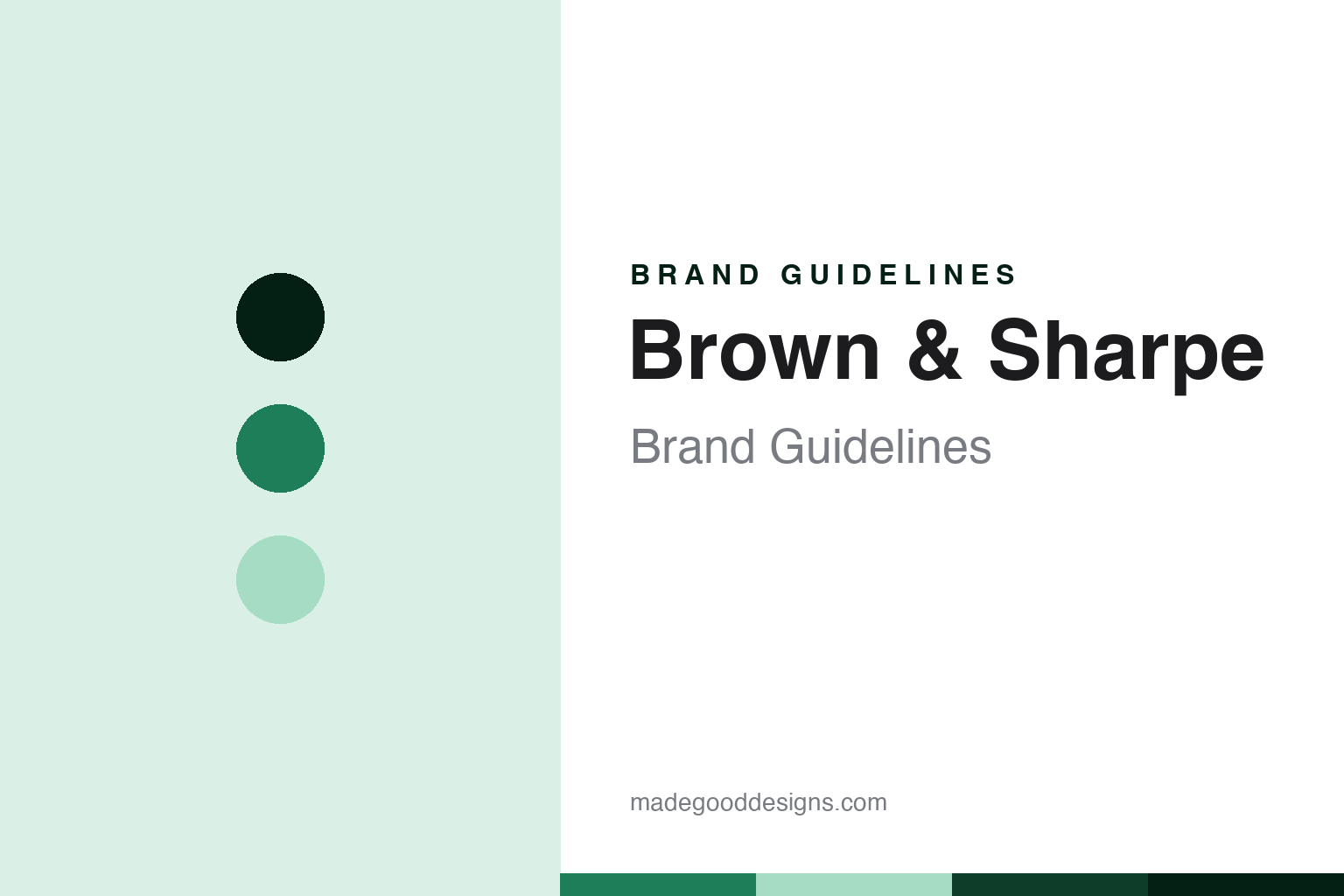
Brown & Sharpe Brand Guidelines
The American heritage name, now Swedish-owned.
Aa
Two constants: a heritage-green palette and a heritage-sans register. Abstract homage — not a Brown & Sharpe product or mark; no caliper, gauge or logo is reproduced.
The American heritage name, now Swedish-owned
Brown & Sharpe is an 1833 Providence metrology pioneer — whose name and instruments have belonged to Sweden’s Hexagon since 2001.
Brown and Sharpe follows TESA as the round’s second foreign-owner twist — one of the oldest names in American precision measurement, whose metrology business and name have belonged to a Swedish group for two decades. Its answer to a round about who owns the measuring tools is the storied-name one: an American heritage brand now owned abroad.
Its identity is the American heritage name, now Swedish-owned. The 1833 Providence founding, the Brown and Sharpe partnership and the Hexagon ownership are the story here. American roots, Swedish parent. The American heritage name, now Swedish-owned.
(Honest notes, so the founding, the ownership, the making and two corrections are framed accurately. Brown and Sharpe is associated with the archetypal precision hand tools — the micrometer, the vernier caliper, the height gauge and the gauge block — and later coordinate measuring machines; we report its heritage as documented. On founding: the company was founded in 1833 in Providence, Rhode Island, by David Brown and his son Joseph R. Brown, and in 1853 Joseph R. Brown partnered with Lucian Sharpe, giving the enduring Brown and Sharpe name. On ownership, verified and dated: the metrology business, along with the name and trademarks, was acquired by Sweden’s Hexagon in 2001, and today Brown and Sharpe is a metrology brand within Hexagon Manufacturing Intelligence, a division of the Swedish, Stockholm-listed Hexagon. On two corrections: the company’s machine-tool production ended in 1991, and we do not claim that line was cleanly sold to another maker, since that is not supported; and Hexagon’s 2026 spin-off of a software company did not include the metrology business, which stayed with Hexagon. On the making: within Hexagon’s global metrology operations, so we do not assert a single country. There is no official brand hex; these tones are an unofficial interpretation.)
Colour
Brown & Sharpe lives in a heritage green. Click a swatch to copy the hex.
Brown and Sharpe’s identity is heritage, Hexagon-owned and storied — a heritage green, an ink, a pale green, a deep pine, and a paper. The palette leans heritage green and deep pine: a solid, established register that nods to a long American precision lineage rather than a loud logo colour. It signals the American heritage name, now Swedish-owned — heritage, Hexagon-owned and storied. The honest caveat: with no official brand hex, and only Hexagon’s green identity documented, these values are an established, unofficial interpretation, not first-party colours.
The lesson is a heritage green signals an old, storied identity. Brown and Sharpe’s world is nearly two centuries of precision. For designers, it is a reminder that a solid green and a pale green can carry a heritage, precision brand — an established tone held as an accent, not a product shot. Because a mid hue can fail as small text, keep type dark and let the colour live in the accents, palette and band. The takeaways: date the founding to 1833 and Providence with the 1853 partnership; name the Hexagon ownership since 2001; correct the machine-tool end in 1991 without a sale claim; and note the metrology business stayed with Hexagon through the 2026 software spin-off.
Typography
The register is a heritage sans — heritage, Hexagon-owned, storied.
Brown and Sharpe’s identity carries a heritage, Hexagon-owned spirit — an old American name held by a Swedish group. A heritage sans captures the mood: clean, solid and established, the register of a storied maker. Set in a heritage-green palette, the heritage sans feels dependable and rooted — exactly the personality Brown and Sharpe carries. It behaves like a made, historic thing rather than a loud logo, mirroring a heritage-rule and a vernier-line. (Brown and Sharpe’s real products and the name are things we describe but do not reproduce, and the exact typeface is not ours to use.) Because it is not ours to use, the honest description is “a heritage-sans brand,” shown here in a stand-in. The type behaves like the brand: heritage, Hexagon-owned and storied.
Aa
A heritage-sans brand — dependable and rooted. (Specimen set in Sora, a heritage-sans STAND-IN; NOT the Brown & Sharpe logo or products.)
The measuring node
Brown & Sharpe stands for the American heritage name, now Swedish-owned.
Brown and Sharpe sits fourth in the round as its second foreign-owner twist. A heritage-green palette, a heritage sans and an 1833 founding make one thing — the American heritage name, now Swedish-owned — the whole identity: heritage, Hexagon-owned and storied. The 1833 Providence founding is the pitch, the Hexagon ownership is the frame, and the archetypal instruments are the substance. The point is an American heritage brand now owned abroad, in a round about who owns the measuring tools.
Put to work, the identity is the brand told straight, the ownership named and two corrections made. A brand in this spirit would date the founding to 1833 and Providence with the 1853 partnership, name the Hexagon ownership since 2001, correct the machine-tool end in 1991 without a sale claim, and note the metrology business stayed with Hexagon through the 2026 software spin-off. A reader in this spirit would keep the facts right: Brown and Sharpe is associated with the micrometer, the vernier caliper and the height gauge; it was founded in 1833 in Providence by David and Joseph R. Brown, with Lucian Sharpe joining in 1853; it has belonged to Sweden’s Hexagon since 2001; and it is made within Hexagon’s global operations. Brown and Sharpe sits after TESA and before Sylvac. The honest editorial moves are to date the founding, to name the owner, to correct the machine-tool end, and to keep the metrology business with Hexagon.
For designers and brand-builders, Brown and Sharpe carries the measuring node: date a two-century founding — and correct what did not happen. The lessons: a brand can be one of the oldest names in its category, here Brown and Sharpe; a founding is dated to 1833 in Providence, Rhode Island, by David Brown and his son Joseph R. Brown, with Joseph R. Brown and Lucian Sharpe partnering in 1853 to give the enduring name; an ownership is named, the metrology business and name acquired by Sweden’s Stockholm-listed Hexagon in 2001, today a brand within Hexagon Manufacturing Intelligence; a correction is made, that machine-tool production ended in 1991 without a supported claim of a clean sale of that line; and a second correction is made, that Hexagon’s 2026 software spin-off did not include the metrology business, which stayed with Hexagon. It is also a reminder to stay precise: Brown and Sharpe is the American heritage name, now Swedish-owned, of the measuring aisle — with the palette here an unofficial interpretation. The hook is that lineage: Brown and Sharpe is the American heritage name, now Swedish-owned, an 1833 Providence metrology pioneer whose name and instruments have belonged to Sweden’s Hexagon since 2001. Read that way, Brown and Sharpe is less a single caliper than the American heritage name, now Swedish-owned: heritage, Hexagon-owned, storied. The lesson for a brand is that dating a two-century founding and correcting what did not happen reinforce the honesty, and naming the owner keeps it earned. Brown and Sharpe made the-American-heritage-name-now-Swedish-owned the identity — proof that an honestly-owned heritage can anchor a node.
Explore & save
Keep Brown & Sharpe’s identity on hand — save it to a board in the Made Good inspiration library.
Brown & Sharpe identity set
Pin the heritage-green palette and the heritage-sans register to your own board.


