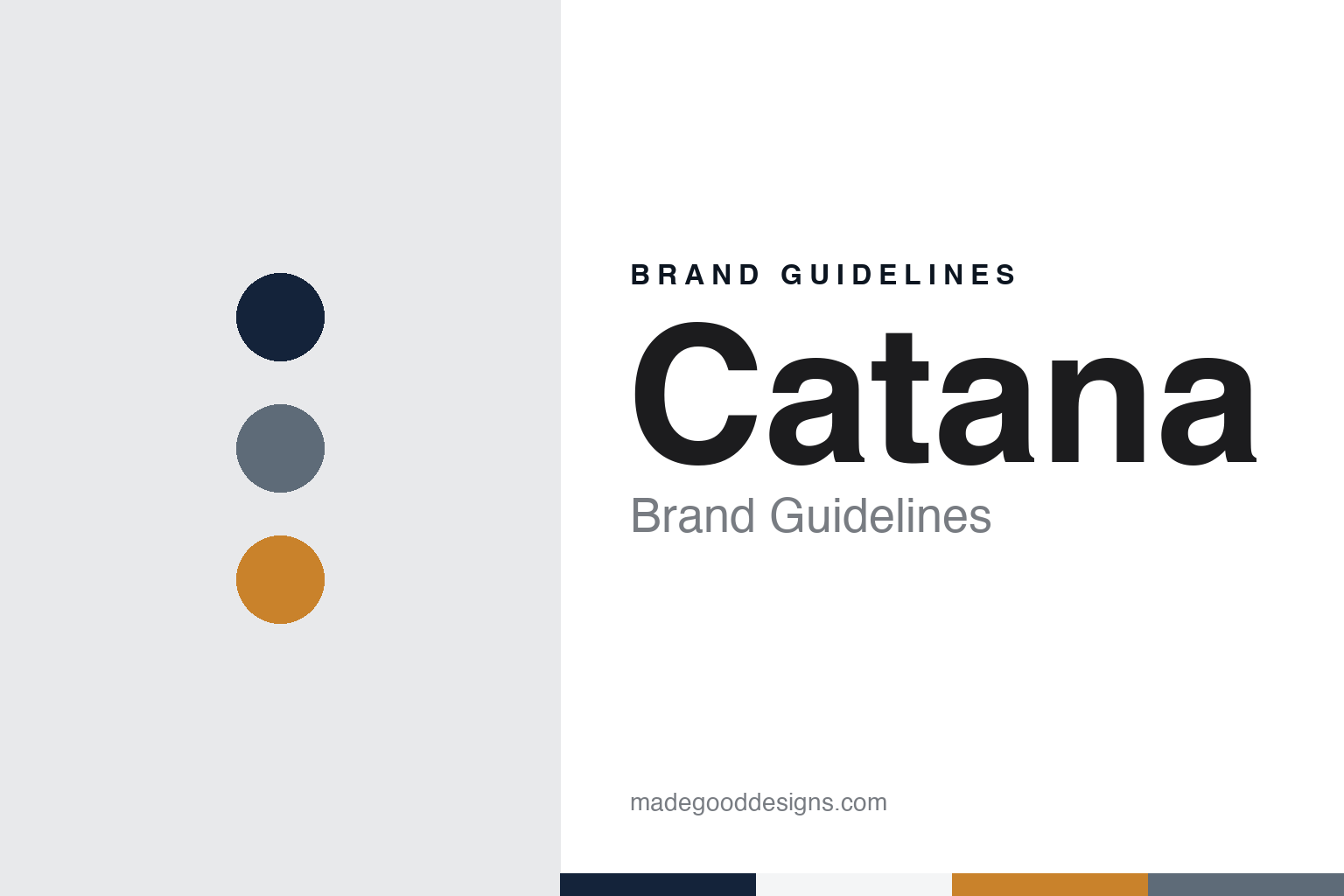
Catana Brand Guidelines
A Var yard of 1984 that became the name of a catamaran group.
Aa
Two constants: a navy, steel and white palette and a condensed sans register. Abstract homage — not a Catana product or mark; no boat, logo or hull graphic is reproduced.
Cogolin, 1984
Two engineers and a Lock Crowther design.
Catana began in 1984 at Cogolin, near Saint-Tropez in the Var. According to a history published by the Swiss sailing magazine Skippers on 28 November 2024, the company grew out of a meeting between two engineers, Jean-Pierre Prade and Thierry Goyard, who asked the naval architect Lock Crowther to design an uncluttered catamaran for them. The result, the Catana 40 named Pêcheur de Lune, was built on a shoestring in Cogolin; it came without a fitted interior, and its outboard motor sat on a bracket. A photo caption in the same history says that this boat, the yard’s opening model, is still sailing.
The early yard was small. Skippers says it was short of capital and equipment, with no overhead crane, sat some seven kilometres from the sea and built five or six catamarans a year. In 1989 the architect Christophe Barreau designed the Catana 42, of which 33 were built. The brand’s own website still dates its start to Cogolin in 1984 and describes a first generation of boats that laid down the direction of its design.
In 1992 the company ran into difficulties. Olivier Poncin, then head of the monohull builder Dufour, came close to an agreement with Catana, Skippers reports, but it was never signed, and Poncin went on to set up Nautitech instead. Catana looked for other financial partners and in 1997 moved to Canet-en-Roussillon, near Perpignan, where it is still based. The brand’s website calls the Canet years its second generation, with larger boats designed for long voyages, among them the Catana 581.
Colour
Bankruptcy, then a new owner.
Ownership changed twice in a few years. In 1999, Skippers says, the owner of a Catana catamaran, Yves Gallot-Lavallée, took control of the yard and moved the boats towards comfort, offering much better equipped catamarans to an older clientele; the magazine adds that the boats became heavier. Catana went bankrupt in 2003.
The administrator, Skippers reports, had four bids in front of him, and the one from Olivier Poncin was judged the most credible. Eleven years after his first approach, Poncin bought the yard in 2003. Catana Group’s own history says simply that in 2003 he saw the demand for catamarans and bought the Catana brand. He led the business for twenty years, the magazine says. Writing in 2015, SAIL described Catana as the established catamaran builder behind the new Bali line.
Under the new owner, a fourth generation of designs, six or seven models in all, was ordered from Christophe Barreau, according to Skippers. When Barreau moved on to other projects, Catana asked his design office for a range of larger and more luxurious cruising catamarans, beginning with a 59-foot boat that replaced the 581 of 2000 and followed by 70- and 63-foot models. In 2014 Poncin told the magazine that he wanted to keep the Catana heritage of hulls and decks in PVC foam sandwich.
That same year the yard launched a second brand. Bali Catamarans was reported by the German magazine Yacht on 1 August 2014 as a line of comfortable cruising catamarans, set apart in concept from the sporty Catana range, and its opening model was unveiled at Cannes that September. Catana Group says it saw the long-distance cruising market alone as too narrow. The Skippers history observes that the growth of Bali has rather overshadowed the parent brand since then. The group that owns both brands, Catana Group, is listed on Euronext Paris, according to its investor pages, and its own site refers to the Canet works as the Catana-Bali yard.
Typography
Builders and their brands.
Catamaran and trimaran builders present themselves through a small set of public materials: the yard name, the model names, the hull graphics, the brochure and the boat-show stand. Model names usually carry a length in feet, sometimes with a word for the layout or character of the boat, and a builder’s range is often easier to follow through those numbers than through any logo.
Charter shapes the look of many of these boats. Some yards build the same hulls for private owners under their own brand and for charter companies under the charter company’s name and model number, so a single design can appear in two liveries and in two sets of brochures. Others have stepped away from charter fleets to concentrate on private owners, and say so in their own timelines.
Ownership varies widely and is set out here plainly with dates. The sector includes yards still run by their founders, brands that sit inside listed groups, builders owned by investment funds, and yards that have passed through insolvency, court-supervised restructuring or a change of shareholder. A brand and the yard that builds it are not always owned by the same company, and the corporate pages on founders and owners are usually where those links are set out.
Design credits follow the same rule. Naval architects and designers are named in this guide only where a dated source or the builder itself credits them, and hull decorations, colour codes and graphic charters are described only as the builders publish them. Nothing here is a claim about how any boat sails or behaves at sea; the palettes and typefaces shown are unofficial interpretations, not the builders’ own marks.
Aa
A condensed sans for a technical, sea-going register. (Specimen set in Saira Condensed, a sans STAND-IN; NOT the Catana logo.)
Ocean Class
A new generation inside a family group.
The Catana brand returned to new designs with the Ocean Class, the Catana OC, short for Ocean Cruise. Skippers described it in November 2024 as the opening model of a new generation, launched just over two years earlier. The brand’s website now presents a revised Ocean Class², and in July 2026 it published an interview about the newest model in the line.
Today Catana is one brand within Catana Group, the family group that Katamarans said in September 2025 was led by Olivier Poncin’s son, Aurélien Poncin. The group’s brands are Catana, Bali, the power-catamaran brand YOT, unveiled in June 2023 according to Marine Industry News, and a newer houseboat brand, Seaty. Katamarans listed production at Canet-en-Roussillon and Marans in France, El Haouaria in Tunisia and Aveiro in Portugal. The Catana website describes a yard team of 50 to 80 people and a process it calls fully integrated, from design to delivery, coordinated between architects, engineers and production specialists.
The two sailing brands are presented separately. SAIL noted in October 2015 that Catanas use daggerboards while the Bali boats have fixed keels, and the group keeps separate websites and dealer networks for each. The Catana site is organised around long-distance cruising, with sections on its forty years of history, its know-how and the Ocean Class, events such as an open-yard experience at Canet and the Miami Boat Show, and an owners’ community it calls the Catana League.
For a design guide, Catana shows how a yard can keep its founding name for long-distance cruising boats while a sister brand serves a wider market. Compare Bali Catamarans, its sister brand in Catana Group, and Nautitech, the yard Olivier Poncin set up after his first approach to Catana. For this guide we use a deep navy, steel grey and white with a condensed sans, an unofficial interpretation; no product or logo is reproduced.
Explore & save
Keep Catana’s identity on hand — save it to a board in the Made Good inspiration library.
Catana identity set
Pin the Catana navy, steel and white palette and the condensed sans register to your own board.
Source & notes
Frequently Asked Questions
What font can I use to match the Catana look?
This guide describes Catana’s type as “A condensed sans for a technical, sea-going register”. Its type specimen is set in Saira Condensed from Google Fonts as a stand-in; Saira Condensed is not Catana’s own lettering.
What colours are in the Catana palette?
This guide’s Catana palette is Night navy #14233A, Deck ink #0C1520, Steel grey #5E6B78, Hull white #F4F5F6 and Signal amber #C9822B. The tones are the guide’s own unofficial interpretation, not official Catana hex codes.
When was Catana founded?
Catana was founded in 1984, in Cogolin, France. This guide gives Canet-en-Roussillon (since 1997) as where Catana is based.
Who founded Catana?
Catana was founded by Jean-Pierre Prade and Thierry Goyard in 1984.
Who owns Catana?
Catana is owned by Catana Group (Poncin family). This guide dates Catana to 1984, in Cogolin, France.
Where is Catana based?
Catana is based in Canet-en-Roussillon (since 1997). This guide dates Catana to 1984, in Cogolin, France.