Bali Catamarans Brand Guidelines
The Canet yard’s second brand, built around one shared living space.
Aa
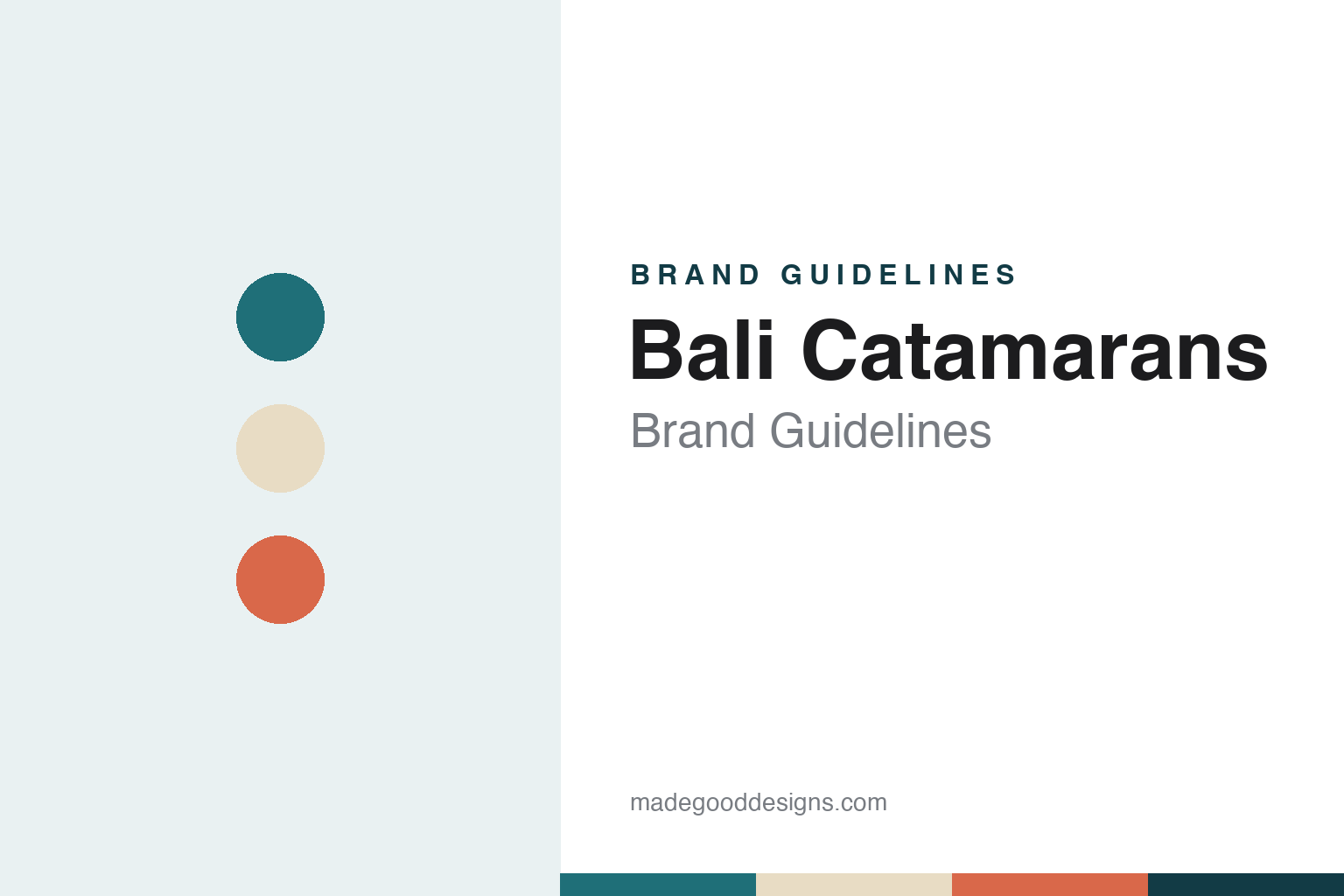
Two constants: a teal, sand and white palette and a rounded sans register. Abstract homage — not a Bali Catamarans product or mark; no boat, logo or hull graphic is reproduced.
A New Label at Canet
A Catana Group brand launched in 2014.
Bali Catamarans is a brand of Catana Group, the catamaran builder based at Canet-en-Roussillon, near Perpignan on France’s Mediterranean coast, and it sits alongside the older Catana range rather than replacing it. The German sailing magazine Yacht reported the new label on 1 August 2014. The Catana yard, it wrote, wanted to add comfortable cruising catamarans to its programme and had launched a completely new brand for them, set apart in concept from the sporty and rather exclusive Catana boats. More volume, more space inside and out, and more amenities for cruising were the stated aims.
The opening model was the 45-foot Bali 4.5. Yacht said the concept had been drawn up personally by the head of the yard, Olivier Poncin, and realised by the designer Xavier Faÿ, who, the magazine noted, had also worked for Lagoon. The Swiss sailing magazine Skippers, in a history of the group published on 28 November 2024, dates the boat’s public unveiling to the Cannes boat show in September 2014. Catana Group’s own history says the Bali 4.5 appeared that September and was followed a few weeks later by a smaller model, the Bali 4.3.
The group’s account of why the brand exists is straightforward. Poncin bought the Catana brand in 2003, the company says, and some years later concluded that the market for long-distance cruising catamarans alone was too narrow to give the business the visibility it wanted. The decision was then taken to go after the largest part of the sailing multihull market, where competition was already well established. Skippers reports that Poncin still appears as “designer” in the specifications of the boats.
Colour
Open Space, a solid foredeck and a tilting door.
What set the boats apart was the layout. Catana Group describes three ideas behind the range: a single shared space joining the saloon and the aft cockpit, a door that tilts up out of the way between them, and a fully decked bow. The brand calls the result “Open Space,” and its website names the Porte Bali, the Bali door, and the Open Space as its signature features, saying that the outside comes inside and the living space connects with the sea.
Reviewers picked up the same points. Writing in SAIL on 30 October 2015, Zuzana Prochazka described how the Bali 4.5 does away with the forward trampoline used on many catamarans and replaces it with what she could only call a patio: solid surfaces covered with cushions, with tables and forward-facing seats set against the cabin top. She credited the design to the naval architect Xavier Fay, described foam-cored, vacuum-infused hulls, and noted that unlike Catanas, which use daggerboards, the Bali has fixed keels. A large window that opens vertically links the galley with the foredeck, and the vertical section of the transom folds down to extend the aft cockpit.
Yacht listed two versions of the 4.5 from the start: one with a slightly raised steering position at the side, and one with a covered helm on a flybridge on the cabin roof. Owners could choose a three-cabin layout with a large owner’s cabin in the port hull, or a four-cabin version aimed at the charter market, with room for extra skipper and crew cabins. Today the brand says that all its models except the Bali Catsmart have a flybridge, which it presents as a rooftop on the sea.
The range has grown since. Skippers counted seven catamarans from 38 to 54 feet in November 2024 and put the number of Bali boats built in ten years at almost 1,500. The current website lists sailing models from the Catsmart and the Bali Catspace up to larger numbered boats, and Marine Industry News noted in June 2023 that the Bali range already included power catamarans that took their cue from the sailing boats.
Typography
Builders and their brands.
Catamaran and trimaran builders present themselves through a small set of public materials: the yard name, the model names, the hull graphics, the brochure and the boat-show stand. Model names usually carry a length in feet, sometimes with a word for the layout or character of the boat, and a builder’s range is often easier to follow through those numbers than through any logo.
Charter shapes the look of many of these boats. Some yards build the same hulls for private owners under their own brand and for charter companies under the charter company’s name and model number, so a single design can appear in two liveries and in two sets of brochures. Others have stepped away from charter fleets to concentrate on private owners, and say so in their own timelines.
Ownership varies widely and is set out here plainly with dates. The sector includes yards still run by their founders, brands that sit inside listed groups, builders owned by investment funds, and yards that have passed through insolvency, court-supervised restructuring or a change of shareholder. A brand and the yard that builds it are not always owned by the same company, and the corporate pages on founders and owners are usually where those links are set out.
Design credits follow the same rule. Naval architects and designers are named in this guide only where a dated source or the builder itself credits them, and hull decorations, colour codes and graphic charters are described only as the builders publish them. Nothing here is a claim about how any boat sails or behaves at sea; the palettes and typefaces shown are unofficial interpretations, not the builders’ own marks.
Aa
A rounded sans for an open, relaxed register. (Specimen set in Nunito, a sans STAND-IN; NOT the Bali Catamarans logo.)
Catana Group
A listed, family-led builder with several yards.
Bali has no separate company history of its own: it is the volume brand of a group. Catana Group, which takes its name from the older brand, is listed on Euronext Paris, according to its investor pages. In September 2025 the catamaran trade site Katamarans described it as a family group, bought by Olivier Poncin in 2003 and now led by his son, Aurélien Poncin. The same report named four production sites: Canet-en-Roussillon and Marans, near La Rochelle, in France; El Haouaria in Tunisia; and Aveiro in Portugal, with an after-sales base at Port Pin Rolland near Toulon. It gave the group’s brands as Bali, Catana, the power-catamaran brand YOT and a newer houseboat brand, Seaty.
YOT was unveiled in June 2023, Marine Industry News reported, with JnJ Design named as its naval architects; the group says work on it began in 2020. Bali and Catana are kept apart as brands, with separate websites, separate dealer networks listed by the group and separate model lines. Catana Group presents Catana as its long-distance cruising brand and Bali as the brand for the wider cruising and charter market it set out to reach in 2014.
The public face of the brand follows the boats. The Bali website is built around the door and the foredeck, and it quotes owners on being able to choose between inside and outside, depending on the weather, at the press of a button. Its numbered models are named for their length, so that the 45-foot boat became the 4.5, while the website describes the Catana Group heritage as forty years of experience in designing and building catamarans.
For a design guide, Bali Catamarans shows how a builder can launch a second brand defined by one layout idea and keep it distinct from the parent name. Compare Catana, the older brand in the same group, and Lagoon, another French cruising-catamaran builder. For this guide we use a sea teal, warm sand and white with a rounded sans, an unofficial interpretation; no product or logo is reproduced.
Explore & save
Keep Bali Catamarans’s identity on hand — save it to a board in the Made Good inspiration library.
Bali Catamarans identity set
Pin the Bali Catamarans teal, sand and white palette and the rounded sans register to your own board.
Source & notes
Frequently Asked Questions
What font can I use to match the Bali Catamarans look?
This guide describes Bali Catamarans’ type as “A rounded sans for an open, relaxed register”. Its type specimen is set in Nunito from Google Fonts as a stand-in; Nunito is not Bali Catamarans’ own lettering.
What colours are in the Bali Catamarans palette?
This guide’s Bali Catamarans palette is Lagoon teal #1F6F78, Deep harbour #123B45, Warm sand #E8DCC4, Sail white #FAF8F3 and Coral buoy #D9684A. The tones are the guide’s own unofficial interpretation, not official Bali Catamarans hex codes.
When was Bali Catamarans launched?
Bali Catamarans was launched in 2014, in Canet-en-Roussillon, France. This guide lists Catana Group as its owner.
Who owns Bali Catamarans?
Bali Catamarans is owned by Catana Group. This guide dates Bali Catamarans to 2014, in Canet-en-Roussillon, France.