Seawind Catamarans Brand Guidelines
The Australian catamaran maker that moved its yard to Vietnam.
Aa
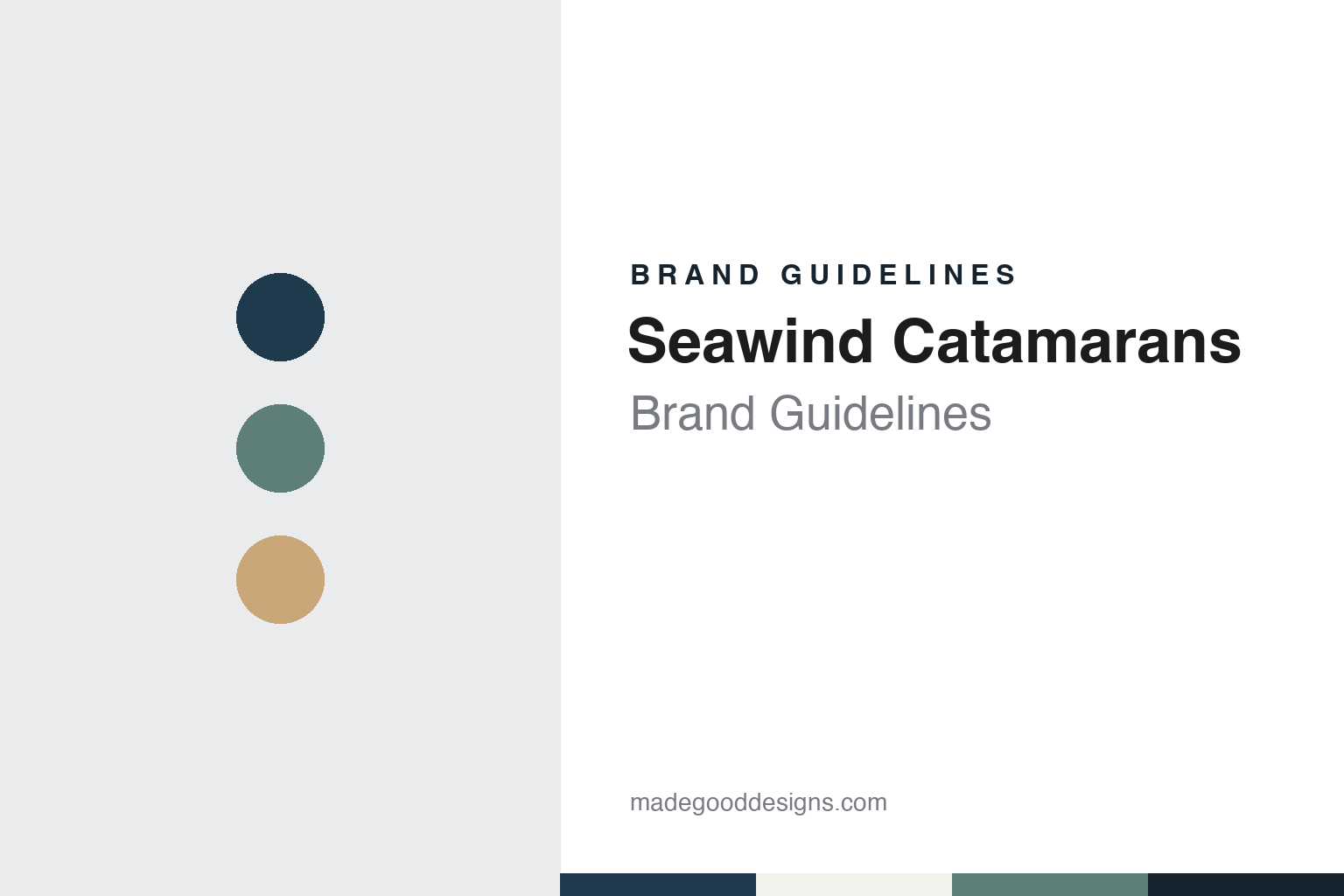
Two constants: a harbour navy, river grey-green and sandstone palette and a plain geometric sans register. Abstract homage — not a Seawind product or mark; no boat, logo or nameplate is reproduced.
Wollongong
Three decades of building in New South Wales.
Seawind Catamarans is an Australian catamaran builder founded in 1982. The company says it was established that year in Sydney, and its website names Richard Ward as founder and chief executive. Its own history begins with a small off-the-beach catamaran of four to five metres, before the firm turned to cruising catamarans through the 1980s and 1990s.
For three decades the boats were built in New South Wales. Cruising World reported in November 2012 that the company’s Australian production facility was in Wollongong, on the coast south of Sydney, and in May 2013 the same magazine wrote that Seawind had been building catamarans in the state for 30 years. The company’s history lists the Seawind 1000, a 33-foot cruising catamaran launched in 1994, and the 38-foot Seawind 1160, launched at the Sydney Boat Show in 2004 with a tri-folding door between saloon and cockpit, a feature the company still presents as a signature of its range.
The company also took on other lines. It says it acquired the Venturer range of power catamarans in 2000. In 2010 it bought Corsair Marine, a builder of trailerable trimarans: Trade Only Today reported the purchase in November 2010 and said the terms were not disclosed, and English Wikipedia dates the deal to October 2010. Corsair had been founded in 1984 in Chula Vista, California, by John T. Walton, with the designer Ian Farrier on its management team; it was bought in 1994 by its Australian dealer, Paul Koch, and moved its headquarters and production to Ho Chi Minh City, Vietnam, in 2006, according to Wikipedia. Ward, then managing director, called the deal “a marriage made in heaven” in the statement quoted by Trade Only Today.
Colour
Administration, and a move to the Saigon River.
The Corsair purchase gave Seawind a factory in Vietnam just as building in Australia became harder. Kevin Green wrote in Cruising World in May 2013 that a soaring Australian dollar and a slumped market had pushed the company “to the wall” in 2011, and that leaving administration had required a business plan built on cutting costs. Trade-a-Boat reported that Seawind Group Holdings, the holding company of Seawind and Corsair, was released from voluntary administration on 9 October by the administrators BRI Ferrier, and that the agreement included closing the Wollongong production facility. Cruising World reported in November 2012 that the restructuring had taken place in early October, and quoted Ward calling that year the most challenging of his 30 years in business. The company said at the time that it remained wholly Australian-owned, Trade-a-Boat reported.
Production moved in stages. Trade-a-Boat reported that building of the Seawind 1160 had moved to Vietnam during 2011, and covered the arrival of the 101st Seawind 1160, the model’s opening Vietnam-built hull, at the 14th annual Seawind Pittwater Regatta, north of Sydney. Cruising World wrote in 2012 that the larger Seawind 1250 would join the 1160 and a smaller model at the Vietnam factory once the last boats on order in Australia were finished. Seawind said that shipwrights from its Australian yard had moved to Vietnam to oversee the work, and that after-sales service in Australia would continue through Multihull Central at Rozelle Bay on Sydney Harbour.
Green described the yard in 2013 as a 12,000-square-metre site with three factory buildings on a bend of the Saigon River, run by a team of 15 Australian managers with 185 local staff, including CAD designers, and building Seawinds alongside Corsair trimarans. He reported foam-cored hulls, a refined vacuum-bagging process with triaxial glass cloth in key structural areas, and build schedules posted in English and Vietnamese for each boat, and he quoted the operations manager as saying the 1160 had become CE approved. Seawind was by then dealing directly with suppliers including Lewmar and North Sails, the magazine reported.
Typography
Design and documentation.
Catamaran and trimaran builders present themselves through a small set of public materials: the yard name, the model names, the hull graphics, the brochure and the boat-show stand. Model names usually carry a length in feet, sometimes with a word for the layout or character of the boat, and a builder’s range is often easier to follow through those numbers than through any logo.
Charter shapes the look of many of these boats. Some yards build the same hulls for private owners under their own brand and for charter companies under the charter company’s name and model number, so a single design can appear in two liveries and in two sets of brochures. Others have stepped away from charter fleets to concentrate on private owners, and say so in their own timelines.
Ownership varies widely and is set out here plainly with dates. The sector includes yards still run by their founders, brands that sit inside listed groups, builders owned by investment funds, and yards that have passed through insolvency, court-supervised restructuring or a change of shareholder. A brand and the yard that builds it are not always owned by the same company, and the corporate pages on founders and owners are usually where those links are set out.
Design credits follow the same rule. Naval architects and designers are named in this guide only where a dated source or the builder itself credits them, and hull decorations, colour codes and graphic charters are described only as the builders publish them. Nothing here is a claim about how any boat sails or behaves at sea; the palettes and typefaces shown are unofficial interpretations, not the builders’ own marks.
Aa
A plain geometric sans for a practical cruising brand. (Specimen set in Outfit, a sans STAND-IN; NOT the Seawind logo.)
Seawind
An Australian name with a yard in Vietnam.
Seawind’s range has grown since the move. The company credits the naval architects Reichel Pugh with the 52-foot Seawind 1600, which it dates to 2016, and its website in 2026 lists cruising catamarans from about 38 to 52 feet alongside the Corsair trimaran range, as well as day-charter versions. It says it opened a further production facility in Ho Chi Minh City and a handover and service centre at Ocean Marina in Thailand in 2023, and that in 2024 it set up a production facility in Izmir, Turkey, from which a hull has since been launched. Its website names Ho Chi Minh City as its manufacturing headquarters, and English Wikipedia says the Seawind group employs more than 200 people.
Ward has stayed at the head of the business: the 2010 and 2012 reports described him as managing director, Cruising World called him the owner in 2013, and the company’s website in 2026 quotes him as founder and CEO. The company also says it opened a European sales and service office in 2017.
Much of what defines the brand is a set of recurring features rather than a single model. The company presents twin helm stations, an indoor and outdoor living area joined by the tri-folding door, and boats suited both to private owners and to charter as the constants of its range, and it describes its catamarans as built for “real sailors.” Those are its own descriptions; the documented story is a builder that kept its Australian name and management while moving its yard from Wollongong to the Saigon River.
For a design guide, Seawind Catamarans shows how a brand can keep one identity while its factory moves to another country. Compare Lagoon, a French catamaran brand inside a large boatbuilding group, and HH Catamarans, another multihull builder working in Asia. For this guide we use a harbour navy, a river grey-green and a sandstone with a sans, an unofficial interpretation; no product or logo is reproduced.
Explore & save
Keep Seawind Catamarans’s identity on hand — save it to a board in the Made Good inspiration library.
Seawind Catamarans identity set
Pin the Seawind harbour navy, river grey-green and sandstone palette and the plain geometric sans register to your own board.
Source & notes
Frequently Asked Questions
What font can I use to match the Seawind Catamarans look?
This guide describes Seawind Catamarans’ type as “A plain geometric sans for a practical cruising brand”. Its type specimen is set in Outfit from Google Fonts as a stand-in; Outfit is not Seawind Catamarans’ own lettering.
What colours are in the Seawind Catamarans palette?
This guide’s Seawind Catamarans palette is Harbour navy #1F3A4D, Deep ink #14232E, River grey-green #5E7F78, Sandstone #C9A678 and Hull white #F4F2EC. The tones are the guide’s own unofficial interpretation, not official Seawind Catamarans hex codes.
When was Seawind Catamarans founded?
Seawind Catamarans was founded in 1982, in Australia. Seawind Catamarans is known for Cruising catamarans, Corsair trimarans.
Who founded Seawind Catamarans?
Seawind Catamarans was founded by Richard Ward in 1982. Seawind Catamarans is known for Cruising catamarans, Corsair trimarans.