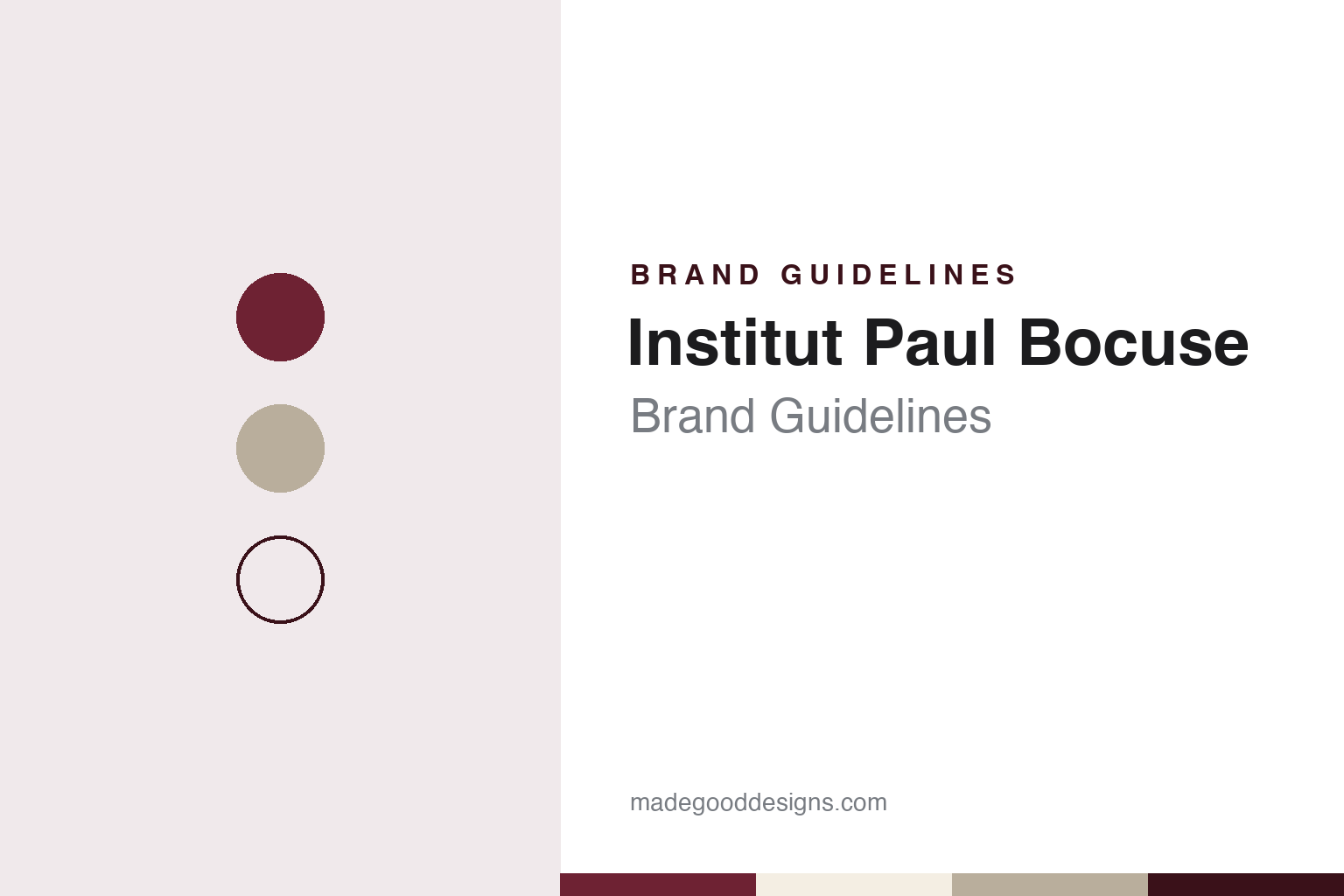
Institut Paul Bocuse Brand Guidelines
The Écully school that moved from a chef’s name to an acronym.
Aa
Two constants: a claret, stone and cream palette and a classical serif register. Abstract homage — not an Institut Paul Bocuse or Institut Lyfe mark; no logo, crest or building is reproduced.
Écully, 1990
A state-backed school at the edge of Lyon.
The school now called Institut Lyfe began at Écully, on the western edge of Lyon, in 1990. Its own history page says the École des Arts Culinaires et d’Hôtellerie d’Écully was inaugurated that year at the initiative of the culture minister Jack Lang, with the chef Paul Bocuse as honorary president. French Wikipedia gives the founding name as the École supérieure des arts culinaires et de l’hôtellerie d’Écully and names Bocuse and Gérard Pélisson, a co-founder of the hotel group Accor, as the school’s co-founders.
The school dates the next steps itself. Pélisson joined Bocuse at the head of the board in 1998, it says, and in 1999 the school began a professional licence degree with the Université Jean Moulin Lyon 3. In 2002 Paul Bocuse gave the school his name and it became the Institut Paul Bocuse, organised as a non-profit association under France’s law of 1901. The same year, with the support of AccorHotels, it opened Le Royal, a hotel-school on the Place Bellecour in central Lyon. A network of partner universities abroad, which the school calls the Alliance, followed in 2004, and a research centre in 2008.
The 2010s brought more programmes and more public-facing outlets. In 2013, the school says, it launched a fourth-year specialisation and an MSc in international hospitality management with emlyon business school, and opened a restaurant called L’Institut on the Place Bellecour. A foundation chaired by Gilles Pélisson followed in 2015. Bachelor programmes in international hospitality and restaurant management and in culinary arts, joined in 2021 by one in pastry, now form the core of its undergraduate teaching, with fourth-year specialisations that range from wines and spirits to hotel brand design and marketing, according to its website.
Colour
Two châteaux at Écully.
The campus is built around the Château du Vivier, a nineteenth-century house in a wooded park at Écully that French Wikipedia describes as neo-Gothic. The school’s gastronomic teaching restaurant, Saisons, occupies its ground floor and is open to the public on weekdays, French Wikipedia says; it has been led by the chef Florian Pansin since February 2020.
A second campus was added beside the first. Lyon Mag reported in April 2023 that a new building, designed by the Lyon architect Mathias Soulier as part of a project begun in 2017, held 22 classrooms and a 250-seat amphitheatre across about 6,500 square metres, close to the 6,700 square metres of the original campus. The paper reported that it carried the name of Gérard Pélisson and was given over to management and entrepreneurship, while cooking classes stayed on the campus named after Paul Bocuse. The school’s own timeline places the opening of this extension, in a second house called the Château de la Roseraie, in 2025, together with a pastry academy of more than 1,000 square metres, and gives the combined campus as 17,000 square metres.
The school describes itself as having about 1,200 students of 75 nationalities in Lyon, and as one part of a wider family that includes ten associated campuses abroad. Its campus page lists one campus for hospitality, restaurants, wines and drinks and another for culinary arts and pastry, with about 1,000 square metres of teaching laboratories. Its applied outlets, as the school and French Wikipedia list them, include a brasserie and a bakery-pastry shop on the emlyon campus in Lyon’s seventh arrondissement, a cocktail bar, an experimental restaurant on new eating habits, a fast-casual counter and the Le Royal hotel-school, which French Wikipedia describes as an MGallery hotel.
The school has also published under its name, including L’Art de recevoir à la française with Flammarion in 2011 and a volume with Larousse in 2015, according to French Wikipedia.
Typography
How culinary schools present themselves.
Culinary and pastry schools present themselves through a small set of public signs: a school name, a crest or logo, a colour scheme and a short descriptive line. Some names carry a symbol. Le Cordon Bleu takes its name from the blue ribbon of a French royal order, English Wikipedia says, and guests cut a blue ribbon when its new Paris campus opened in 2016, So Good magazine reported. Others come from a place: Ferrandi Paris is linked to the Paris street where its workshop school was installed in 1958, French Wikipedia says.
Ownership shapes how a school describes itself. Ferrandi belongs to the Paris Île-de-France chamber of commerce and industry, a public body, while Le Cordon Bleu was bought by Élisabeth Brassart in 1945, English Wikipedia says, and by André J. Cointreau in 1984, the Los Angeles Times reported, before growing into an international group. Other schools are run by education groups, families or universities; this guide reads their own pages on founders and history alongside dated press sources.
The buildings are part of the image. Schools publish their campuses, teaching kitchens, laboratories and training restaurants, where students cook and serve real guests. Press visits describe the same spaces from outside: in 2014 Le Figaro watched student chefs in whites with their names embroidered on the chest, and in 2016 So Good described a glass Paris building with a vegetable garden on its roof.
Programmes and diplomas appear under the names the schools give them, from vocational certificates to bachelor and master’s degrees, and official recognition is cited as the schools or dated sources state it. This guide sets out what can be checked about each school — who founded it, who owns it and where it teaches — and marks clearly what rests only on the school’s own word.
Aa
A classical serif for a school housed in a château. (Specimen set in Cormorant Garamond, a serif STAND-IN; NOT the Institut Paul Bocuse or Institut Lyfe logo.)
Institut Lyfe
A new name announced in April 2023.
The change of name was announced at a press conference at the château on 27 April 2023. Lyon Capitale and Lyon Mag both reported that day that the Institut Paul Bocuse would from then on be called the Institut Lyfe, short for “Lyon For Excellence.” Lyon Mag reported that the institute’s administrator, Gilles Pélisson, and its head, Dominique Giraudier, presented the new name as a way of looking ahead and turning towards an international audience, and that the school kept all of its activities under the new name.
Lyon Mag reported the school’s leaders as saying that the institute held the right to use the Paul Bocuse name free of charge until 2037 under an arrangement made by the chef himself, and that students already enrolled in 2023 would still receive diplomas bearing the name Institut Paul Bocuse. The culinary campus kept the name Paul Bocuse, the paper reported.
Since then the school has presented itself on its website as “Institut Lyfe (formerly Institut Paul Bocuse),” keeping the old name in brackets beside the new one, and French Wikipedia describes it as a school of international management for hospitality, restaurants, culinary arts, pastry and oenology. The website names its chief executive as François Mary.
For a design guide, Institut Paul Bocuse shows how a school can move from a founder’s name to an acronym while keeping both in view: the old name stays on a campus and in brackets beside the new one. Compare École Ducasse, another French school built around a chef’s name, and Ferrandi Paris. For this guide we use claret, stone and cream with a serif, an unofficial interpretation; no product or logo is reproduced.
Explore & save
Keep Institut Paul Bocuse’s identity on hand — save it to a board in the Made Good inspiration library.
Institut Paul Bocuse identity set
Pin the claret, stone and cream palette and the classical serif register to your own board.
Source & notes
Frequently Asked Questions
What font can I use to match the Institut Paul Bocuse look?
This guide describes Institut Paul Bocuse’s type as “A classical serif for a school housed in a château”. Its type specimen is set in Cormorant Garamond from Google Fonts as a stand-in; Cormorant Garamond is not Institut Paul Bocuse’s own lettering.
What colours are in the Institut Paul Bocuse palette?
This guide’s Institut Paul Bocuse palette is Claret #6E2233, Cellar #3A1119, Château stone #B9AE9C, Napkin cream #F4EEE3 and Paper #FAF8F4. The tones are the guide’s own unofficial interpretation, not official Institut Paul Bocuse hex codes.
When did Institut Paul Bocuse open?
Institut Paul Bocuse opened in 1990, in Écully, near Lyon, France.