École Ducasse Brand Guidelines
A chef’s surname as an umbrella over several schools.
Aa
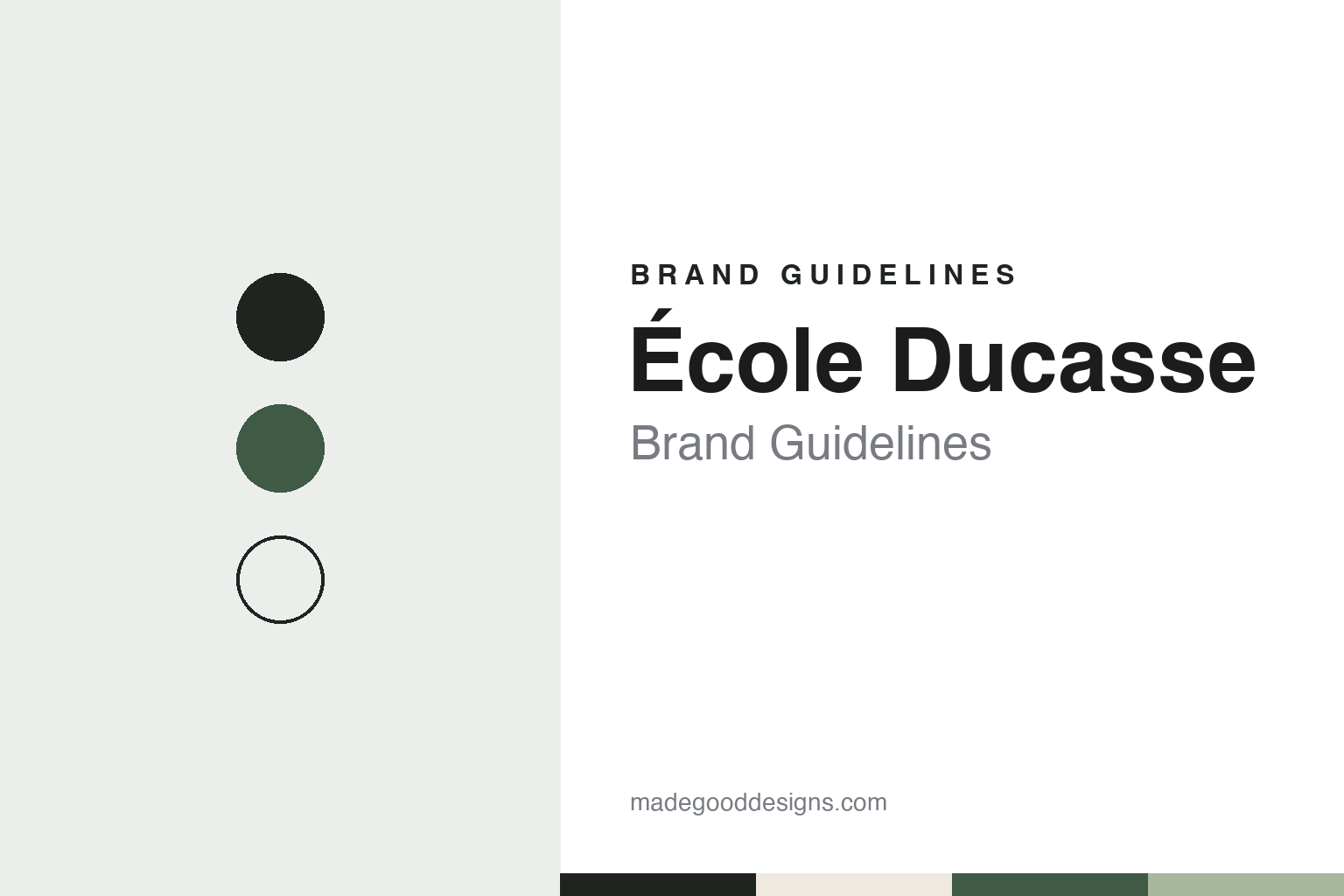
Two constants: a charcoal, sage and linen palette and a geometric sans register. Abstract homage — not an École Ducasse mark; no logo, campus or dish is reproduced.
Ducasse Education
A chef’s school network, created in 1999.
École Ducasse is the school network of the French chef Alain Ducasse. The school says he created it in 1999, and trade reports from 2019 date the foundation of the business behind it, Ducasse Education, to the same year. In June 2019 the travel-trade site GTP Headlines and the education-trade site The PIE News described its teaching at that point as bachelor programmes, retraining courses, continuing vocational training and private lessons, delivered across three schools in France and two abroad, one of them in the Philippines, together with partnerships with universities overseas.
The school ties its teaching to the chef’s own cooking. Its about page links the school to his “Naturalité” approach, a cuisine centred on vegetables, cereals and fish that it says he introduced at the Plaza Athénée in Paris in 2014, and describes the graduate it trains for as a cook who is also a manager and an entrepreneur, able to handle costs as well as a brigade. Teaching is centred on practice in kitchens and laboratories, it says, with an emphasis on the gestures of French cooking and pastry.
Programmes, as the school lists them in 2026, fall into six groups: a three-year higher-education diploma that combines kitchen work, management teaching and three six-month internships; retraining programmes in cooking, pastry, bread, chocolate and ice cream; advanced courses for working cooks; short courses for professionals, taught on its campuses or in clients’ own kitchens; an online course in the basics of French pastry; and classes for amateurs. Masterclasses for experienced chefs are given at both main campuses, the school says.
Colour
Meudon-la-Forêt and Yssingeaux.
The network has two main campuses in France. The newer is École Ducasse – Paris Campus at Meudon-la-Forêt, about 10 kilometres from central Paris. GTP Headlines reported its opening by Sommet Education in November 2020 and described a site of 5,000 square metres with a shop selling food to take away and a teaching restaurant open to the public. The school describes the campus as four buildings inspired by the four elements — water, fire, earth and air — linked by open, light-filled spaces, with six kitchens, laboratories for pastry and bread, seven classrooms, a sensory-analysis room and an edible garden used to teach seasonality and plant-based ingredients. Its teaching restaurant is called Adour.
The older campus is the École Nationale Supérieure de Pâtisserie, known as ENSP, at Yssingeaux in the Haute-Loire, about an hour and a half from Lyon. The school says ENSP was founded in 1984, teaches pastry, bakery, chocolate, confectionery and ice cream, and occupies the Château de Montbarnier, with twelve pastry laboratories and an 84-seat amphitheatre across 7,200 square metres. In 2023, it says, a 2,300-square-metre building named the Campus Yves Thuriès opened with three classrooms, four laboratories and 36 student rooms; it was inaugurated in the presence of Alain Ducasse and the pastry chef Yves Thuriès, whom the school names as the owners of ENSP since 2007.
A third address in France, École Ducasse – Paris Studio, is a school for amateur cooks in central Paris, according to the website.
Abroad, the school lists studios run with local partners. École Ducasse Nai Lert Bangkok Studio, in the Thai capital, combines a training centre, an events space, a café and a shop; École Ducasse Abu Dhabi Studio, on the historic Al Hosn site, opened at the end of 2023 in partnership with Erth Hospitality and has a kitchen and pastry laboratory, a chef’s table and a terrace, the school says. Its website also invites approaches from would-be franchisees and academic partners.
Typography
How culinary schools present themselves.
Culinary and pastry schools present themselves through a small set of public signs: a school name, a crest or logo, a colour scheme and a short descriptive line. Some names carry a symbol. Le Cordon Bleu takes its name from the blue ribbon of a French royal order, English Wikipedia says, and guests cut a blue ribbon when its new Paris campus opened in 2016, So Good magazine reported. Others come from a place: Ferrandi Paris is linked to the Paris street where its workshop school was installed in 1958, French Wikipedia says.
Ownership shapes how a school describes itself. Ferrandi belongs to the Paris Île-de-France chamber of commerce and industry, a public body, while Le Cordon Bleu was bought by Élisabeth Brassart in 1945, English Wikipedia says, and by André J. Cointreau in 1984, the Los Angeles Times reported, before growing into an international group. Other schools are run by education groups, families or universities; this guide reads their own pages on founders and history alongside dated press sources.
The buildings are part of the image. Schools publish their campuses, teaching kitchens, laboratories and training restaurants, where students cook and serve real guests. Press visits describe the same spaces from outside: in 2014 Le Figaro watched student chefs in whites with their names embroidered on the chest, and in 2016 So Good described a glass Paris building with a vegetable garden on its roof.
Programmes and diplomas appear under the names the schools give them, from vocational certificates to bachelor and master’s degrees, and official recognition is cited as the schools or dated sources state it. This guide sets out what can be checked about each school — who founded it, who owns it and where it teaches — and marks clearly what rests only on the school’s own word.
Aa
A clean geometric sans for a modern campus network. (Specimen set in Jost, a sans STAND-IN; NOT the École Ducasse logo.)
Sommet Education
A Swiss group as majority shareholder.
Ducasse Education changed hands in 2019. In June that year GTP Headlines and The PIE News reported an agreement under which Sommet Education, the Swiss hospitality-education group behind Glion and Les Roches, would become the majority shareholder of Ducasse Education; both quoted Alain Ducasse as the business’s owner. The PIE News reported that the Meudon campus, then still to open, had the full support of Sommet Education, and GTP Headlines reported its opening under Sommet in November 2020. The 2019 reports also described a school in the United Arab Emirates as still to come; the school’s own pages now date its Abu Dhabi studio to the end of 2023, four years after the agreement with Sommet Education was announced.
In 2026 Sommet Education’s website lists École Ducasse among its schools, alongside the Glion Institute of Higher Education and Les Roches, and the École Ducasse website sends job seekers to Sommet Education’s careers site.
The naming follows the structure. Trade reports in 2019 used the company name, written in capitals as “DUCASSE Education,” while the schools now trade as École Ducasse followed by a place and a format — Paris Campus, Paris Studio, Bangkok Studio, Abu Dhabi Studio — and the pastry school at Yssingeaux keeps its own long name, École Nationale Supérieure de Pâtisserie, on the same website. The chef’s surname carries the network; the second half of each name tells a visitor whether the site teaches professionals over three years or amateurs for an afternoon.
For a design guide, École Ducasse shows how a chef’s surname can work as an umbrella over several schools, each named by place and format. Compare Institut Paul Bocuse, another French school built around a chef’s name, and Le Cordon Bleu, a Paris-founded network of culinary schools. For this guide we use charcoal, sage and linen with a sans, an unofficial interpretation; no product or logo is reproduced.
Explore & save
Keep École Ducasse’s identity on hand — save it to a board in the Made Good inspiration library.
École Ducasse identity set
Pin the charcoal, sage and linen palette and the geometric sans register to your own board.
Source & notes
Frequently Asked Questions
What font can I use to match the École Ducasse look?
This guide describes École Ducasse’s type as “A clean geometric sans for a modern campus network”. Its type specimen is set in Jost from Google Fonts as a stand-in; Jost is not École Ducasse’s own lettering.
What colours are in the École Ducasse palette?
This guide’s École Ducasse palette is Range charcoal #1F2421, Garden sage #3F5A45, Herb #A9B79C, Linen #EFE9DF and Paper #F9F7F3. The tones are the guide’s own unofficial interpretation, not official École Ducasse hex codes.
When was École Ducasse created?
École Ducasse was created in 1999 (as Ducasse Education), in France.
Who founded École Ducasse?
École Ducasse was founded by Alain Ducasse in 1999 (as Ducasse Education).