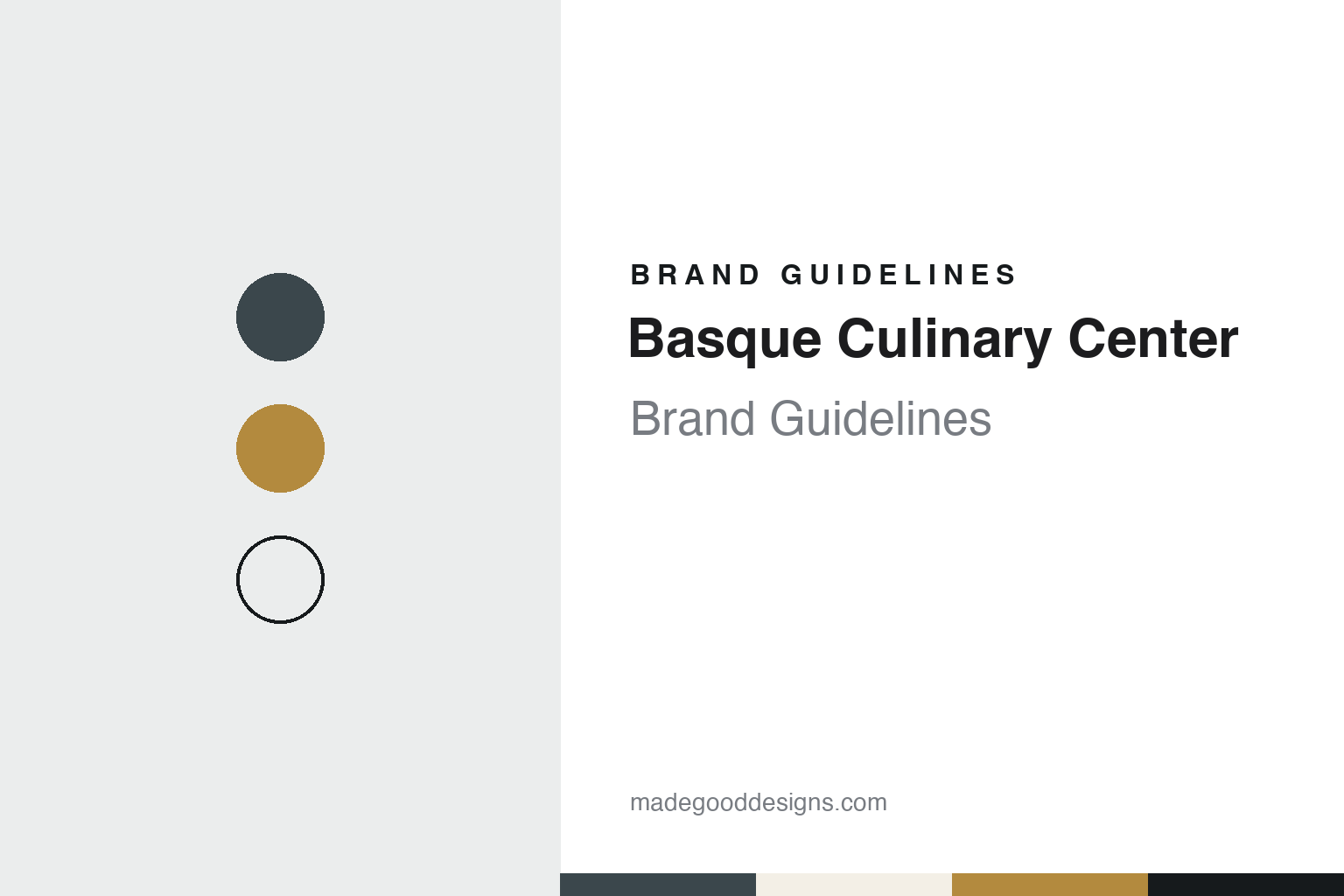
Basque Culinary Center Brand Guidelines
San Sebastián’s gastronomy faculty in two buildings.
Aa
Two constants: a facade gold, flysch slate and corten palette and an architectural sans register. Abstract homage — not a Basque Culinary Center product or mark; no logo, building image or photograph is reproduced.
Miramón, 2009
Chefs and a university sign a foundation.
The Basque Culinary Center began with a signature. On 23 March 2009, El Diario Vasco reported the next morning, chefs and public bodies met at the Kursaal in San Sebastián to sign the agreement creating the foundation behind it. The formal promoters were Mondragon Unibertsitatea, the private university of the Basque Country, and a group of Basque chefs, among them Juan María Arzak and Pedro Subijana; the paper named seven chefs who joined the foundation’s board, together with the university’s rector, Iosu Zabala.
According to the same report, San Sebastián city council gave land in Miramón park for the building, and the project had the backing of the Spanish science ministry, the Basque Government and the Provincial Council of Gipuzkoa. The paper described the plan as a university degree in culinary arts plus postgraduate courses for working professionals, with a research and innovation centre alongside, and reported that teaching was due to start in 2011. It listed six lines of research, among them eating habits, food trends, management innovation in the sector and the preparation, presentation and preservation of food. El Diario Vasco called the project the second of its kind in Europe, after a similar school in Piedmont.
English Wikipedia describes the result as two linked bodies: the Faculty of Gastronomic Sciences of Mondragon University and a Research and Innovation Centre for food and gastronomy. The foundation’s board, it says, brings together the founding chefs, Mondragon University and the AZTI technology centre, the Basque Government, the Gipuzkoa council, San Sebastián city council and food and drink companies. The centre’s own website says it has been based in Donostia-San Sebastián since 2011, and Basque Wikipedia dates the opening to the 2011–12 academic year.
The school also built an international circle early. English Wikipedia says an International Advisory Committee chaired by Ferran Adrià held its opening meeting in San Sebastián in July 2010 and met again in Lima in September 2011, where it produced a text titled “Open Letter to the Chefs of the Future”, and later in Tokyo, New York, São Paulo and Mexico City.
Colour
A building like a stack of dishes.
The centre’s look was set by its building. Dezeen reported in December 2011 that the Spanish architects Vaumm had completed a golden, five-storey building on a steep hillside beside the Miramón technology park, where visitors enter on the upper storeys and walk down to the floors below. The plan is a U around a central courtyard, with a bridge block joining the north and south wings on the top two floors. The facades are perforated metal panels in a golden finish, decorated with different patterns, and deep projecting balconies wrap the building; the architects intended them, Dezeen wrote, to resemble a stack of dishes.
Inside, the teaching follows a university model. English Wikipedia describes the bachelor’s degree in gastronomy and culinary arts as an official four-year university degree built on five areas: cooking, service, management, science and culture. Postgraduate courses cover subjects such as advanced cookery, restaurant pastry, sommelier studies and gastronomic journalism, and the school’s cafeteria works as a training kitchen and dining room where degree students serve members of the public. The centre’s current website lists a master’s degree in food fermentation, short professional courses and online learning next to the degree, and Spanish Wikipedia names Joxe Mari Aizega as its director.
Typography
Design and documentation.
Culinary and pastry schools present themselves through a small set of public signs: a school name, a crest or logo, a colour scheme and a short descriptive line. Some names carry a symbol. Le Cordon Bleu takes its name from the blue ribbon of a French royal order, English Wikipedia says, and guests cut a blue ribbon when its new Paris campus opened in 2016, So Good magazine reported. Others come from a place: Ferrandi Paris is linked to the Paris street where its workshop school was installed in 1958, French Wikipedia says.
Ownership shapes how a school describes itself. Ferrandi belongs to the Paris Île-de-France chamber of commerce and industry, a public body, while Le Cordon Bleu was bought by Élisabeth Brassart in 1945, English Wikipedia says, and by André J. Cointreau in 1984, the Los Angeles Times reported, before growing into an international group. Other schools are run by education groups, families or universities; this guide reads their own pages on founders and history alongside dated press sources.
The buildings are part of the image. Schools publish their campuses, teaching kitchens, laboratories and training restaurants, where students cook and serve real guests. Press visits describe the same spaces from outside: in 2014 Le Figaro watched student chefs in whites with their names embroidered on the chest, and in 2016 So Good described a glass Paris building with a vegetable garden on its roof.
Programmes and diplomas appear under the names the schools give them, from vocational certificates to bachelor and master’s degrees, and official recognition is cited as the schools or dated sources state it. This guide sets out what can be checked about each school — who founded it, who owns it and where it teaches — and marks clearly what rests only on the school’s own word.
Aa
An architectural sans for a school known through its buildings. (Specimen set in Archivo, a sans STAND-IN; NOT the Basque Culinary Center logo.)
GOe
A second building in Gros.
In October 2025 the centre opened a second building. EITB’s news service reported the official inauguration of the new headquarters in the Gros district of San Sebastián on Monday 20 October 2025. Called GOe, short for Gastronomy Open Ecosystem, it was designed by BIG Bjarke Ingels Group with the Basque studio BAT Architecture. Metalocus reported that BIG won the competition launched in 2021 with a proposal titled “Olatuen bidea – Path of the Waves”, and that construction began in November 2023. The building of about 9,000 square metres holds eight research and teaching kitchens, ten laboratories, coworking space, classrooms, an auditorium, a restaurant and a café, the magazine wrote, wrapped in a corten steel skin with large glass openings. At its centre is a Gastro Hall that runs from the ground floor to the roof, crossed by a grand staircase that doubles as an amphitheatre for events and lets visitors look into the kitchens. Arquitectura Viva describes it as partly underground at the foot of Mount Ulía, with a landscaped, stepped roof that works as a public square and evokes the flysch rock of the Basque coast.
The centre says the opening drew more than 1,500 participants and that GOe was made possible with the support of the Basque Government, the Provincial Council of Gipuzkoa and San Sebastián city council; its director general, Joxe Mari Aizega, called it a space for knowledge, creativity and collaboration. The centre’s website also lists an EDA Drinks & Wine Campus, which English Wikipedia places in Álava, with sites in Laguardia and Vitoria-Gasteiz.
For a design guide, the Basque Culinary Center shows a school identity that can be read through two buildings by named architects: the golden stack of dishes at Miramón and the corten-clad, terraced GOe in Gros. Compare it with the Michelin Guide, which El Diario Vasco reported in 2010 had chosen San Sebastián to present its 2011 edition, and with Ferrandi Paris, another cookery-school identity in this series. For this guide we use facade gold, flysch slate and corten with a sans, an unofficial interpretation; no product or logo is reproduced.
Explore & save
Keep Basque Culinary Center’s identity on hand — save it to a board in the Made Good inspiration library.
Basque Culinary Center identity set
Pin the Basque Culinary Center facade gold, flysch slate and corten palette and the architectural sans register to your own board.
Source & notes
Frequently Asked Questions
What font can I use to match the Basque Culinary Center look?
This guide describes Basque Culinary Center’s type as “An architectural sans for a school known through its buildings”. Its type specimen is set in Archivo from Google Fonts as a stand-in; Archivo is not Basque Culinary Center’s own lettering.
What colours are in the Basque Culinary Center palette?
This guide’s Basque Culinary Center palette is Flysch slate #3B474C, Ink #161A1C, Facade gold #B38A3E, Corten #8C4A2B and Paper #F7F4EE. The tones are the guide’s own unofficial interpretation, not official Basque Culinary Center hex codes.
When was Basque Culinary Center founded?
Basque Culinary Center was founded in 2009 (foundation); campus opened 2011, in San Sebastián, Spain.
Who founded Basque Culinary Center?
Basque Culinary Center was founded by Mondragon Unibertsitatea and Basque chefs in 2009 (foundation); campus opened 2011.