Oddfellows Brand Guidelines
The San Francisco-born motion studio now based in Portland.
Aa
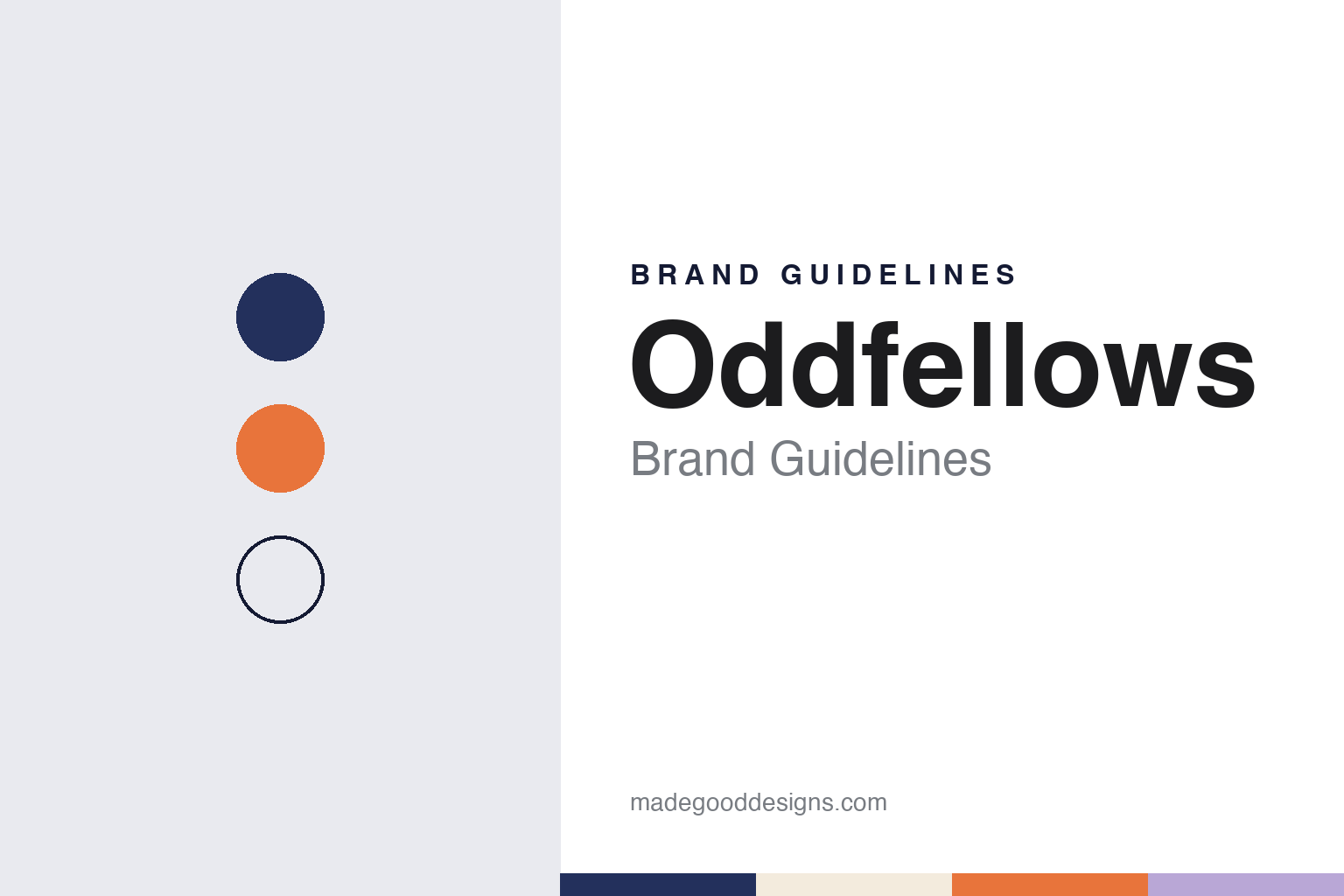
Two constants: a night ink, cream and tangerine palette and a rounded grotesque register. Abstract homage — not an Oddfellows film, frame or mark; no artwork or logo is reproduced.
From San Francisco to Portland
Three founders, two cities, one studio.
Oddfellows is a design and animation studio that began in San Francisco and now gives its address as Portland, Oregon. A release from Passion Animation Studios, reprinted by Stash in June 2017, named its founders as TJ Kearney, executive producer, and Colin Trenter and Chris Kelly, both creative directors. The same three names appear in the credits of a 2015 film for Nest published by Motionographer, where Trenter is listed as creative director, Kearney as executive producer and Kelly among the designers.
The studio’s own website calls it “a visual strategy and storytelling studio with over a decade of experience,” and its page on its latest rebrand says the change came “after 13 years in the business.” Neither page gives a founding date.
The move north came in stages. In September 2016 the Motionographer writer Joe Donaldson reported that what “started as a small San Francisco-based company” had “expanded to Portland with a new team and body of work,” launched alongside a new website. By June 2026 Stash was describing Oddfellows as a “Portland design and motion house,” and the website now lists a single Portland studio. The company says that building was previously a candy distributor, and that it rebuilt it with the design firms Casework and Green Rabbet so that it felt “more like a home studio than a corporate office.”
In June 2017 Passion Animation Studios, the animation arm of the London company Passion Pictures, announced in that release that it had signed Oddfellows to its roster. By 2026 Stash was crediting Colin Trenter as founder and executive creative director, with Erica Kelly as executive producer; the website’s team page lists eighteen people, among them Trenter, Chris Kelly, Erica Kelly, Jarratt Moody and Yuki Yamada.
Colour
Explainer films, personal pieces and brand anthems.
Oddfellows built its early work on short films for technology companies. When Motionographer featured its “Works With Nest” film in October 2015, the studio said it was its fourth collaboration with Nest’s design team. Nest already had a live-action version, the studio said, but it wanted to show the connected-home products working together, so the team combined motion design and cel animation with live-action footage of the devices. The work was made by artists spread across several time zones. The 2017 release listed Cartoon Network, Google and Twitter among the studio’s clients.
Personal work sat beside the commissions. In his 2016 piece Donaldson singled out “The Junebug,” a self-initiated film of design and animation, and wrote that for a small studio “it can be hard to make time to develop your own voice, especially with paying clients at the door.”
A decade later the commissions had grown into brand films and identity systems. In June 2026 Stash reported that Oddfellows had made an anthem film for Replit, the cloud software-development platform, to introduce the company’s refreshed brand identity. Trenter told the magazine the result was “a 60-second brand film and a suite of extended assets,” built by layering graphic design, intimate footage and generative imagery. In October 2026 Stash covered the studio’s launch film for Harvey II, from the legal-software company Harvey. Oddfellows said it had avoided “the cold, metallic visual language” of the category and started instead with “pencil to paper,” building a visual system out of marks, language and documents; it said the piece came together in roughly a month.
The company’s capabilities page lists creative direction, visual strategy, design, motion, illustration, systems and storytelling, and names technology, entertainment, finance, fashion and arts and culture among the industries it works in. It frames its method as “Magic + Logic,” and says it writes a strategic design brief “before we make the first brushstroke, or push a single pixel.”
Typography
Studios, showreels and credits.
Motion-design and animation studios sell something that is hard to show in a single image, so most of them lead with the work itself. A studio’s website usually opens on a showreel or a grid of moving thumbnails, and the name, logo and ident sit around that work rather than in front of it. Because an ident can be re-animated for a new reel, a new season or a new office, the written name and a short slogan often carry much of the lasting identity.
The people are part of the presentation. Production companies in advertising commonly list a roster of named directors, each with a page of their own, alongside the in-house producers, designers and animators. Trade press such as SHOOT, Stash, Televisual and Cartoon Brew reports hires, promotions and new offices, and credits commercials, title sequences, series openings and music videos to studios and directors by name; those credits, rather than the studio’s own wording, are the record that later histories rely on.
Ownership takes several forms. Some studios remain founder-owned for decades, with the founders still listed as directors in company registers. Others take a minority investment from a larger studio, join a group of sister companies, or are bought outright, sometimes by a company from outside animation, and keep trading under their own name afterwards. A studio’s corporate pages on founders and history are useful, but dated trade reports and register entries show when these changes actually happened.
For a design guide, the useful lesson is how much these studios ask of a name. A short, memorable studio name has to work as a credit at the end of a commercial, as a word animated in a reel and as a signature on a website, often in the same week. The palettes and type in these guides are our own unofficial interpretations, and no studio frame, character or logo is reproduced.
Aa
A rounded, friendly grotesque for a studio that draws by hand and on screen. (Specimen set in Bricolage Grotesque, a sans STAND-IN; NOT the Oddfellows logo.)
Builders of moving experiences
A studio that rebranded itself.
Oddfellows treats its own identity as a project. Its website files the rebrand under its own work, with the client listed as Oddfellows. The new positioning, “Builders of Moving Experiences,” now sits on the home page, and the company says the rebrand “goes beyond aesthetics.” The credits name Colin Trenter and Chris Kelly for executive creative direction and Yuki Yamada and Jarratt Moody for creative direction, with strategy and copy by Inside.Company, web design and development by Luke Greenaway and audio by Antfood. The home page opens on a grid of its projects, each with a one-line description under its title.
The studio also presents itself through community pages rather than only a showreel. It says it holds a monthly Virtual Open Studio, where visitors can bring portfolios and questions, and that it has opened a Discord server to collaborators and the wider design community. A series called “Behind the Work” has its artists explain how they achieved particular looks, including a tip on reflections in three-dimensional After Effects projects. The team page lists its people by first and last name, each paired with a letter of the alphabet.
The name is written as a single word, Oddfellows, and the trade press uses that spelling. Its two-city history is part of the story the studio tells: Motionographer in 2016 described a small San Francisco company growing into a Portland studio, and Stash in 2026 introduced it simply as a Portland design and motion house.
For a design guide, Oddfellows shows how a motion studio can present itself through a small number of clearly credited films, a written positioning line and an open-studio programme, rather than through a single logo. Compare Passion Pictures, the London company that signed it in 2017, and Golden Wolf, a London animation studio in the same series. For this guide we use a night ink, a warm cream, a tangerine and a soft lilac with a sans, an unofficial interpretation; no product or logo is reproduced.
Explore & save
Keep Oddfellows’s identity on hand — save it to a board in the Made Good inspiration library.
Oddfellows identity set
Pin the Oddfellows night ink, cream and tangerine palette and the rounded grotesque register to your own board.
Source & notes
Frequently Asked Questions
What font can I use to match the Oddfellows look?
This guide describes Oddfellows’ type as “A rounded, friendly grotesque for a studio that draws by hand and on screen”. Its type specimen is set in Bricolage Grotesque from Google Fonts as a stand-in; Bricolage Grotesque is not Oddfellows’ own lettering.
What colours are in the Oddfellows palette?
This guide’s Oddfellows palette is Night ink #23305C, Deep navy #141A33, Warm cream #F3EBDD, Tangerine #E8743B and Soft lilac #B9A7D6. The tones are the guide’s own unofficial interpretation, not official Oddfellows hex codes.
Who founded Oddfellows?
Oddfellows was founded by TJ Kearney, Colin Trenter and Chris Kelly (named in a 2017 release).