Numa Brand Guidelines
The Berlin aparthotel operator that began as Cosi in 2019.
Aa
Two constants: a courtyard green, plaster and clay palette and a geometric sans register. Abstract homage — not a Numa asset or mark; no logo, sign or interior is reproduced.
Cosi
A Berlin start-up with apartments it furnished itself.
Numa began in Berlin in 2019 under another name. On 21 August 2019 TechCrunch reported that Cosi, “a new Berlin-based startup,” had raised seed funding before it had opened to guests, in a round led by the venture firms Cherry Ventures and e.ventures. The paper named three founders: Christian Gaiser, the chief executive, who had earlier founded Bonial.com, the local shopping platform sold to Axel Springer in 2011; Dimitri Chandogin; and the chief technology officer Gerhard Maringer, who came from financial technology.
The idea was set out plainly in that report. Cosi described itself as a “full-stack” hospitality brand: it signed long-term leases with property owners, furnished the apartments itself so that it could “control” the interior design, ran a digital service across the guest journey and then let the apartments for short stays as an alternative to a hotel. Gaiser told TechCrunch that the company had two groups of guests in mind: tourists spending a few days in Berlin who wanted to “live like a real Berliner,” and business travellers staying for weeks or months. He named smaller boutique hotels and local serviced-apartment operators as the closest competitors. The technology guests see, he added, was only part of it: running the business needed background tools for housekeeping, maintenance and yield management.
By March 2021 the business was called Cosi Group. TechCrunch reported on 8 March 2021 that the Vienna real-estate group Soravia had backed a new round, with Cherry Ventures and e.ventures following on. Gaiser described a shift towards what he called “midstay” guests, people staying a month or longer, such as new arrivals in a city looking for a permanent flat; the company said it then had 750 units under contract. Gaiser also said that more hotel buildings were coming up for takeover and that owners of empty offices were offering space for conversion into midstay apartments, which helped explain why a firm that began with Berlin flats soon talked about whole buildings.
Colour
Studios, codes and very few staff.
The company changed its name to Numa. When TechCrunch reported a growth round led by DN Capital on 7 February 2022, it wrote that NUMA Group was “then called Cosi” at the time of the 2019 report. The same article said the group offered around 2,500 units in Berlin, Munich, Rome, Milan, Madrid, Barcelona and Vienna, that it had expanded into Spain, Italy, Austria and the Czech Republic in 2021, and that it worked with investors, property owners, developers and hotel operators. It also described NUMA go, which the company called a “tech franchise,” offering its software to other hoteliers for a share of revenue. Headline, Cherry Ventures and Soravia were among the backers named. TechCrunch compared the group with Sonder and said Numa was aimed at a broader range of guests, while Sonder sat at a higher price point. The company writes its name both as NUMA and as Numa; this guide uses Numa.
The product is an apartment-style hotel run largely through software. Skift reported on 30 April 2025 that Numa’s properties offer fully equipped studios, digital check-in and code-based room access, describing a hybrid of hotel management and short-term apartment rental. In September 2023 the investment firm Verlinvest said it had led a new round in the company and described online check-in and check-out and guest service by WhatsApp; those are the companies’ own descriptions. Verlinvest gave the date of the company’s foundation as 2019 and named Gaiser as chief executive and co-founder.
For guests, the visible brand is therefore less a lobby than a sequence of screens and messages: a booking page, a check-in link, a door code and a chat thread. The physical side is the furnished studio and apartment, which, from the start, the company chose to fit out itself rather than leave to individual owners.
Typography
Apartments, apps and brand families.
Aparthotel and serviced-apartment operators sell a stay that sits between a hotel room and a rented flat: a studio or apartment with a kitchen, let by the night or the month. Their brands are seen on building signs, booking pages, key cards and apps, and in the lobbies and shared rooms that trade titles describe when a brand is launched or refreshed.
Many of these companies present themselves as brand families rather than single names. A listed group may run several brands at once, each with its own name on the door, while the group name appears on corporate pages and investor statements. Others run one core brand and add a second, more premium name for newer, purpose-built buildings. Property, unit and city counts appear in company statements and dated press reports, and they change often as buildings open, close or switch operator.
Ownership varies widely across the category. Some operators are arms of listed property groups; some are founder-led companies that began with a handful of flats; others are backed by investors or have changed hands through acquisitions. Many do not own their buildings at all, but lease them from developers, pension funds or other landlords, so the brand on the façade belongs to the operator while the building belongs to someone else.
When these operators describe a brand change, they often talk about spaces as much as graphics: a reception desk combined with a café, a lounge turned into a coffee bar, a shared kitchen that doubles as a meeting room, or studios fitted for longer stays. This guide sets out what can be checked about each brand, who founded it, who owns it and how it is organised, and marks plainly what rests on the company’s own word.
Aa
A clean geometric sans for codes, maps and screens. (Specimen set in Manrope, a sans STAND-IN; NOT the Numa logo.)
Numa
From Berlin flats to a group of brands.
Numa has grown by buying other operators as well as signing new buildings. Skift reported on 28 November 2023 that the Berlin company had acquired YAYS Group, a Dutch aparthotel operator, from Proprium Capital Partners, without disclosing terms. In 2024 it bought Native Places, the British serviced-apartment and aparthotel brand, Skift reported in October 2025.
By the spring of 2025 the scale had changed. Skift reported on 30 April 2025 that Numa Group was operating in 36 cities across 15 countries and had signed close to 9,000 units, most of them already open, and that it was run from Berlin with Christian Gaiser as chief executive.
On 6 October 2025 the group introduced a second, upscale brand, Native by Numa, which Skift described as a line of design-led hotels and serviced apartments. All the former Native Places sites in the United Kingdom moved under the new name, so the brand started with 20 properties and about 1,000 signed units across five British cities, Skift reported. The arrangement gives the group two names side by side: the original Numa brand and a second, upscale label that began in British cities.
For a design guide, Numa shows how an operator with very few people on site has to carry its identity in a booking flow, a door code and the furnishing of each room. Compare Limehome, another German serviced-apartment operator, and Sonder, which TechCrunch set beside Numa in 2022. For this guide we use a courtyard green, plaster and a brick clay with a sans, an unofficial interpretation; no product or logo is reproduced.
Explore & save
Keep Numa’s identity on hand — save it to a board in the Made Good inspiration library.
Numa identity set
Pin the Numa courtyard green, plaster and clay palette and the geometric sans register to your own board.
Source & notes
Frequently Asked Questions
What font can I use to match the Numa look?
This guide describes Numa’s type as “A clean geometric sans for codes, maps and screens”. Its type specimen is set in Manrope from Google Fonts as a stand-in; Manrope is not Numa’s own lettering.
What colours are in the Numa palette?
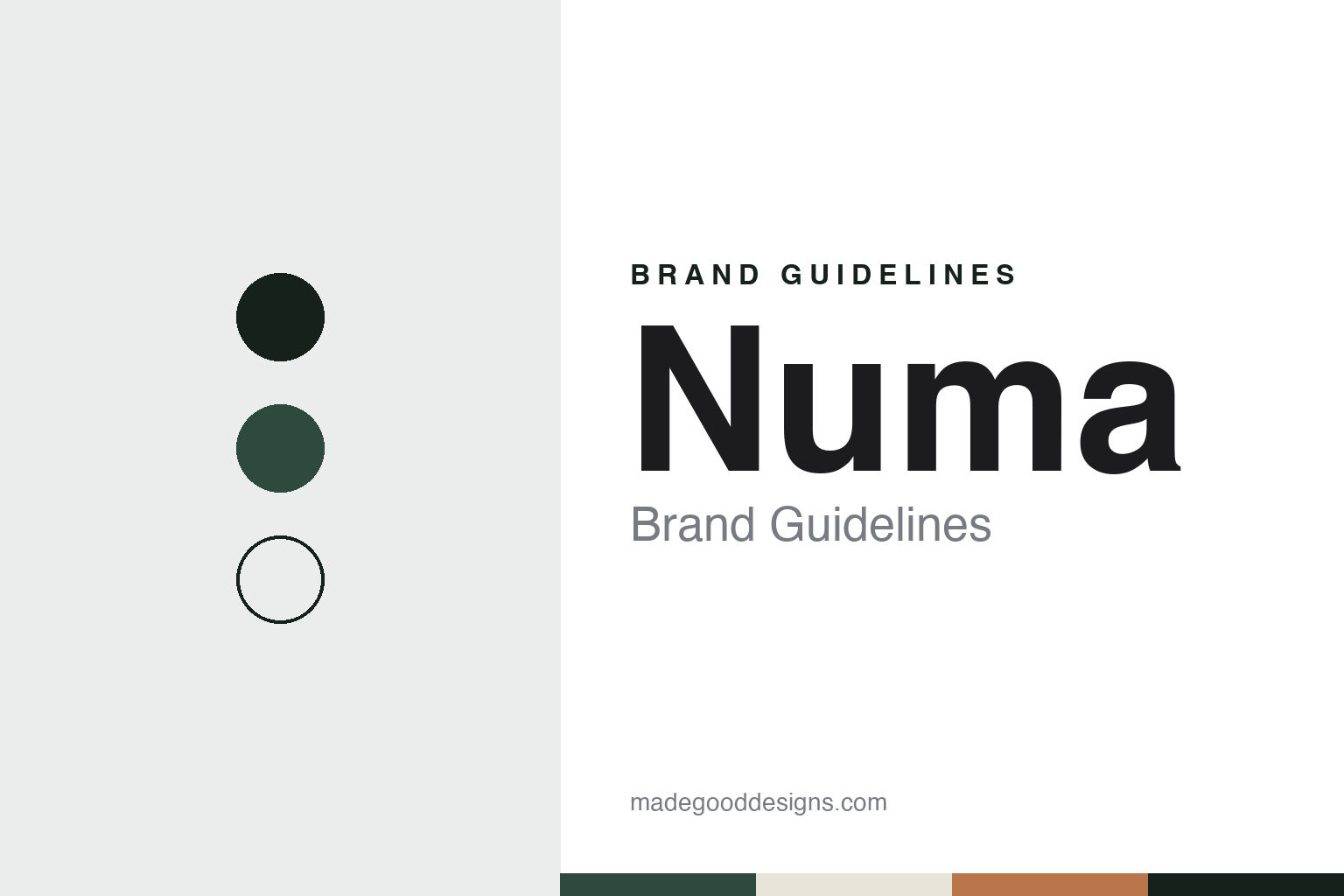
This guide’s Numa palette is Courtyard green #2E4A3F, Night ink #16211C, Plaster #E9E4DA, Brick clay #B9764A and Linen #F6F3EE. The tones are the guide’s own unofficial interpretation, not official Numa hex codes.
When was Numa founded?
Numa was founded in 2019 (as Cosi), in Berlin, Germany.
Who founded Numa?
Numa was founded by Christian Gaiser, Dimitri Chandogin and Gerhard Maringer in 2019 (as Cosi).