Limehome Brand Guidelines
The Munich serviced-apartment operator with no reception desk.
Aa
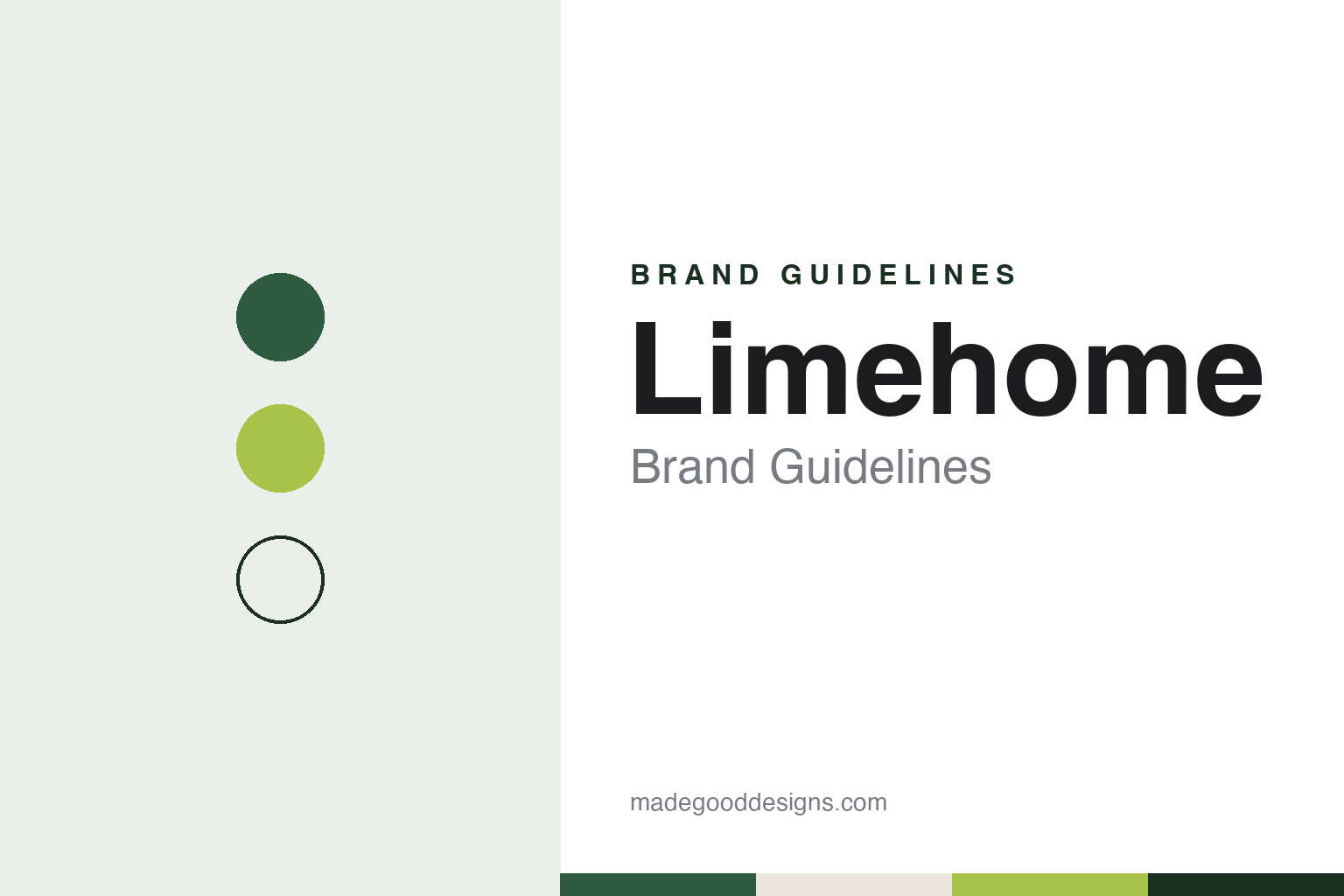
Two constants: a Limehome spruce, lime and stone palette and a geometric sans register. Abstract homage — not a Limehome product or mark; no interior, logo or app screen is reproduced.
Munich, 2018
Two founders and leased apartments.
Limehome is a serviced-apartment operator based in Munich. It was founded in 2018 by Lars Stäbe and Josef Vollmayr, the German start-up site deutsche-startups.de reported in December 2021, describing a company that rents residential units and fits them out as apartments for short and longer stays. Investors named in that report included HV Capital, Lakestar and Picus Capital, as well as the hotel group Althoff Hotels.
The company’s own history says it began with a team of ten people and now has offices in Munich and Madrid. In the 2021 interview, Vollmayr said Limehome had relied from the start on an operating system it built itself, and that during 2021 it had expanded into the Netherlands and added locations in Germany, Austria and Spain, in business and leisure destinations and in both smaller and larger cities. He described the year as difficult for the industry because rules on short stays kept changing, at times to the point of complete bans on overnight stays, and said the company had nonetheless kept expanding into new cities.
The hospitality trade site Tageskarte reported in September 2023, at the company’s fifth anniversary, that Limehome had signed its 5,000th apartment, in Stuttgart, and was present at 230 locations in 110 European cities across seven countries. Germany accounted for more than 3,000 of those apartments and Berlin alone for more than 500, the report said; it named Lisbon, Madrid, Amsterdam and Vienna among the company’s key locations. A third Stuttgart site, in Zuffenhausen, was then under construction with more than 130 units, developed with JW Investment Holding, and the company had more than 200 staff. Tageskarte described Vollmayr as co-founder and co-CEO.
Colour
An access code instead of a front desk.
Limehome’s model is digital. Its website says guests choose an apartment on the website or app, check in online and receive an access code to open the door, with “no reception needed”; check-out and invoicing are handled the same way. The company calls itself “a digital-first operator” and says it automates “the boring parts” of a stay. Instead of owning buildings, it leases them, or parts of them, from owners and developers, and its website has separate pages inviting property owners to lease to Limehome.
The look is meant to repeat across very different buildings, from new blocks to converted hotels. The company’s website promises “contemporary furnishings” with “a calming aesthetic,” and its strapline, used across the site and its press releases, is “Designed to stay.” In a press release of June 2026 the company said it had begun rolling out a new suite design, already installed in London, Valencia and a new Berlin flagship, with warmer materials, improved comfort features and “a more consistent visual language across properties.” It said the design had been developed with outside design studios and refined through several rounds of testing and feedback, and that it was meant to be simpler to install in different types of building, from new blocks to older hotels being converted. The rollout, the company said, continues with new openings and selected refurbishments.
The name itself has appeared in two forms. The company’s own earlier pages, and German trade press such as deutsche-startups.de in 2021, wrote it in lower case, as “limehome”; the June 2026 press release writes “Limehome” with a capital letter, the form used in this guide. For a brand that guests meet mostly on a phone screen and on a door code, that wordmark, the strapline and the furnished rooms carry most of the identity.
Typography
Brand families and operators.
Aparthotel and serviced-apartment operators sell a stay that sits between a hotel room and a rented flat: a studio or apartment with a kitchen, let by the night or the month. Their brands are seen on building signs, booking pages, key cards and apps, and in the lobbies and shared rooms that trade titles describe when a brand is launched or refreshed.
Many of these companies present themselves as brand families rather than single names. A listed group may run several brands at once, each with its own name on the door, while the group name appears on corporate pages and investor statements. Others run one core brand and add a second, more premium name for newer, purpose-built buildings. Property, unit and city counts appear in company statements and dated press reports, and they change often as buildings open, close or switch operator.
Ownership varies widely across the category. Some operators are arms of listed property groups; some are founder-led companies that began with a handful of flats; others are backed by investors or have changed hands through acquisitions. Many do not own their buildings at all, but lease them from developers, pension funds or other landlords, so the brand on the façade belongs to the operator while the building belongs to someone else.
When these operators describe a brand change, they often talk about spaces as much as graphics: a reception desk combined with a café, a lounge turned into a coffee bar, a shared kitchen that doubles as a meeting room, or studios fitted for longer stays. This guide sets out what can be checked about each brand, who founded it, who owns it and how it is organised, and marks plainly what rests on the company’s own word.
Aa
A geometric sans for an app-led operator. (Specimen set in Outfit, a sans STAND-IN; NOT the Limehome logo.)
Limehome
From German cities to 13 countries.
The portfolio has grown through leases with property owners. In December 2025 the start-up news site Munich Startup reported that Limehome had contracted more than 3,500 additional units and reached around 12,500 serviced apartments and rooms in 156 cities in 13 European countries, with growth in Paris, London, Barcelona and Berlin and around 1,000 new units in the German-speaking countries, the Benelux countries and the Iberian Peninsula. The same report said the company had received new financing from Cheyne Strategic Value Credit, part of the asset manager Cheyne Capital, combining growth finance with an equity stake. It named Vollmayr and Cesar de Sousa Freitas as the company’s co-CEOs; the company’s website names the same two as its chief executives.
By June 2026 Limehome said it had more than 13,000 apartments and hotel rooms under contract in 160 cities in 13 countries, and more than 300 staff. Its press release that month listed new openings in Düsseldorf, Gelsenkirchen and Leverkusen and in central London, locations in Italian cities including Rome, Milan and Florence, and contracts in the five biggest Dutch cities, Amsterdam among them. It named landlords including Aroundtown, the listed property company, in Frankfurt, and Baltisse in Brussels, where the company said an existing hotel in the European Quarter was being converted into 114 serviced apartments; in Milan’s Navigli district it said Colliers Global Investors Italy had chosen it as sole tenant for 30 units.
For a design guide, Limehome shows how a brand with no front desk carries its identity through a booking app, an access code and one furnished room design repeated across many leased buildings. Compare Numa, a Berlin-founded digital aparthotel operator, and Bob W, a Helsinki-founded short-stay operator. For this guide we use a spruce green, fresh lime, pale stone and warm white with a sans, an unofficial interpretation; no product or logo is reproduced.
Explore & save
Keep Limehome’s identity on hand — save it to a board in the Made Good inspiration library.
Limehome identity set
Pin the Limehome spruce, lime and stone palette and the geometric sans register to your own board.
Source & notes
Frequently Asked Questions
What font can I use to match the Limehome look?
This guide describes Limehome’s type as “A geometric sans for an app-led operator”. Its type specimen is set in Outfit from Google Fonts as a stand-in; Outfit is not Limehome’s own lettering.
What colours are in the Limehome palette?
This guide’s Limehome palette is Spruce #2E5B3F, Deep pine #1B2E22, Fresh lime #A9C24A, Pale stone #D6D1C6 and Warm white #F7F5F0. The tones are the guide’s own unofficial interpretation, not official Limehome hex codes.
When was Limehome founded?
Limehome was founded in 2018, in Munich, Germany. Limehome is known for Serviced apartments with digital check-in.
Who founded Limehome?
Limehome was founded by Lars Stäbe and Josef Vollmayr in 2018.