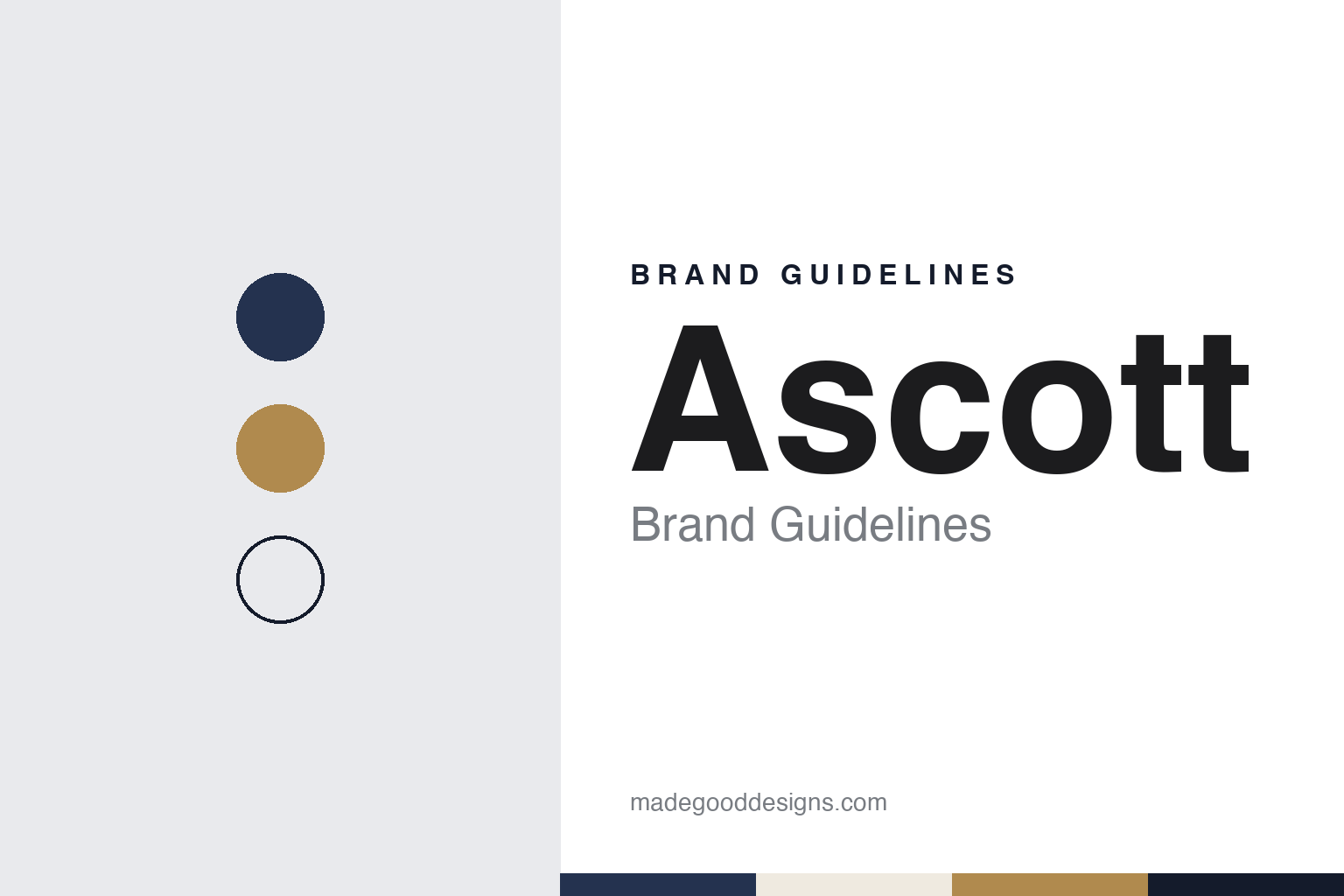
Ascott Brand Guidelines
The Singapore serviced-residence group named after Scotts Road.
Aa
Two constants: a navy, brass and linen palette and a hospitality serif register. Abstract homage — not an Ascott property, product or mark; no logo, sign or key card is reproduced.
Scotts Road
One residence in Singapore, then a string of mergers.
Ascott began in Singapore on 14 August 1984, when Scotts Holdings opened The Ascott Singapore, a serviced residence on Scotts Road, according to English Wikipedia. The same source says the name was coined by Ameerali Jumabhoy of the family behind Scotts Holdings: it stands for Scotts Road, where the building stood, and nods to the Ascot races in England, a reference to the family’s association with equestrian sport. The name, in other words, is a street address turned into a brand.
The company that now carries the name was formed through mergers. Wikipedia says Scotts Holdings merged with Stamford Group, the serviced-residence arm of DBS Land, to form The Ascott Limited, with a joint portfolio of more than 1,700 units in eight cities. In 1998 Pidemco Land set up its own serviced-residence arm, Somerset International, and bought Liang Court Holdings, forming Somerset Holdings. When DBS Land and Pidemco Land merged to form CapitaLand, Ascott and Somerset Holdings were merged too, in 2000, giving a portfolio of about 6,000 serviced residences in ten countries, Wikipedia says.
Ascott became a wholly owned subsidiary of CapitaLand on 28 April 2008. After CapitaLand restructured and CapitaLand Investment was listed on 20 September 2021, Ascott became that company’s wholly owned lodging arm, according to Wikipedia; trade reports in 2022 and 2026 describe it in the same terms. Its chief executive, Kevin Goh, has also been named as CapitaLand’s chief executive for lodging in reports by The Business Times.
The group grew by buying other operators as well as by signing new buildings. Wikipedia records that Ascott took half of Citadines, a European serviced-residence chain with properties in France, the UK, Belgium, Spain and Germany, in 2003, and bought the rest in 2004; at that point it ran three brands, Ascott The Residence, Citadines and Somerset. It then took a stake in Australia’s Quest Apartment Hotels in 2014 and a majority of it in 2017, a majority of the US corporate-housing firm Synergy Global Housing in 2017, and a majority of Green Oak Hotel Management, the holding company of the Indonesian hotel operator TAUZIA, in 2018.
Colour
Citadines, Somerset, lyf and Oakwood.
Ascott runs a family of brands rather than one. The serviced residences that carry the Ascott name sit alongside Somerset, inherited from the 2000 merger, and Citadines, the aparthotel chain bought in 2003–2004. The word Citadines means “city dwellers” in French, TOP HOTEL NEWS noted in September 2022, when Ascott unveiled a refresh of the brand under the tagline “for the love of cities.” At that time the trade title counted 104 Citadines properties in operation, with Citadines Raffles Place Singapore as the flagship.
The refresh was described in terms of spaces rather than graphics. TOP HOTEL NEWS reported a “café check-in” at Citadines Raffles Place, where the reception desk is combined with a café in the lobby; a social lounge at Citadines Bay City Manila turned into a coffee bar; a residents’ kitchen that doubles as a private dining or meeting room; and a lobby workspace with communal tables and high bar stools. A programme called activ∞, written with the infinity sign, was named as a signature across Citadines properties, covering resident events and fitness amenities.
The youngest of the in-house brands is lyf, written in lower case. Ascott launched it as a co-living brand in 2016, Wikipedia says. The Business Times reported in July 2020 that the earliest lyf to open, lyf Funan Singapore, had opened in September 2019 and that lyf Sukhumvit 8 Bangkok, with 196 units, was opening that week; Kevin Goh described lyf to the paper as “a hybrid lodging solution” combining serviced residences, hotels and co-living apartments, designed for long stays with room for short ones.
Another brand arrived in 2022. On 4 July that year CapitaLand Investment announced that Ascott was buying the serviced-apartment brand Oakwood from Mapletree Investments, The Business Times reported, adding some 81 properties and about 15,000 units; the price was not disclosed. Oakwood Premier Tokyo and Oakwood Premier Coex Center Seoul were named among its flagship properties, and Goh said Oakwood would “continue to grow alongside Ascott’s current portfolio of global brands.” Wikipedia records the purchase as made in 2022.
By its own count the group has kept growing. In February 2026 Serviced Apartment News carried Ascott’s statement that it had signed about 19,000 units across 102 properties in 2025, entered more than ten new cities including Taipei and Wellington, and had more than 1,000 properties with over 176,000 units in operation or under development worldwide.
Typography
How the category presents itself.
Aparthotel and serviced-apartment operators sell a stay that sits between a hotel room and a rented flat: a studio or apartment with a kitchen, let by the night or the month. Their brands are seen on building signs, booking pages, key cards and apps, and in the lobbies and shared rooms that trade titles describe when a brand is launched or refreshed.
Many of these companies present themselves as brand families rather than single names. A listed group may run several brands at once, each with its own name on the door, while the group name appears on corporate pages and investor statements. Others run one core brand and add a second, more premium name for newer, purpose-built buildings. Property, unit and city counts appear in company statements and dated press reports, and they change often as buildings open, close or switch operator.
Ownership varies widely across the category. Some operators are arms of listed property groups; some are founder-led companies that began with a handful of flats; others are backed by investors or have changed hands through acquisitions. Many do not own their buildings at all, but lease them from developers, pension funds or other landlords, so the brand on the façade belongs to the operator while the building belongs to someone else.
When these operators describe a brand change, they often talk about spaces as much as graphics: a reception desk combined with a café, a lounge turned into a coffee bar, a shared kitchen that doubles as a meeting room, or studios fitted for longer stays. This guide sets out what can be checked about each brand, who founded it, who owns it and how it is organised, and marks plainly what rests on the company’s own word.
Aa
A refined hospitality serif for a group named after a street. (Specimen set in Cormorant Garamond, a serif STAND-IN; NOT the Ascott logo or any of its brand marks.)
Ascott
A street name that became a brand family.
For designers the useful thing about Ascott is how many identities sit under one owner. A single parent company holds a serviced-residence name taken from a Singapore street, a French aparthotel name that means “city dwellers,” a lower-case co-living name, and a US-founded apartment brand bought in 2022.
The 2022 Citadines refresh also shows how an operator describes a brand change through the guest’s route through a building: a reception that works as a café, a lounge turned into a coffee bar, a kitchen that becomes a meeting room, and a programme name that borrows a mathematical symbol. The trade report described the change through those spaces.
For a design guide, Ascott shows how a group built through mergers can hold several brand voices at once, from a residence named after a road to a co-living brand written in lower case. Compare its parent, CapitaLand, and Oakwood, the apartment brand Ascott agreed to buy in 2022. For this guide we use a deep navy, a brass gold and a linen white with a serif, an unofficial interpretation; no product or logo is reproduced.
Explore & save
Keep Ascott’s identity on hand — save it to a board in the Made Good inspiration library.
Ascott identity set
Pin the Ascott navy, brass and linen palette and the hospitality serif register to your own board.
Source & notes
Frequently Asked Questions
What font can I use to match the Ascott look?
This guide describes Ascott’s type as “A refined hospitality serif for a group named after a street”. Its type specimen is set in Cormorant Garamond from Google Fonts as a stand-in; Cormorant Garamond is not Ascott’s own lettering.
What colours are in the Ascott palette?
This guide’s Ascott palette is Scotts Road navy #24324F, Night ink #141B2B, Lobby brass #B08A4E, Linen #EFEAE0 and Paper #F8F6F1. The tones are the guide’s own unofficial interpretation, not official Ascott hex codes.
When was Ascott founded?
Ascott was founded in 1984 (The Ascott Singapore), in Singapore.