Staycity Brand Guidelines
The Dublin aparthotel group begun in one Temple Bar flat.
Aa
Two constants: a green, brick and oat palette and a friendly geometric sans register. Abstract homage — not a Staycity or Wilde property, product or mark; no logo or sign is reproduced.
Temple Bar
Two brothers, one apartment and a website.
Staycity began in Dublin in 2004 with a single apartment in Temple Bar. Its founders are the brothers Tom and Ger Walsh, according to The Irish Times in June 2018 and the news site Fora in January 2018; in October 2025 The Irish Times again gave 2004 as the year the company was established, with Tom Walsh as chief executive and co-founder. The 2018 profile describes Tom Walsh as an engineer by profession who had worked for the adhesives maker Loctite, and Ger as a computing graduate of Trinity College Dublin.
The apartment had been converted from a former recording studio, and when the brothers decided to let it to tourists, Ger built a website for it; a booking came in straight away, The Irish Times reported. They turned that into a business plan. In 2004 they leased a block of 27 apartments in Dublin’s Italian Quarter near Millennium Walk from a developer, then a further 27 on Augustine Street. In 2005 the company moved into Amsterdam, working on commission with a local firm that controlled the apartments, a model Staycity later dropped because it was not in control of the guest experience, and in 2006 it moved into Birmingham. By 2006, the paper said, it had some 120 properties under its control, and Tom Walsh had joined his brother full-time.
Ownership has stayed largely with the founders. In 2018 The Irish Times reported that the company was owned by the brothers, family members and some key executives, with director Paul Dowling holding a 25 per cent stake and the hotel-industry executive Patrick Dempsey close to 5 per cent. In 2007 the Ryan family’s investment vehicle Irelandia had taken a 40 per cent stake; it sold out in 2015, when the Walshes bought the stake back with funding from Proventus Capital Partners. Ger Walsh had by then left the business to work in technology, but kept his shareholding and his seat on the board. In 2025 The Irish Times described Staycity as privately held.
Colour
Leased buildings, two brands.
Staycity runs its buildings rather than listing other people’s homes. The Irish Times set out the model in 2018: a developer builds a turnkey property, furnished down to the cutlery; a pension fund or other financier buys it and leases it to Staycity, typically for 25 years, with rights to renew; and Staycity operates it. Tom Walsh told the paper that almost everything in the portfolio was owned by pension funds, naming LaSalle Investment Management, Knight Frank pension managers and the Dutch pension fund ABP among the funds it worked with.
The company has two brands. Staycity Aparthotels is the core name. Wilde, introduced as “Wilde Aparthotels by Staycity,” is the group’s premium, purpose-built brand: Fora reported in January 2018 that it had just been launched, with London as its opening city, and The Irish Times called Wilde the group’s boutique lifestyle brand in October 2025. The same Fora report said Staycity had recently opened aparthotels in Marseille, Lyon and Manchester and ran more than 4,500 serviced apartments in ten cities, mainly in the UK.
The company has since moved into continental Europe through deals as well as leases. In November 2024 TOP HOTEL NEWS reported that Staycity had taken a majority stake in the German extended-stay business Felix Group, from the Munich developer Denkmalneu, adding two operating sites in Dresden and Leipzig with 388 rooms between them and a Vienna project then under construction. At that time the group had around 5,800 rooms open across 35 aparthotels in France, Germany, Ireland, Italy and the UK. The same report said Staycity had set up a separate development platform, Carnsor, led by its chief development officer Andrew Fowler, responsible for sourcing sites and developing buildings for both brands.
By October 2025 the group operated 6,500 rooms in 39 aparthotels across 20 cities, aimed at business and leisure travellers, The Irish Times reported, adding that Staycity had exchanged contracts with Swiss Life Asset Management for a site on Blackfriars Road in Southwark, London, its fifth London site in in-house development. By mid-2018 the head office had moved to a historic building in Dublin’s Liberties, the earlier profile said.
Typography
How the category presents itself.
Aparthotel and serviced-apartment operators sell a stay that sits between a hotel room and a rented flat: a studio or apartment with a kitchen, let by the night or the month. Their brands are seen on building signs, booking pages, key cards and apps, and in the lobbies and shared rooms that trade titles describe when a brand is launched or refreshed.
Many of these companies present themselves as brand families rather than single names. A listed group may run several brands at once, each with its own name on the door, while the group name appears on corporate pages and investor statements. Others run one core brand and add a second, more premium name for newer, purpose-built buildings. Property, unit and city counts appear in company statements and dated press reports, and they change often as buildings open, close or switch operator.
Ownership varies widely across the category. Some operators are arms of listed property groups; some are founder-led companies that began with a handful of flats; others are backed by investors or have changed hands through acquisitions. Many do not own their buildings at all, but lease them from developers, pension funds or other landlords, so the brand on the façade belongs to the operator while the building belongs to someone else.
When these operators describe a brand change, they often talk about spaces as much as graphics: a reception desk combined with a café, a lounge turned into a coffee bar, a shared kitchen that doubles as a meeting room, or studios fitted for longer stays. This guide sets out what can be checked about each brand, who founded it, who owns it and how it is organised, and marks plainly what rests on the company’s own word.
Aa
A friendly geometric sans for a city-apartment brand. (Specimen set in DM Sans, a sans STAND-IN; NOT the Staycity or Wilde logo.)
Staycity
A plain name and a premium second brand.
The name says what the company sells: a stay in a city. It began as the name of a website for one Dublin apartment and stayed with the company as it grew into a group of operator-run aparthotels in Ireland, the UK and continental Europe. Beside it, the group created a second, more distinct name, Wilde, for its premium buildings, so that one plain descriptive brand and one more character-led brand sit under the same operator.
That split is the design lesson. The core brand carries the operator’s name on studio and apartment buildings across many cities, while the premium brand was introduced by early 2018 with its own name and later described as a boutique lifestyle brand. Both run on leased buildings: in 2018 Tom Walsh said almost everything in the portfolio was owned by pension funds, so the operator’s name goes on buildings that others own.
For a design guide, Staycity shows how a founder-led operator can grow from a single apartment into two brands without changing its own plain name. Compare Ascott, whose Citadines brand is another aparthotel name, and Limehome, a younger serviced-apartment operator from Munich. For this guide we use a deep green, a brick red and an oat white with a sans, an unofficial interpretation; no product or logo is reproduced.
Explore & save
Keep Staycity’s identity on hand — save it to a board in the Made Good inspiration library.
Staycity identity set
Pin the Staycity green, brick and oat palette and the friendly geometric sans register to your own board.
Source & notes
Frequently Asked Questions
What font can I use to match the Staycity look?
This guide describes Staycity’s type as “A friendly geometric sans for a city-apartment brand”. Its type specimen is set in DM Sans from Google Fonts as a stand-in; DM Sans is not Staycity’s own lettering.
What colours are in the Staycity palette?
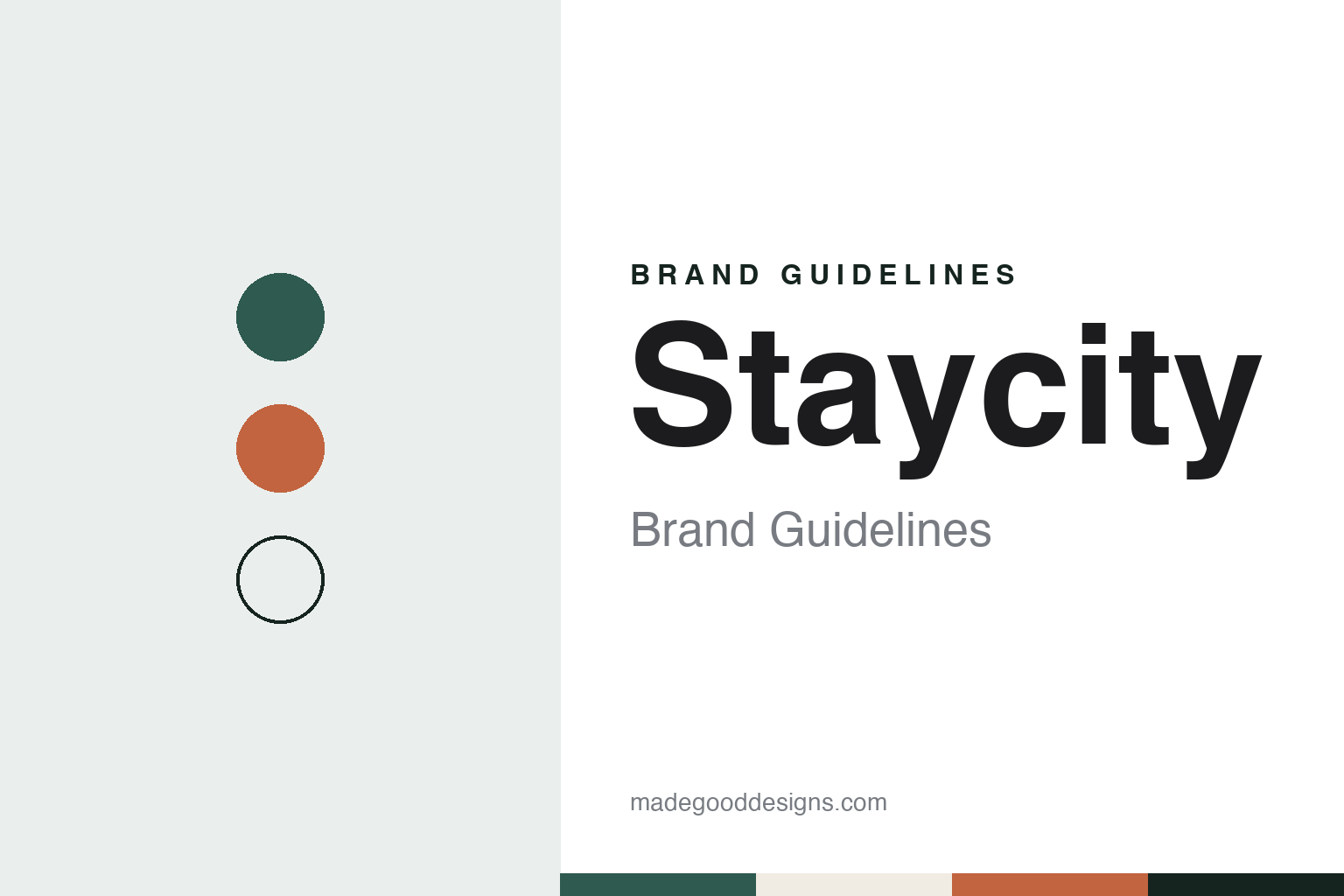
This guide’s Staycity palette is Liffey green #2E5A4F, Dark slate #16241F, Brick red #C2643F, Oat #F1ECE3 and Paper #F8F7F3. The tones are the guide’s own unofficial interpretation, not official Staycity hex codes.
When was Staycity founded?
Staycity was founded in 2004, in Dublin, Ireland.
Who founded Staycity?
Staycity was founded by Tom and Ger Walsh in 2004.