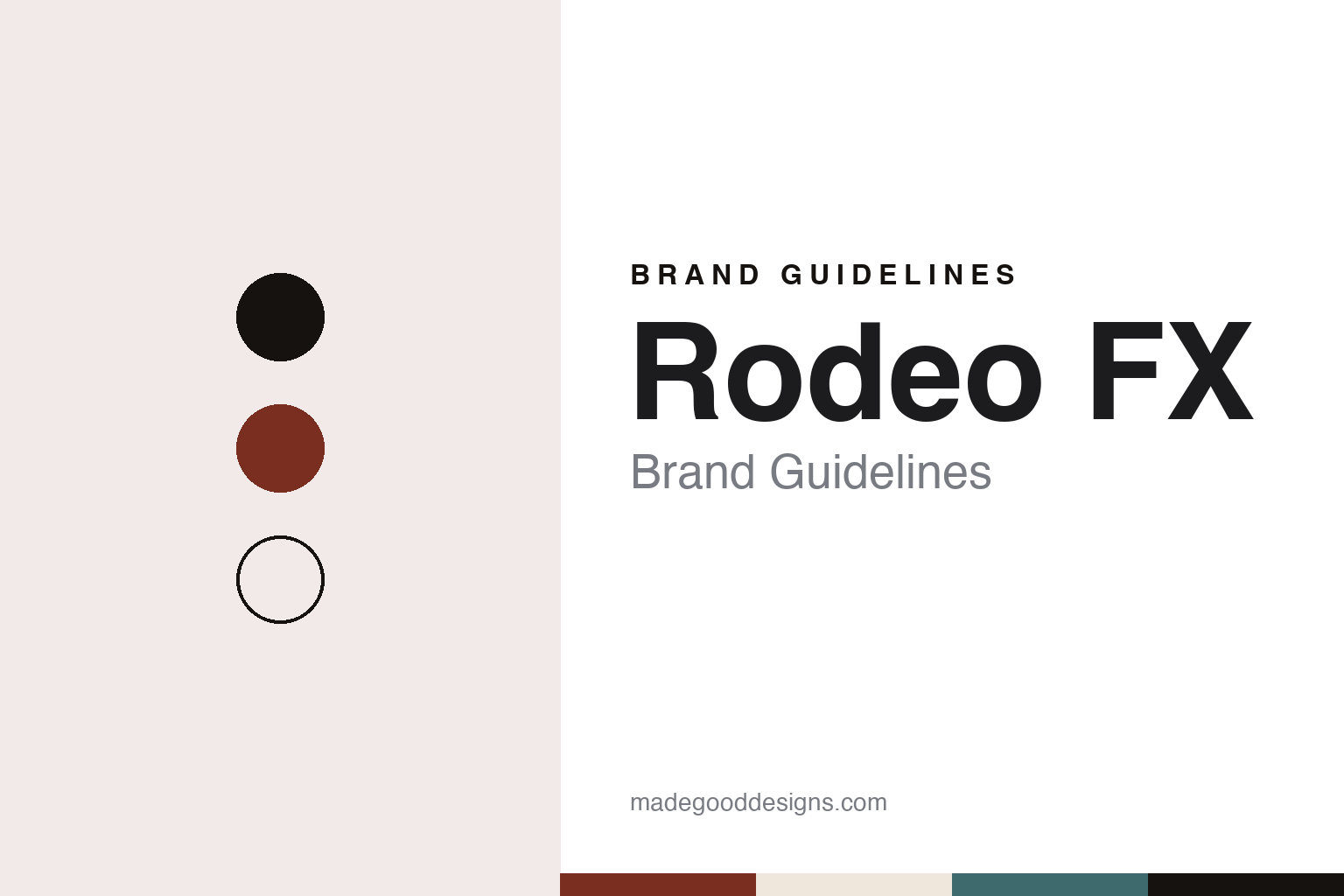
Rodeo FX Brand Guidelines
The Montreal studio that grew out of an Old Montreal basement.
Aa
Two constants: a red, black and limestone palette with a cool teal, and a geometric grotesque register. Abstract homage — not a Rodeo FX product or mark; no frame, logo or title card is reproduced.
A basement in Old Montreal
One founder, one city, feature films from 2007.
Rodeo FX was founded in Montreal in 2006 by Sébastien Moreau, according to English and French Wikipedia, and began producing visual effects for feature films in 2007. An AFP report published by Digital Journal in January 2026 said the studio was born about twenty years earlier in a dim basement in Old Montreal; one of its visual-effects supervisors told the agency that it all started in the basement of the building next door to the studio’s current home. Moreau still led the company in 2025: Cartoon Brew described him that March as Rodeo FX’s founder and chief executive.
The name pairs a short English word, “Rodeo”, with FX, the industry’s usual abbreviation for effects, and the company uses the same name in French and in English, as both Wikipedia editions show.
In its early years the studio worked on feature films. English Wikipedia says that in 2013 Rodeo FX moved into television, creating more than 150 shots with altered visuals for the fourth season of HBO’s Game of Thrones. The AFP report of 2026 said the studio worked on the fourth and fifth seasons of Netflix’s Stranger Things, where a 3D modeller spent about a year refining the series’ Demogorgon creature and compared the work to making a clay sculpture. The same report said that for the first season of the HBO Max series Dune: Prophecy, released in 2024, the team based an imperial palace on the Mediterranean coastline and researched the trees and rock found there.
Colour
From one city to five offices.
The studio grew outward from Montreal in steps that are each dated. English Wikipedia says Rodeo FX opened its next office in Quebec City in early 2014; French Wikipedia dates that opening to the spring of 2014. In December 2014, after buying the effects company Hatch FX, it opened an office in Los Angeles; English Wikipedia quotes the company’s head of technology as saying the move put it closer to the studios, directors and the film development process. In November 2017 Rodeo FX announced an office in Munich as a base for the European effects market, and English Wikipedia says its European office moved to Paris in June 2023. Cartoon Brew described the Paris studio, opened in 2023, as the company’s fifth international office.
Acquisitions widened the work beyond film and series effects. French Wikipedia says that in September 2020 Rodeo FX bought BLVD-MTL, a multimedia studio in Montreal. English Wikipedia now describes the company as offering visual effects, advertising, animation and experiential work, and in 2026 a company announcement carried by Post Magazine listed offices in Montreal, Quebec City, Toronto, Los Angeles and Paris.
The studio’s public face is largely its breakdown reels. The trade site befores & afters keeps a running list of Rodeo FX breakdowns, including a reel for IT: Welcome to Derry alongside several other series. In a breakdown reel a shot is shown as filmed and then layer by layer as finished, so the reels double as the studio’s public portfolio.
Typography
How visual-effects studios present themselves.
Visual-effects studios rarely sell anything to the public, so their brands live in a handful of places: the studio name and logo, the showreel, the title card that runs at the end of a film’s credits, and the pages a studio publishes about its people and its offices. Many names began as nicknames or in-jokes among small founding teams, and several studios have kept an old short form while the company behind it changed hands.
Showreels and project pages do most of the work. Studios publish clips, breakdowns and lists of supervisors by name, while trade titles such as fxguide, Cartoon Brew, Variety and Deadline report which studio worked on which film or series. In this guide, film and series credits are given only as a dated source credits them, and studio and staff counts only as a dated source or the company itself gives them.
Offices are part of the identity too. Studios describe themselves by the cities they work in, and a single brand may sit over studios in Europe, North America, India and Australia, each opened in a different year and sometimes closed again. Corporate pages name founders, chief executives and owners, and those ownership lines vary widely: some studios are owned by their founders, some belong to listed groups or holding companies, and some are owned by streaming services or technology firms.
This guide sets out what can be checked about each studio — who founded it, when and where, who owns it now and how its name and look have changed — from dated sources, and marks plainly what rests only on the company’s own word. Colours and typefaces shown here are our own interpretation, not the studios’ official palettes.
Aa
A geometric grotesque for a short, two-part studio name. (Specimen set in Space Grotesk, a sans STAND-IN; NOT the Rodeo FX logo.)
Rodeo FX
Mikros Animation joins the company.
The main change to the company came out of another group’s collapse. When Technicolor Group, the owner of MPC, The Mill and Mikros Animation, began shutting down in February 2025, its animation studio was put up for sale. On 27 March 2025 Cartoon Brew reported that the Montreal-headquartered Rodeo FX had acquired Mikros Animation, with terms not disclosed. The deal, the trade site said, covered all of Mikros Animation’s operations as well as Technicolor Canada’s equipment, while the Technicolor India group that had worked on Mikros productions was not included; Mikros’s episodic division was bought separately by another company.
Cartoon Brew said Mikros Animation had worked on 17 animated features for studios including DreamWorks Animation, Paramount Animation and Netflix, and had produced nearly 300 hours of episodic series for broadcasters such as Nickelodeon, TF1 and France TV. It quoted the Quebec law firm Lavery, which advised Technicolor Canada on the sale, as saying it would preserve up to 207 jobs in Montreal and another 80 in France. A Rodeo FX spokesperson told the site that most of Mikros’s recent staff in Montreal and Paris would keep working. Mikros Animation kept its own brand under Rodeo FX, with its own slate of projects and production pipeline, and a long-serving Mikros executive, Julien Meesters, was appointed president of the Mikros operation. Variety also reported the acquisition on 28 March 2025. The result is a two-brand structure: Rodeo FX for effects, advertising and experiential work, and Mikros Animation for animated features and series, under one Montreal owner.
In January 2026 the AFP report described Rodeo FX as still headquartered in Montreal, far from Hollywood, with offices in Los Angeles, Paris and Toronto. The same report quoted a supervisor on how long the work takes: a fight scene of less than seven minutes in the fourth season of Stranger Things took up to a year from concept to final cut, he said.
For a design guide, Rodeo FX shows how a Montreal studio can keep a short, informal name across several cities while adding a second brand of its own. Compare MPC, whose former parent sold Mikros Animation to Rodeo FX, and Cinesite, another studio that runs effects and animation side by side. For this guide we use a deep red, black and limestone with a teal accent and a sans, an unofficial interpretation; no product or logo is reproduced.
Explore & save
Keep Rodeo FX’s identity on hand — save it to a board in the Made Good inspiration library.
Rodeo FX identity set
Pin the Rodeo FX red, black and limestone palette and the geometric grotesque register to your own board.
Source & notes
Frequently Asked Questions
What font can I use to match the Rodeo FX look?
This guide describes Rodeo FX’s type as “A geometric grotesque for a short, two-part studio name”. Its type specimen is set in Space Grotesk from Google Fonts as a stand-in; Space Grotesk is not Rodeo FX’s own lettering.
What colours are in the Rodeo FX palette?
This guide’s Rodeo FX palette is Saddle red #7A2E1F, Basement black #16120F, Limestone #EFE7DC, River teal #3E6A6E and Paper #F8F6F2. The tones are the guide’s own unofficial interpretation, not official Rodeo FX hex codes.
When was Rodeo FX founded?
Rodeo FX was founded in 2006, in Montreal, Quebec, Canada.
Who founded Rodeo FX?
Rodeo FX was founded by Sébastien Moreau in 2006.