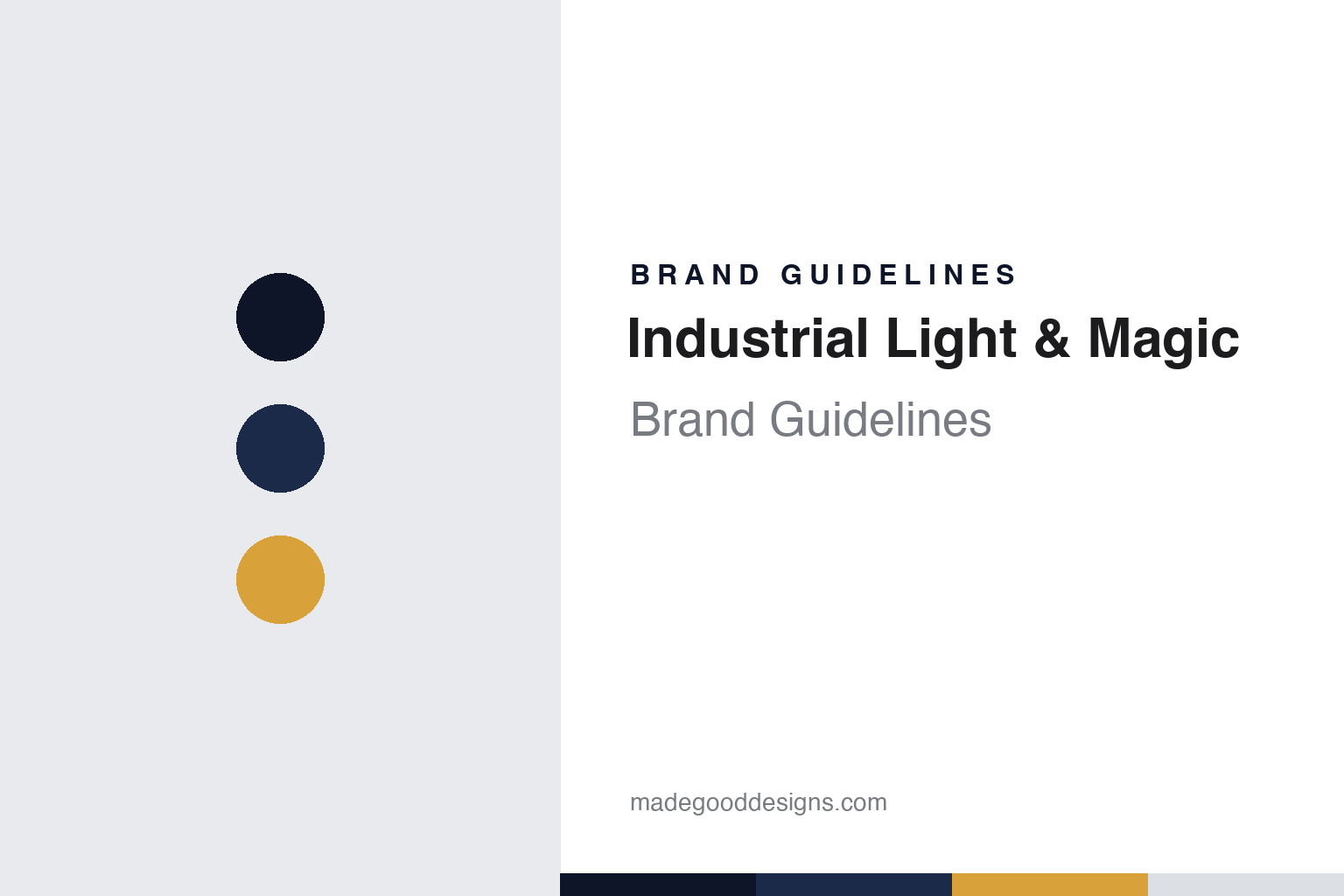
Industrial Light & Magic Brand Guidelines
The Lucasfilm workshop that grew from a Van Nuys warehouse.
Aa
Two constants: a night blue and lamp amber palette and a condensed sans register. Abstract homage — not an Industrial Light & Magic product or mark; no frame, logo or character is reproduced.
A warehouse in Van Nuys
A light-industrial address and a film that needed new effects.
Industrial Light & Magic was founded by George Lucas on 26 May 1975, English Wikipedia says, to create the visual effects for the film that became Star Wars (1977). It is a division of Lucasfilm, the production company Lucas also founded, and it is usually shortened to ILM. The studio’s own history page places its start in Van Nuys, California, and treats 1975 to 1980 as its early years.
The first team was put together by John Dykstra, whom the effects artist Douglas Trumbull had suggested to Lucas. Writing in Variety in August 2025, Jazz Tangcay quoted the visual-effects supervisor John Knoll describing that group as artists, engineers and people with very different backgrounds, many of whom had never worked in film; Variety counts industrial designers, electronics and mechanical engineers and even musicians among them, about 25 artists working out of a warehouse in Van Nuys. English Wikipedia says the name came from the location map: the warehouse sat in an area zoned for light industry, so Lucas called the group Industrial Light and Magic.
In late 1978, as work began on the sequel to Star Wars, Lucas reformed most of the team in Marin County, north of San Francisco. English Wikipedia says the company then worked from an inconspicuous property in San Rafael until 2005, known to locals as the Kerner Company, a name chosen so that it would draw no attention. Variety says Lucas decided to keep the group together and offer it as a service to other filmmakers, so that it could go on building experience and technology between his own films.
A computer division, the Graphics Group, was set up inside Lucasfilm in 1979 with Edwin Catmull, English Wikipedia says; it belonged to a separate division from ILM and was later sold to Steve Jobs and renamed Pixar. ILM itself worked with Steven Spielberg on films including Jurassic Park (1993), where, English Wikipedia says, artists painted colour and texture directly onto the surfaces of computer models. In 2000 the studio created OpenEXR, an image file format for high-dynamic-range pictures, according to the same source.
Colour
From San Rafael to the Presidio, and from Lucasfilm to Disney.
In 2005 ILM left San Rafael for the Letterman Digital Arts Center in the Presidio of San Francisco, where it is still based, English Wikipedia says. In the same move a management-led team bought the physical and practical effects divisions and formed a separate company, which kept the Kerner name.
The studio then spread beyond California. Screen Global Production reported in August 2023 that ILM’s Singapore studio had opened in 2004 and had moved into Disney’s Southeast Asia offices in the Sandcrawler Building in 2013. English Wikipedia says ILM first opened a temporary site in Vancouver, moved in 2014 to a studio on Water Street in Gastown, and moved again in 2025 to The Stack tower in Coal Harbour. A London studio in Soho opened on 15 October 2014, and a television division, ILM TV, was launched there on 7 November 2018. A Sydney studio was announced in July 2019 and a Mumbai studio opened in October 2022, according to English Wikipedia.
The ownership changed in 2012. In October that year the Walt Disney Company agreed to buy Lucasfilm, and the Los Angeles Times reported on 31 October 2012 that the deal would bring ILM and Skywalker Sound to Disney along with the Star Wars films. English Wikipedia says Disney’s purchase of Lucasfilm brought it ILM, Skywalker Sound and LucasArts. After Disney bought 21st Century Fox, the Fox VFX Lab, including its Technoprops division, was folded into ILM, the same source says.
In August 2023 Disney said the Singapore studio would close. A Disney spokesperson told the Singapore broadcaster CNA that ILM was “consolidating its global footprint and winding down its Singapore studio due to economic factors affecting the industry,” Screen Global Production reported on 15 August 2023, putting the number of staff affected at about 300. Disney said it would offer those employees the chance to move to its other studios, and Singapore’s Economic Development Board and Infocomm Media Development Authority said they were helping staff find roles elsewhere.
Typography
Visual effects as an industry.
Visual-effects studios rarely sell anything to the public, so their brands live in a handful of places: the studio name and logo, the showreel, the title card that runs at the end of a film’s credits, and the pages a studio publishes about its people and its offices. Many names began as nicknames or in-jokes among small founding teams, and several studios have kept an old short form while the company behind it changed hands.
Showreels and project pages do most of the work. Studios publish clips, breakdowns and lists of supervisors by name, while trade titles such as fxguide, Cartoon Brew, Variety and Deadline report which studio worked on which film or series. In this guide, film and series credits are given only as a dated source credits them, and studio and staff counts only as a dated source or the company itself gives them.
Offices are part of the identity too. Studios describe themselves by the cities they work in, and a single brand may sit over studios in Europe, North America, India and Australia, each opened in a different year and sometimes closed again. Corporate pages name founders, chief executives and owners, and those ownership lines vary widely: some studios are owned by their founders, some belong to listed groups or holding companies, and some are owned by streaming services or technology firms.
This guide sets out what can be checked about each studio — who founded it, when and where, who owns it now and how its name and look have changed — from dated sources, and marks plainly what rests only on the company’s own word. Colours and typefaces shown here are our own interpretation, not the studios’ official palettes.
Aa
A condensed sans for a studio name that began on a zoning map. (Specimen set in Barlow Condensed, a sans STAND-IN; NOT the Industrial Light & Magic logo.)
Industrial Light & Magic
Five studios, one name and a stage made of light.
Today ILM names five studios: San Francisco, Vancouver, London, Mumbai and Sydney. Its website says it has nearly 2,000 employees across them, while Variety put the figure at more than 3,500 visual-effects artists worldwide in August 2025. Janet Lewin is senior vice-president, general manager and head of ILM, Variety says. The website sorts the work into visual development, StageCraft, visual effects, feature animation and immersive entertainment, for film, television, streaming, commercials and attractions.
StageCraft is ILM’s virtual-production system, which uses high-definition LED walls to show computer-generated scenery around actors on set. The company’s history page says it developed StageCraft in 2018; English Wikipedia says it was introduced in 2019, on The Mandalorian. In Variety, Knoll said the LED wall was used for roughly half the scenes in that series and described it as a lighting instrument that brings image-based lighting into the physical set. ILM also built digital versions of the Swedish band ABBA for ABBA Voyage, Variety reported.
The studio has also folded its side brands back into one name. ILMxLAB became ILM Immersive in May 2023, English Wikipedia says, and Lewin told Variety in 2025 that the company had deliberately brought its sub-brands together under ILM, so that the immersive brand is now part of ILM itself. The marks belong to the parent company: the website states that Industrial Light & Magic, ILM, the “Bulb and Gear” design logo, StageCraft and TechnoProps are service marks of Lucasfilm Ltd. English Wikipedia dates the current logo to May 2023.
For a design guide, Industrial Light & Magic shows how a studio name taken from a zoning map can carry a long history, pass through sub-brands and return to a single short form. Compare Pixar, which grew out of Lucasfilm’s computer division, and Weta FX, another visual-effects studio. For this guide we use a night blue, a lamp amber and a studio grey with a condensed sans, an unofficial interpretation; no product or logo is reproduced.
Explore & save
Keep Industrial Light & Magic’s identity on hand — save it to a board in the Made Good inspiration library.
Industrial Light & Magic identity set
Pin the Industrial Light & Magic night blue and lamp amber palette and the condensed sans register to your own board.
Source & notes
Frequently Asked Questions
What font can I use to match the Industrial Light & Magic look?
This guide describes Industrial Light & Magic’s type as “A condensed sans for a studio name that began on a zoning map”. Its type specimen is set in Barlow Condensed from Google Fonts as a stand-in; Barlow Condensed is not Industrial Light & Magic’s own lettering.
What colours are in the Industrial Light & Magic palette?
This guide’s Industrial Light & Magic palette is Night blue #1C2A4A, Stage ink #0E1528, Lamp amber #D8A13A, Studio grey #DCDFE4 and Paper #F6F5F1. The tones are the guide’s own unofficial interpretation, not official Industrial Light & Magic hex codes.
When was Industrial Light & Magic founded?
Industrial Light & Magic was founded in 1975, in Van Nuys, California.
Who founded Industrial Light & Magic?
Industrial Light & Magic was founded by George Lucas in 1975.
Who owns Industrial Light & Magic?
Industrial Light & Magic is owned by Lucasfilm, part of Disney since 2012.