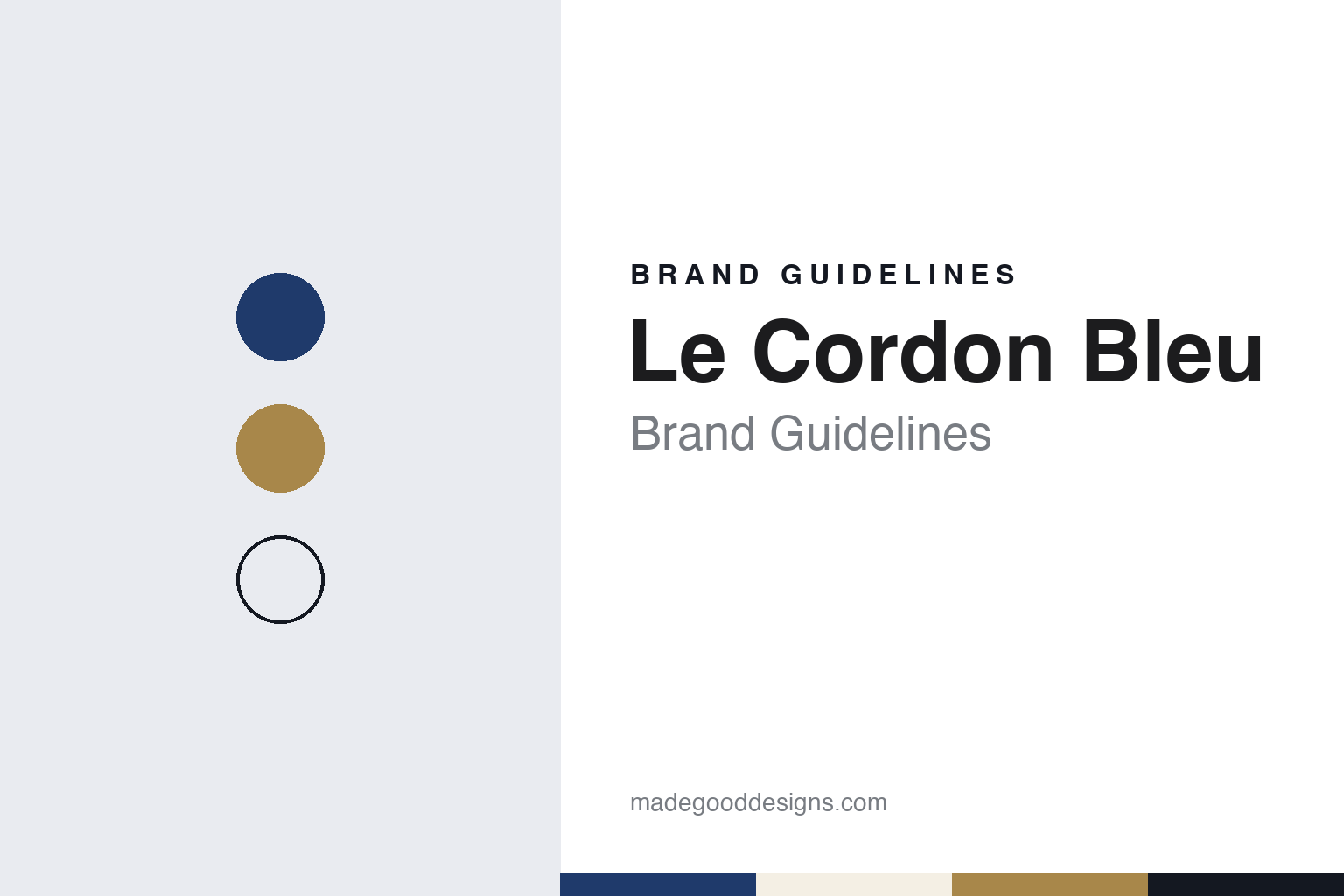
Le Cordon Bleu Brand Guidelines
The 1895 Paris cooking school named for a blue ribbon.
Aa
Two constants: a ribbon blue, ivory and brass palette and a classical serif register. Abstract homage — not a Le Cordon Bleu crest or mark; no logo, ribbon emblem or building is reproduced.
The blue ribbon
A cookery magazine becomes a Paris school.
Le Cordon Bleu began in Paris in 1895. English and French Wikipedia both name its founders as Marthe Distel, a journalist who published the cookery magazine La Cuisinière Cordon Bleu, and the cook Henri-Paul Pellaprat. French Wikipedia says the success of the magazine led Distel to give cooking demonstrations, and that the school she founded with Pellaprat opened its doors on 14 January 1896 in the Palais-Royal quarter of Paris. English Wikipedia adds that the magazine had offered lessons from established French chefs before the school took shape.
The name is older than the school. English Wikipedia traces it to the blue silk ribbon worn by knights of the Order of the Holy Spirit, the French royal order created in 1578. According to one story it relates, the order’s banquets came to be called “cordons bleus,” and by the nineteenth century the blue ribbon stood for fine cooking in general. The ribbon still appears at the school’s public ceremonies: when its new Paris campus opened in 2016, guests cut an inaugural blue ribbon, So Good magazine reported.
The name travelled early. English Wikipedia says a former student helped to open a school under the Le Cordon Bleu name in London in 1933.
The sources used for this guide do not say how the school operated during the occupation of 1940–1944. In 1945, English Wikipedia says, citing Justin Spring’s 2017 book The Gourmands’ Way, Élisabeth Brassart bought what remained of the struggling school from a Catholic orphanage that had come to own it; French Wikipedia names that charity as the Apprentis d’Auteuil. Brassart then ran the school for almost four decades.
Colour
From Brassart to Cointreau.
The modern group dates from 1984. That year, the Los Angeles Times reported in July 1995, André J. Cointreau bought the school from Brassart, its long-serving director and a friend of his family; French Wikipedia gives the year of the sale as 1988. Cointreau came from the families behind Cointreau liqueur and Rémy Martin cognac, the paper said, and had worked in marketing and finance, including at the Cointreau liqueur company, before the purchase.
Within about a decade the school had changed shape. By 1995, the Los Angeles Times reported, it had branches in London and Tokyo, had moved its Paris operation to a larger building and had a teaching staff of 26; its holding companies were then based in London. French Wikipedia now names the parent company as Le Cordon Bleu International BV, based in Amsterdam, and says the network teaches cuisine, pastry, confectionery, hospitality and restaurant management, publishes books and runs showcase restaurants in countries such as Canada and Mexico.
The network now reaches several continents. English Wikipedia, drawing on the official website, says it consists of 35 institutes in 20 countries with more than 20,000 attendees, in cities including Paris, London, Madrid, Ottawa, Lima, Sydney and Tokyo.
The United States followed a different path. Sixteen schools there operated as “Le Cordon Bleu North America” through a licensing agreement with Career Education Corporation, a for-profit education company based in the Chicago area, English Wikipedia says. In December 2015 Career Education announced that it intended to close all 16, with the last day for new enrolments set at 4 January 2016, The Christian Science Monitor reported; a spokesperson for Le Cordon Bleu told the paper that uncertainty over new federal rules for career colleges had weighed on every party that had considered taking the schools over. English Wikipedia says Le Cordon Bleu keeps a presence in the country through its New York office, Le Cordon Bleu Inc., which places students at its schools abroad.
Typography
Schools, owners and the way they present themselves.
Culinary and pastry schools present themselves through a small set of public signs: a school name, a crest or logo, a colour scheme and a short descriptive line. Some names carry a symbol. Le Cordon Bleu takes its name from the blue ribbon of a French royal order, English Wikipedia says, and guests cut a blue ribbon when its new Paris campus opened in 2016, So Good magazine reported. Others come from a place: Ferrandi Paris is linked to the Paris street where its workshop school was installed in 1958, French Wikipedia says.
Ownership shapes how a school describes itself. Ferrandi belongs to the Paris Île-de-France chamber of commerce and industry, a public body, while Le Cordon Bleu was bought by Élisabeth Brassart in 1945, English Wikipedia says, and by André J. Cointreau in 1984, the Los Angeles Times reported, before growing into an international group. Other schools are run by education groups, families or universities; this guide reads their own pages on founders and history alongside dated press sources.
The buildings are part of the image. Schools publish their campuses, teaching kitchens, laboratories and training restaurants, where students cook and serve real guests. Press visits describe the same spaces from outside: in 2014 Le Figaro watched student chefs in whites with their names embroidered on the chest, and in 2016 So Good described a glass Paris building with a vegetable garden on its roof.
Programmes and diplomas appear under the names the schools give them, from vocational certificates to bachelor and master’s degrees, and official recognition is cited as the schools or dated sources state it. This guide sets out what can be checked about each school — who founded it, who owns it and where it teaches — and marks clearly what rests only on the school’s own word.
Aa
A classical serif — a register suited to a school named for a ribbon. (Specimen set in Cormorant Garamond, a serif STAND-IN; NOT the Le Cordon Bleu logo.)
Le Cordon Bleu
A glass campus on the Seine.
The Paris school moved again in 2016. In November that year So Good, the pastry magazine, described the official opening of a new 4,000-square-metre headquarters in the 15th arrondissement, beside the Beaugrenelle shopping centre and facing the replica Statue of Liberty on the Seine. The four-storey building, in aluminium and glass, was designed by the architecture studio Gabrielli – Pierres – Primard, and its roof was turned into a vegetable garden of more than 800 square metres with fruit, vegetables and beehives, the magazine said. Representatives of more than 20 embassies and the mayor of the 15th arrondissement cut the ribbon with André J. Cointreau, named as president of Le Cordon Bleu International.
The opening looked back as well as forward. It included an exhibition on the school’s history, from a small Paris cookery school to a network of more than 35 establishments, and a cooking demonstration in the style of 1895, with pike-perch, Nantua sauce and freshwater crayfish, according to So Good; former students from countries including China and Brazil then cooked dishes from their home cuisines.
The school’s public image also owes much to its students’ stories. Its alumni, English Wikipedia says, include Julia Child, whose memoir My Life in France was one basis for the 2009 film Julie & Julia, in which the school plays a central role. The same article notes the school in the 1954 film Sabrina, whose heroine attends it, and in Kathleen Flinn’s 2007 book The Sharper Your Knife, the Less You Cry, an account of studying at the Paris school.
For a design guide, Le Cordon Bleu shows how one symbol, a blue ribbon, can hold a school together as it passes from a magazine founder to an international group. Compare Ferrandi Paris, the Paris school of the regional chamber of commerce, and École Ducasse, another French culinary school network. For this guide we use a deep ribbon blue, ink, ivory and a muted brass with a serif, an unofficial interpretation; no product or logo is reproduced.
Explore & save
Keep Le Cordon Bleu’s identity on hand — save it to a board in the Made Good inspiration library.
Le Cordon Bleu identity set
Pin the ribbon blue, ivory and brass palette and the classical serif register to your own board.
Source & notes
Frequently Asked Questions
What font can I use to match the Le Cordon Bleu look?
This guide describes Le Cordon Bleu’s type as “A classical serif — a register suited to a school named for a ribbon”. Its type specimen is set in Cormorant Garamond from Google Fonts as a stand-in; Cormorant Garamond is not Le Cordon Bleu’s own lettering.
What colours are in the Le Cordon Bleu palette?
This guide’s Le Cordon Bleu palette is Ribbon blue #1F3A6B, Ink #141821, Ivory #F4EFE4, Brass #A8874A and Paper #FAF8F3. The tones are the guide’s own unofficial interpretation, not official Le Cordon Bleu hex codes.
When was Le Cordon Bleu founded?
Le Cordon Bleu was founded in 1895, in Paris, France.
Who founded Le Cordon Bleu?
Le Cordon Bleu was founded by Marthe Distel and Henri-Paul Pellaprat in 1895.