Institute of Culinary Education Brand Guidelines
An apartment cooking school that became a school on two coasts.
Aa
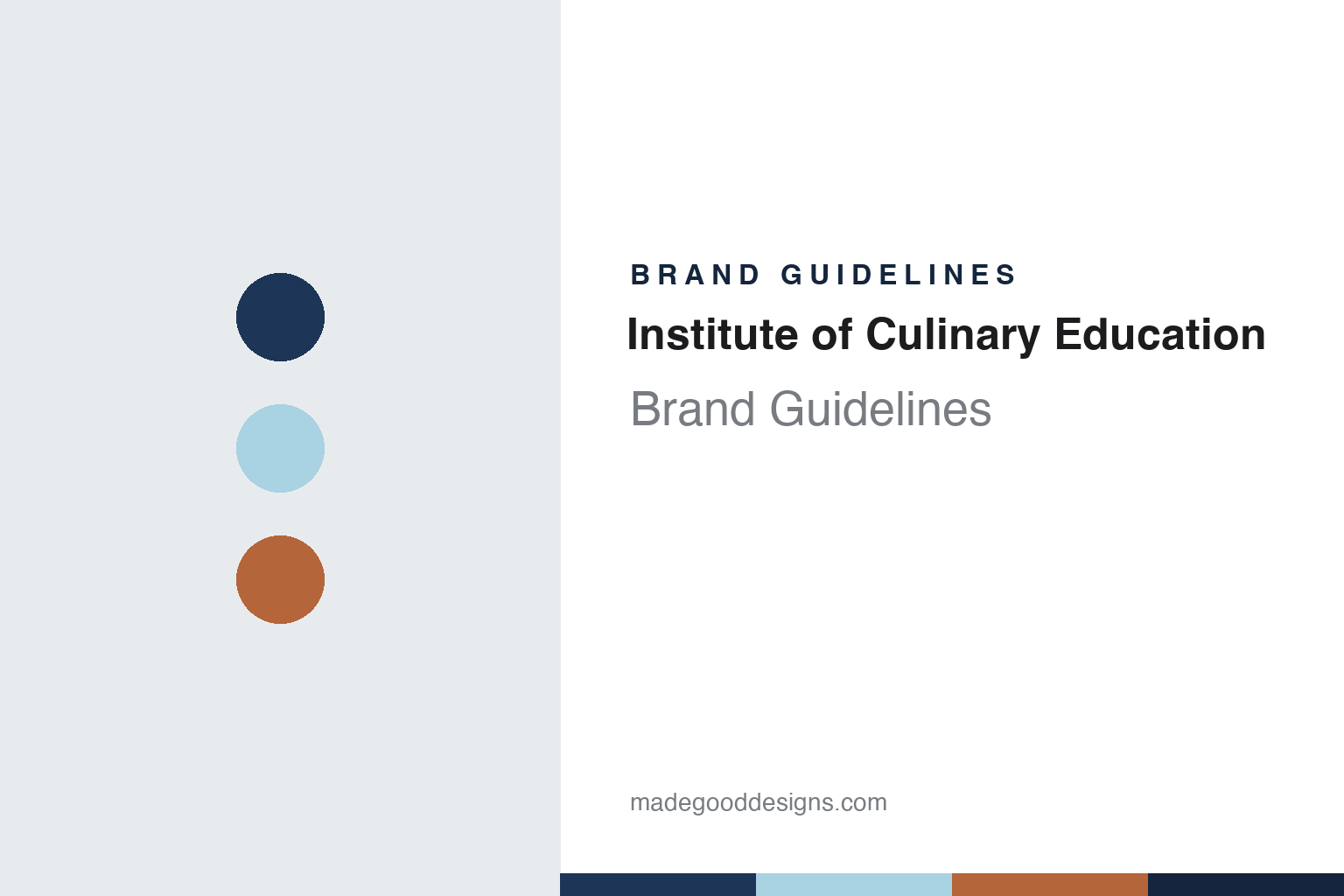
Two constants: a navy, ice blue and copper palette and a clean urban sans register. Abstract homage — not an Institute of Culinary Education mark; no logo or emblem is reproduced.
Peter Kump’s school
An Upper West Side apartment, 1975.
The Institute of Culinary Education traces its roots to 1975, when Peter Kump opened Peter Kump’s New York Cooking School in his apartment on Manhattan’s Upper West Side, English Wikipedia says. Kump’s approach, by that account, was to teach cooking techniques and the building of flavour at a time when most other cooking schools taught recipes. In 1979 the school moved to East 92nd Street, and in 1983 Kump added a professional programme for aspiring chefs. Teachers at the school included James Beard and Marcella Hazan, Wikipedia says. The school itself says Kump was also the founder of the James Beard Foundation.
In 1995 the school was acquired by Rick Smilow, an entrepreneur whose only earlier professional link with food, he told the Flatiron NoMad Partnership, was a management post at Nabisco. That year the school moved to 23rd Street, in Manhattan’s Flatiron district, where it expanded in 1999 and again in 2004; Wikipedia gives the space it reached as 45,000 square feet over seven floors. In 2001 the school took its present name, the Institute of Culinary Education, shortened to ICE.
The Flatiron NoMad Partnership’s profile of the school, written when Smilow had run it for 13 years, described three divisions: a career programme, with separate courses in culinary arts, in pastry and baking and in culinary management; a recreational programme of hands-on cooking, baking and wine classes for amateurs; and private and corporate cooking parties that combine a lesson with a sit-down, full-service meal. At the time of that profile the school occupied five floors with 12 kitchens and a staff of about 100, including 20 people who did nothing but maintain its ovens, refrigerators, mixers, grills and other professional equipment.
The school’s own account of those years, published for its anniversary, says that after the 1995 acquisition it added courses of study, built specially designed facilities and expanded geographically, with specialty programmes in restaurant management, hospitality management, sommelier training, bread baking and cake decorating. It also says that Kump, having started with a smaller recreational programme, grew the school to include career diploma programmes.
Colour
Brookfield Place, Pasadena and the ICC.
In 2015 ICE moved downtown to Brookfield Place in Battery Park City, across from the World Trade Center. English Wikipedia describes a 74,000-square-foot site with ten teaching kitchens, a demonstration kitchen and classrooms, as well as a bean-to-bar chocolate lab, a hydroponic herb and vegetable garden, a culinary technology lab and a mixology bar.
The school expanded west in 2018, opening a second campus in Pasadena, California, which Wikipedia describes as 38,000 square feet with teaching kitchens, classrooms and a learning resource centre. In 2019 ICE began teaching plant-based, nutrition-focused cooking at both campuses, a subject previously taught through the Natural Gourmet Institute. In 2021 it launched an online diploma in culinary arts and an associate degree programme at its Los Angeles campus.
A bigger change came in 2020. In July that year Olive Oil Times reported that the International Culinary Center, the Soho school founded by Dorothy Cann Hamilton in 1984 as the French Culinary Institute, would begin shutting down its operations on 20 July and be absorbed by ICE. ICC students were to be allowed to finish their coursework before the school closed permanently in December. The paper noted that Hamilton had founded the school after visiting the École Grégoire-Ferrandi in Paris, and that it was renamed the International Culinary Center as it added Italian and Spanish cooking. Wikipedia describes the 2020 deal as ICE’s acquisition of the ICC.
At the time, Olive Oil Times reported, Jacques Pépin, ICC’s dean of special programmes, said he was pleased that the school’s heritage and legacy would live on for future culinary professionals at ICE. The paper also quoted ICC’s chief executive, Bruce McCann, saying that through ICE the school’s mission would continue.
Typography
How culinary schools present themselves.
Culinary and pastry schools present themselves through a small set of public signs: a school name, a crest or logo, a colour scheme and a short descriptive line. Some names carry a symbol. Le Cordon Bleu takes its name from the blue ribbon of a French royal order, English Wikipedia says, and guests cut a blue ribbon when its new Paris campus opened in 2016, So Good magazine reported. Others come from a place: Ferrandi Paris is linked to the Paris street where its workshop school was installed in 1958, French Wikipedia says.
Ownership shapes how a school describes itself. Ferrandi belongs to the Paris Île-de-France chamber of commerce and industry, a public body, while Le Cordon Bleu was bought by Élisabeth Brassart in 1945, English Wikipedia says, and by André J. Cointreau in 1984, the Los Angeles Times reported, before growing into an international group. Other schools are run by education groups, families or universities; this guide reads their own pages on founders and history alongside dated press sources.
The buildings are part of the image. Schools publish their campuses, teaching kitchens, laboratories and training restaurants, where students cook and serve real guests. Press visits describe the same spaces from outside: in 2014 Le Figaro watched student chefs in whites with their names embroidered on the chest, and in 2016 So Good described a glass Paris building with a vegetable garden on its roof.
Programmes and diplomas appear under the names the schools give them, from vocational certificates to bachelor and master’s degrees, and official recognition is cited as the schools or dated sources state it. This guide sets out what can be checked about each school — who founded it, who owns it and where it teaches — and marks clearly what rests only on the school’s own word.
Aa
A clean urban sans for a three-letter name. (Specimen set in Work Sans, a sans STAND-IN; NOT the Institute of Culinary Education logo.)
ICE today
A privately owned school in New York and Los Angeles.
ICE is a private, for-profit school with campuses in New York City and Los Angeles, accredited by the Accrediting Commission of Career Schools and Colleges, English Wikipedia says. It offers career diplomas and associate degrees, in person and online, in culinary arts, pastry and baking arts, plant-based culinary arts, restaurant and culinary management and hospitality management, as well as shorter professional courses in bread baking, cake decorating and sommelier training.
Ownership has stayed with one person since 1995. In February 2025, announcing the school’s 50th anniversary, ICE named Rick Smilow as its chairman and chief executive and said the year marked his 30th as principal owner; the school marked the anniversary with programming at both campuses during 2025.
The name has changed once, in 2001, and the short form appears in the school’s own web address, ice.edu. Two other names run through its history: Peter Kump’s, kept in the story of its founding, and the French Culinary Institute, whose heritage passed to ICE in 2020.
For a design guide, the Institute of Culinary Education shows how a school can grow from an apartment kitchen into a two-campus business while keeping a short, three-letter name at the centre of its identity. Compare the Culinary Institute of America, the nonprofit college that began in New Haven in 1946, and Ferrandi Paris, the Paris school that the French Culinary Institute’s founder visited. For this guide we use a harbour navy, an ice blue and a warm copper with a sans, an unofficial interpretation; no product or logo is reproduced.
Explore & save
Keep Institute of Culinary Education’s identity on hand — save it to a board in the Made Good inspiration library.
Institute of Culinary Education identity set
Pin the Institute of Culinary Education navy, ice blue and copper palette and the clean urban sans register to your own board.
Source & notes
Frequently Asked Questions
What font can I use to match the Institute of Culinary Education look?
This guide describes Institute of Culinary Education’s type as “A clean urban sans for a three-letter name”. Its type specimen is set in Work Sans from Google Fonts as a stand-in; Work Sans is not Institute of Culinary Education’s own lettering.
What colours are in the Institute of Culinary Education palette?
This guide’s Institute of Culinary Education palette is Harbour navy #1D3557, Night ink #14253D, Ice blue #A9D2E3, Copper pan #B5653A and Steel white #F4F6F7. The tones are the guide’s own unofficial interpretation, not official Institute of Culinary Education hex codes.
When was Institute of Culinary Education founded?
Institute of Culinary Education was founded in 1975 (as Peter Kump’s New York Cooking School), in New York City.
Who founded Institute of Culinary Education?
Institute of Culinary Education was founded by Peter Kump in 1975 (as Peter Kump’s New York Cooking School).