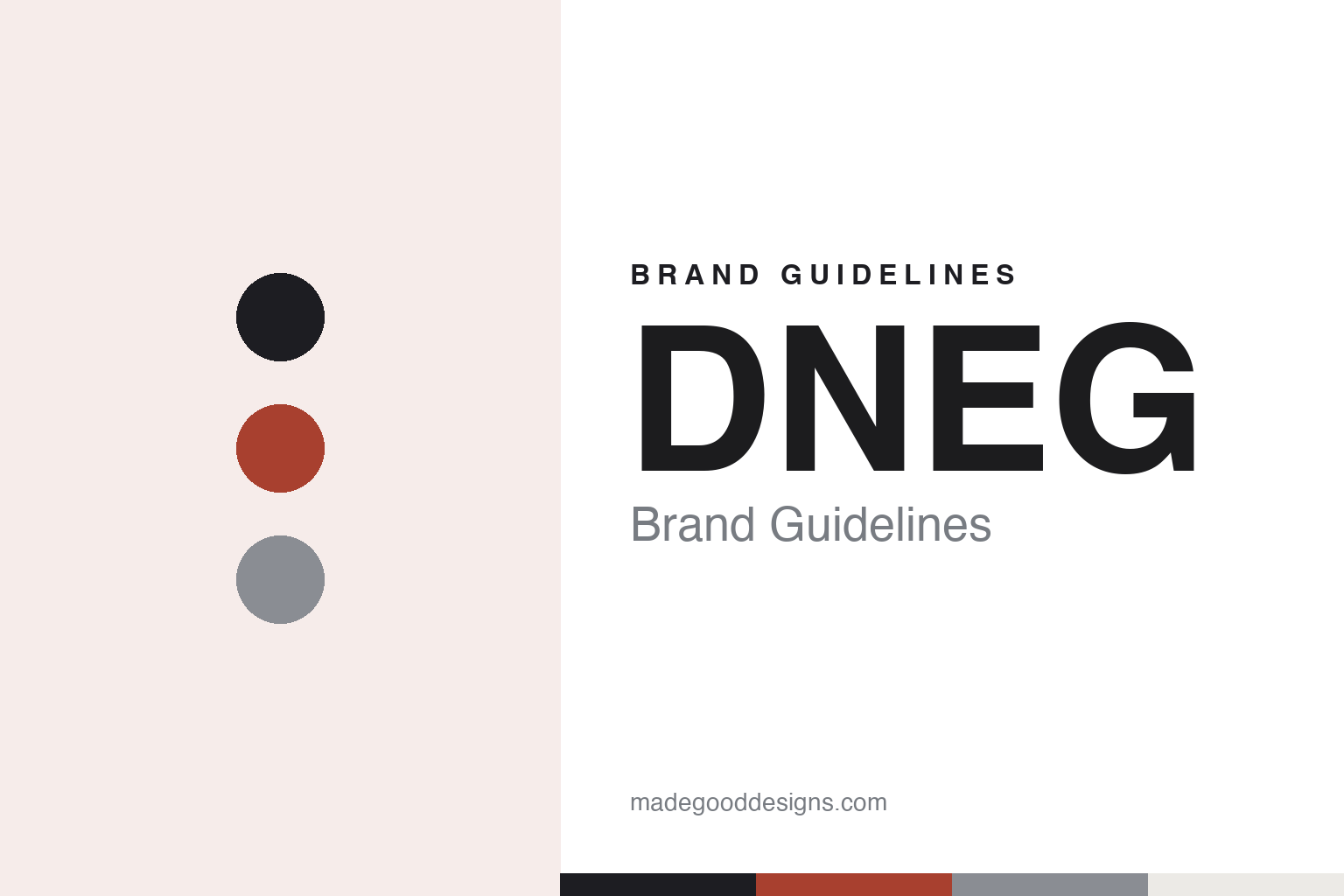
DNEG Brand Guidelines
The Soho studio that turned an industry nickname into a brand.
Aa
Two constants: a charcoal, coral and grey palette and a grotesque sans register. Abstract homage — not a DNEG asset or mark; no logo, typeface or frame is reproduced.
Double Negative
A Soho studio built by effects supervisors and producers.
DNEG began in London in 1998 as Double Negative. The company says it opened in Soho, founded by “a small group of industry professionals,” and that its opening project was the film Pitch Black. English Wikipedia names that group as including Peter Chiang and Paul Franklin, both senior visual-effects supervisors, and Matt Holben and Alex Hope, joint managing directors. The short form is pronounced “D-Neg,” English Wikipedia notes, and It’s Nice That described it in 2018 as Double Negative’s industry moniker before it became the formal name.
The studio grew around feature films. In June 2014 Variety described Double Negative as a studio to which the director Christopher Nolan routinely brought his pictures, citing its work on Inception and noting that Interstellar was then in production there. The company says it moved its London headquarters from Soho to Fitzrovia in 2012 and in 2013 started a team for television and streaming work, which it now calls episodic.
Not every expansion lasted. English Wikipedia says Double Negative opened a Singapore office in 2009. Variety reported in March 2016 that the company would close its Singapore facility by 20 May that year, in what Alex Hope described as a response to the changing global dynamics of the film industry.
Colour
Prime Focus, Novator and a network of studios.
The decisive change came in 2014. On 25 June 2014 Variety reported that Prime Focus World, the creative-services arm of the Indian company Prime Focus, and Double Negative had agreed to merge. The combined business would keep the Double Negative name and be run by Alex Hope and chief executive Matthew Holben, with Prime Focus founder Namit Malhotra as board chairman; Malhotra said in a television interview that Prime Focus would hold 80 to 85 percent of the shares. Prime Focus World then had branches in Los Angeles, Vancouver, New York, London, Dubai, Mumbai and China, Variety reported. The company dates the completed merger to July 2014, the year it also launched a feature-animation division and opened in Vancouver.
Ownership has shifted since then. In August 2021 Deadline reported an investment by the UK firm Novator Capital Advisors into Prime Focus Limited, which it described as DNEG’s parent company and majority shareholder. The deal raised Malhotra’s stake in Prime Focus from 35 to 70 percent and gave Novator 15 percent of DNEG, Deadline reported; Malhotra founded Prime Focus in 1997. English Wikipedia records that in January 2022 DNEG agreed a combination with a Nasdaq-listed acquisition company, Sports Ventures Acquisition Corp., that would have made it a public company, and that the plan was called off in June 2022. The company also lists a 2024 investment in the DNEG Group by an investor it names as UASG.
The studio network kept growing. The company says it opened in Mumbai and Chennai in 2016, Los Angeles in 2017, Montréal in 2018, Bangalore and Toronto in 2021 and Sydney in 2022; Cartoon Brew reported the Sydney studio, for visual effects and animation, in November 2022. The company now describes itself as having 19 studios. In June 2026 Cartoon Brew reported that DNEG had announced the acquisition of Anima Kitchent, an animation studio in the Canary Islands, through its content division ReDefine Originals, with the terms not disclosed; the same report listed Nimona among the animated titles DNEG is known for.
Typography
Studios, showreels and owners.
Visual-effects studios rarely sell anything to the public, so their brands live in a handful of places: the studio name and logo, the showreel, the title card that runs at the end of a film’s credits, and the pages a studio publishes about its people and its offices. Many names began as nicknames or in-jokes among small founding teams, and several studios have kept an old short form while the company behind it changed hands.
Showreels and project pages do most of the work. Studios publish clips, breakdowns and lists of supervisors by name, while trade titles such as fxguide, Cartoon Brew, Variety and Deadline report which studio worked on which film or series. In this guide, film and series credits are given only as a dated source credits them, and studio and staff counts only as a dated source or the company itself gives them.
Offices are part of the identity too. Studios describe themselves by the cities they work in, and a single brand may sit over studios in Europe, North America, India and Australia, each opened in a different year and sometimes closed again. Corporate pages name founders, chief executives and owners, and those ownership lines vary widely: some studios are owned by their founders, some belong to listed groups or holding companies, and some are owned by streaming services or technology firms.
This guide sets out what can be checked about each studio — who founded it, when and where, who owns it now and how its name and look have changed — from dated sources, and marks plainly what rests only on the company’s own word. Colours and typefaces shown here are our own interpretation, not the studios’ official palettes.
Aa
A grotesque sans for a four-letter name. (Specimen set in Space Grotesk, a sans STAND-IN; NOT the DNEG logo or DNEG Script.)
DNEG
An aperture in 2018, a lens-like eye in 2025.
DNEG’s name and look have been redesigned twice in under seven years. In June 2018 It’s Nice That reported a new identity by the agency DixonBaxi for the merged Double Negative and Prime Focus World. The logotype took up the DNEG moniker, with the “D” and “G” mirroring each other to suggest constant motion and transformation, the designers said. The system used the image of an aperture across the website’s interface and icons and even on office clocks and the timelines on company documents, with a muted palette led by a primary coral orange. English Wikipedia shows the earlier Double Negative logo in use from 2000 to 2018.
The second change came at the start of 2025. DNEG presented a refreshed brand, saying it had been more than six years since it launched the DNEG brand; English Wikipedia dates the update to 29 January 2025. Creative Boom reported in February 2025 that the refresh was by DesignStudio, that the existing logo had been subtly refined rather than replaced, and that it added a tagline, “Start With Impossible,” and an animated “Vision” sequence of light streaks swirling inside a lens-like eye. It also added a custom typeface, DNEG Script, made with the French type foundry Lift Type and drawing on classic film posters. The palette stays simple, the magazine said, with a signature red supported by secondary colours.
Today the company lists divisions including DNEG VFX, DNEG Animation, DNEG IXP — which English Wikipedia says was launched in 2024 for advertising, gaming, music and live-entertainment work — and DNEG 360, a virtual-production service, alongside the group businesses ReDefine, Brahma and Prime Focus Studios. English Wikipedia says DNEG Animation was set up in April 2014 in collaboration with Locksmith Animation.
For a design guide, DNEG shows how a studio can turn an industry nickname into a full identity and then refine it rather than start again. Compare Framestore, another London visual-effects studio, and Cinesite. For this guide we use charcoal, a deep coral and a cool grey with a sans, an unofficial interpretation; no product or logo is reproduced.
Explore & save
Keep DNEG’s identity on hand — save it to a board in the Made Good inspiration library.
DNEG identity set
Pin the DNEG charcoal, coral and grey palette and the grotesque sans register to your own board.
Source & notes
Frequently Asked Questions
What font can I use to match the DNEG look?
This guide describes DNEG’s type as “A grotesque sans for a four-letter name”. Its type specimen is set in Space Grotesk from Google Fonts as a stand-in; Space Grotesk is not DNEG’s own lettering.
What colours are in the DNEG palette?
This guide’s DNEG palette is Soho charcoal #1D1D22, Aperture coral #A8402F, Fitzrovia grey #8A8D93, Lens mist #ECEAE6 and Paper #F8F7F5. The tones are the guide’s own unofficial interpretation, not official DNEG hex codes.
When was DNEG founded?
DNEG was founded in 1998 (as Double Negative), in Soho, London.
Who owns DNEG?
DNEG is owned by Prime Focus Limited. This guide dates DNEG to 1998 (as Double Negative), in Soho, London.