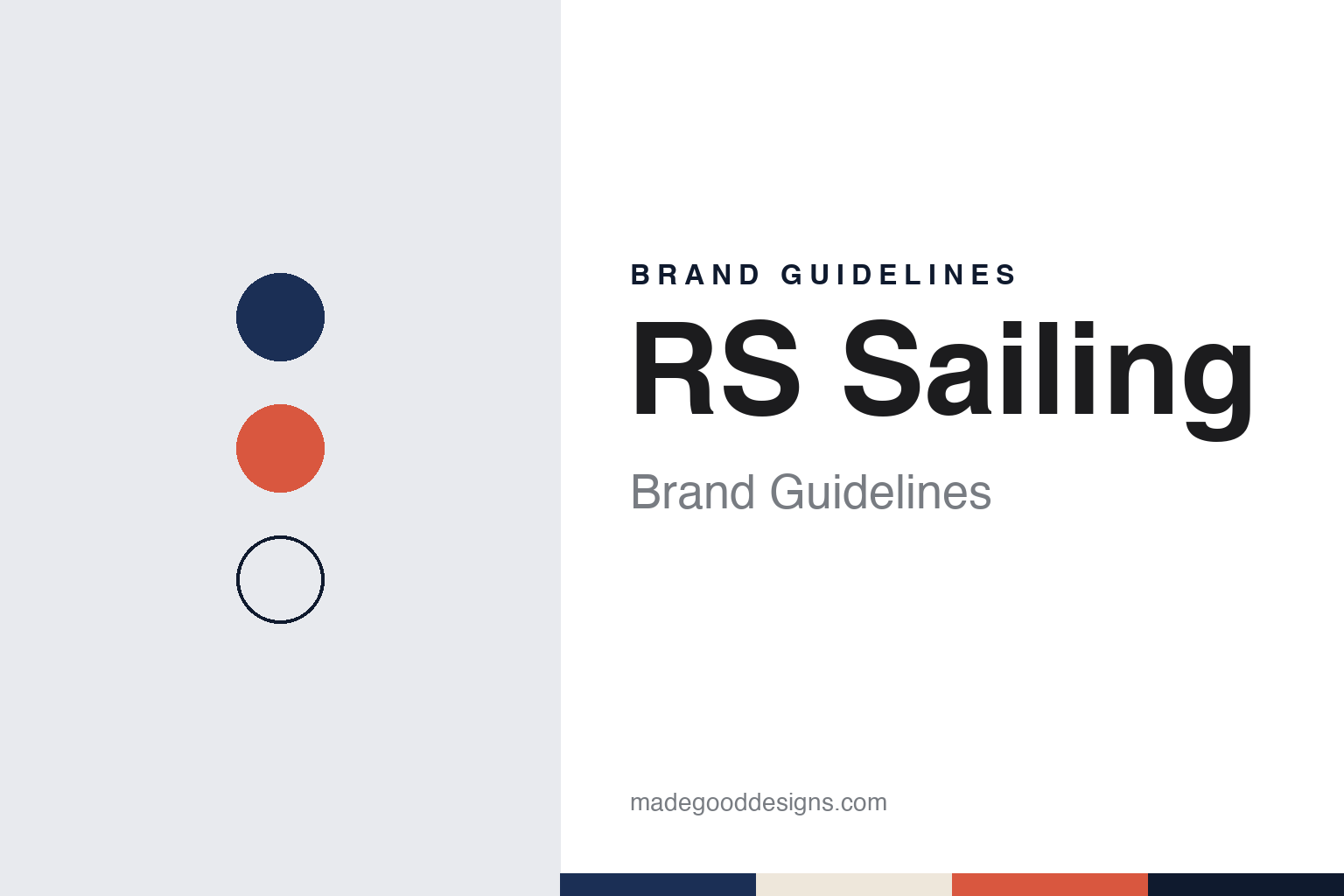
RS Sailing Brand Guidelines
The Romsey dinghy brand that grew out of a London dinghy shop.
Aa
Two constants: a navy, coral and sand palette and a condensed sans register. Abstract homage — not an RS Sailing product or mark; no boat, sail insignia or logo is reproduced.
From LDC to RS
A London dinghy business and a numbered range.
RS Sailing is a British dinghy brand based in Romsey, Hampshire, and it grew out of an older London business. English Wikipedia, in a revision dated June 2026, traces the company to H. Taylor & Son (Brockley) Ltd, incorporated in the UK in 1957, which traded as Racing Sailboats and as the London Dinghy Centre (LDC) in south-east London. The sailing press of the early 2000s used the same names: Yachting World wrote of “LDC Racing Sailboats” in 2005.
The company tells its own origin story briefly. It says the idea behind RS “was born when a small group of sailors sat on a Cornish sea-wall” and talked about moving the sport forward, and that when it launched RS it “had little money” and relied on the boats to speak for themselves. In a February 2021 post the company says the RS600 and the RS400 began the range, and that more adult racing classes followed, all with names ending in two zeros, which it calls its “noughty classes.” RS Marine Group, in a statement carried by First Peninsula Marine in February 2025, said the business had been designing products since 1989.
The early boats drew coverage in the sailing press. In January 2001 Yachting World reported the London Boat Show debut of the RS700, a single-handed trapeze skiff with an asymmetric spinnaker, and quoted Martin Wadhams of LDC on what the design set out to do. In November 2005 the magazine reported that LDC Racing Sailboats had built a prototype of another single-trapeze boat after consulting sailors, international dealers and designers, and quoted LDC’s Nick Peters saying it was aimed at young sailors moving up from boats such as the RS Feva, while staying suitable for adults.
The naming system has stayed simple. The company’s blog presents its racing classes by number and its training and family boats under short word names, each with the RS prefix, and its website runs in English, French, Spanish and Italian editions for a dealer network that the company says has grown over the last decade.
Colour
Designed by RS, built with partners.
RS describes a development process led by its own team rather than a single in-house yard. Its culture page says each new boat begins with a design brief and a development team that includes a designer, a hull manufacturer and sail and spar makers, and that “by out-sourcing production” it can choose the materials, manufacturing systems and suppliers for each model and market. Prototyping, testing and input from key customers come before production tooling is made, the company says.
Some of those partners are named in dated sources. In November 2022 Marine Industry News reported that Hyde Sails and the spar maker Seldén supplied RS Sailing. In November 2026 the company said the owners of Rototek Ltd, a rotational-moulding company in Nottinghamshire, had manufactured RS hulls for more than 25 years.
Racing is organised apart from the builder. The company says RS events are run by independent class associations, each with its own rules, website and calendar, and its blog regularly carries those associations’ championship notices, from British club series to events in Japan. Its culture page describes the social side of those events as part of the brand from the outset.
The RS Feva has a particular place in the company’s own account. When Jon Partridge stepped down as managing director in January 2026, the company credited him with the class’s growth; Marine Industry News reported on 12 January 2026 that he had been with the business for 25 years, had become joint chief executive in 2015, and would continue as a consultant for a period to hand over.
Typography
Builders, lofts and classes.
Dinghy builders and sailmakers present themselves mostly through names and numbers. A builder’s name usually sits on the hull and on its website, while the sail carries the marks that racing needs: a class emblem and a sail number, placed as each class’s rules describe. When a class changes its name, the sail changes with it; in 2019 the International Laser Class Association said new class sails would carry its updated ILCA logo.
Much of this branding lives at the water’s edge rather than in shops. Builders and lofts show their boats and sails at boat shows and on regatta stands, and many of their news pages read like club noticeboards, carrying class championship calendars, results and event reports alongside new models. Class associations, which are often run separately from the builders, organise much of that racing and publish their own rules and websites.
Ownership in the trade takes several forms, and the companies describe it in different ways. Some are family businesses that name their founders and later generations on their own pages; some sailmakers work through franchised or licensed lofts that share one name across many countries; and some builders have passed to investors or merged with former rivals, or have sold individual boat designs and their production rights to other firms. Building is often shared: a brand may design its boats and buy hulls, sails and spars from specialist suppliers.
This guide sets out what can be checked about each company: who founded it, who owns it now, where its boats or sails are made according to dated sources, and how it presents its name. It marks clearly what rests only on the company’s own word, and it makes no claims about speed or safety.
Aa
A condensed sans for numbered class names. (Specimen set in Barlow Condensed, a sans STAND-IN; NOT the RS Sailing logo.)
RS Sailing
A group, a sale and new backers.
RS expanded into a wider group in the early 2020s. In January 2023 Marine Industry News reported that RS Sailing had announced a new overarching identity, RS Marine Group, covering RS Sailing, RS Electric Boats, the powerboat builder Cheetah Marine and a new company, Ocean Play. Each company would keep its own identity while finance, marketing and design were shared, said Jon Partridge, then chief executive on the commercial side; Alex Newton-Southon was chief executive on the technical side. First Peninsula Marine later dated the group’s launch to 2022.
Ocean Play had been announced in November 2022 as a collaboration between RS and the designer Jo Richards to build four of his dinghy designs, made at Roto in Slovenia, Marine Industry News reported. The group did not keep it for long: in February 2025 First Peninsula Marine reported that Performance Sailcraft Europe, part of Performance Marine Group in Rutland, had bought the Ocean Play brand from RS Marine Group, including the manufacturing rights for the four boats, with branding and distribution moving to the buyer.
The latest change came in November 2026. On 6 November RS Sailing said the Swedish marine investor Fredriksborgs Förvaltnings AB and the owners of Rototek Ltd had invested in the company; it did not give the size of their holdings. The company said the RS team, the boats and UK production were unchanged, that dealer partnerships, warranties and parts support continued as normal, and named Alex Newton-Southon as managing director.
For a design guide, RS Sailing shows how a dinghy brand can be built around a numbered family of classes, with design work held by a small team and building shared with long-standing partners. Compare Hyde Sails, a sailmaker named among its suppliers, and LaserPerformance, which once sold several of the dinghies later made by Ocean Play. For this guide we use a deep navy, a coral and a sand tone with a condensed sans, an unofficial interpretation; no product or logo is reproduced.
Explore & save
Keep RS Sailing’s identity on hand — save it to a board in the Made Good inspiration library.
RS Sailing identity set
Pin the RS Sailing navy, coral and sand palette and the condensed sans register to your own board.
Source & notes
Frequently Asked Questions
What font can I use to match the RS Sailing look?
This guide describes RS Sailing’s type as “A condensed sans for numbered class names”. Its type specimen is set in Barlow Condensed from Google Fonts as a stand-in; Barlow Condensed is not RS Sailing’s own lettering.
What colours are in the RS Sailing palette?
This guide’s RS Sailing palette is Harbour navy #1B2F55, Night ink #0F1A2E, Burgee coral #D9573F, Estuary blue #43809E and Slipway sand #EEE7DB. The tones are the guide’s own unofficial interpretation, not official RS Sailing hex codes.
Who owns RS Sailing?
RS Sailing is owned by Investment by Fredriksborgs Förvaltnings AB and Rototek’s owners (announced November 2026).
Where is RS Sailing based?
RS Sailing is based in Romsey, Hampshire, UK. RS Sailing is known for RS400, RS600, RS700, RS Feva.