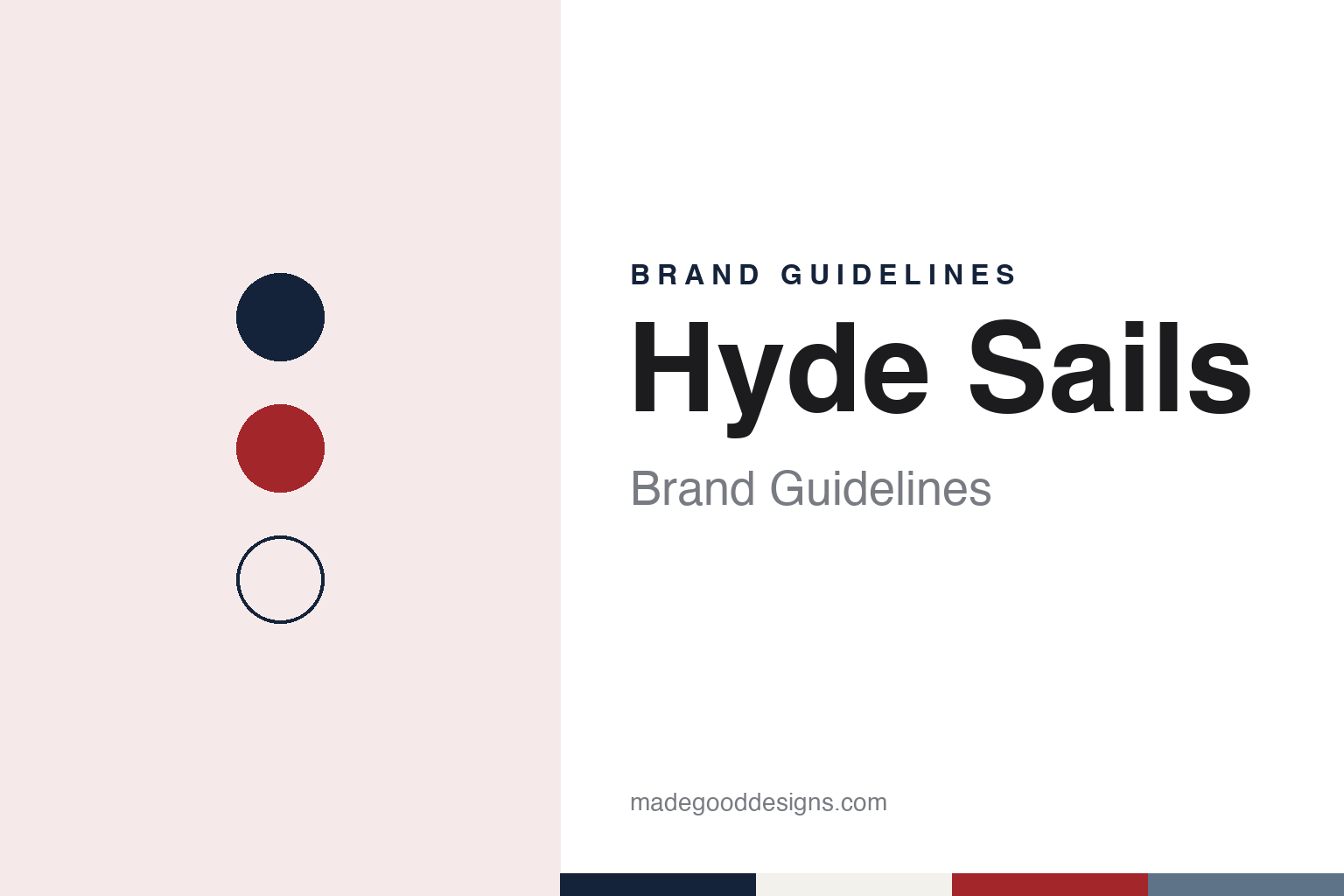
Hyde Sails Brand Guidelines
From Musto & Hyde in Essex to a sail loft in Cebu.
Aa
Two constants: a red, navy and sailcloth palette and a workshop sans register. Abstract homage — not a Hyde Sails product or mark; no sail, logo or insignia is reproduced.
Musto & Hyde
Two dinghy sailors and a loft in Essex.
Hyde Sails began as Musto & Hyde, a sailmaking business set up in Rayleigh, Essex, by the dinghy sailor Keith Musto and Eddie Hyde. English Wikipedia’s article on Musto places the start after the 1964 Tokyo Olympics, where he and Tony Morgan won a silver medal in the Flying Dutchman class. Before that, the same article says, Musto had worked with the engineer Ken Pearce on masts and sails. Hyde Sails itself tells the story more briefly: it says the business was born “over 60 years ago” out of the challenge of finding sails for one-design dinghy racing.
The partnership left a visible trace in the brand. Hyde Sails says its red Flying Dutchman logo reflects Musto’s Olympic result in that two-person racing dinghy, so the mark records a boat class rather than an abstract symbol. Musto later concentrated on sailing and outdoor clothing under his own name, Wikipedia says; that clothing brand, Musto, became part of the Norwegian clothing maker Helly Hansen in 2017. The sailmaking side carried on under the Hyde name alone.
The present UK company, Hyde Sails Limited, was incorporated in November 1980 under the earlier name Hyde Sports and Leisure Limited, according to its Companies House record. The same register lists a holding company, Hyde Holdings Limited, as its person with significant control since April 2016, holding 75 percent or more of the shares and voting rights. The company describes itself as a UK business with offices in Hamble, on the Hampshire coast near Southampton, and in Ipswich, Suffolk, where its registered office is. Its filings describe the nature of the business as manufacturing, wholesale trade and retail sale in specialised stores.
Colour
One-design sails, made to a template.
One-design dinghies, in which every boat in a class is built to the same rules, shaped the business. Hyde Sails says that during the 1980s it built a reputation for making sails to an accurate template, because sailors racing identical boats look for very small differences, and that discipline carried into the rest of its work. The company names Laser, RS Sailing and Topper as long-term customers and calls one-design dinghies and keelboats the backbone of the business.
Much of that work is sold through boat builders rather than to the public. On its manufacturers page Hyde Sails says it supplies sails and accessories for many raced classes even when those sails do not carry its H logo on the tack, the lower front corner of the sail, and that its agreements in most of those cases allow it to supply only the builder. The builders it lists there include RS Sailing, Topper, Ovington and Windsport. Owners of boats from those builders are directed to the builder’s own contact for their class. For a sailor, the visible brand is therefore sometimes a class insignia and a builder’s name, with the sailmaker left off the cloth.
In the 1990s, the company says, it branched out into the custom yacht market. Its website now groups cruising and racing sails into Voyager, Ocean, Racing and Heritage ranges, alongside multihull and downwind sails, boom covers, dinghy and keelboat sails, kites and wings, accessories and a luggage range. Customers can measure their own boats and order through an online “build my sail” route, or work through a network of distributors and dealers that the company says is growing worldwide.
Typography
How sailmakers present themselves.
Dinghy builders and sailmakers present themselves mostly through names and numbers. A builder’s name usually sits on the hull and on its website, while the sail carries the marks that racing needs: a class emblem and a sail number, placed as each class’s rules describe. When a class changes its name, the sail changes with it; in 2019 the International Laser Class Association said new class sails would carry its updated ILCA logo.
Much of this branding lives at the water’s edge rather than in shops. Builders and lofts show their boats and sails at boat shows and on regatta stands, and many of their news pages read like club noticeboards, carrying class championship calendars, results and event reports alongside new models. Class associations, which are often run separately from the builders, organise much of that racing and publish their own rules and websites.
Ownership in the trade takes several forms, and the companies describe it in different ways. Some are family businesses that name their founders and later generations on their own pages; some sailmakers work through franchised or licensed lofts that share one name across many countries; and some builders have passed to investors or merged with former rivals, or have sold individual boat designs and their production rights to other firms. Building is often shared: a brand may design its boats and buy hulls, sails and spars from specialist suppliers.
This guide sets out what can be checked about each company: who founded it, who owns it now, where its boats or sails are made according to dated sources, and how it presents its name. It marks clearly what rests only on the company’s own word, and it makes no claims about speed or safety.
Aa
A plain workshop sans for a sail loft. (Specimen set in Archivo, a sans STAND-IN; NOT the Hyde Sails logo.)
Cebu
A wholly owned factory in the Philippines.
The sails are no longer made in England. Hyde Sails says that in the 2000s, “like many manufacturing businesses,” it established a factory in the Far East, and that the loft is wholly owned by the company. Its heritage page puts the staff at over 250 people; its about page gives a team of 270 sailmakers. The factory is on Cebu in the Philippines: a listing for Hyde Sails Cebu Inc. on the cruising site Noonsite, dated September 2012, places the loft on Mactan Island, close to Cebu City, and notes that it also works on sails and awnings for local and visiting boats, with staff travelling to measure and fit them. The listing names the business as a separate Philippine company, Hyde Sails Cebu Inc., while the UK company describes the factory as its own.
Scale is part of how the company describes itself. Hyde Sails says it makes more than 40,000 sails and more than 10,000 accessories every year, for boats ranging from the smallest dinghies to cruising yachts and traditional craft. It sells directly to sailors as well as to builders, through its UK offices and a network of agents and distributors. The website’s footer calls the business a dinghy, keelboat and yacht sail company.
The visual identity has two parts that the company itself names: the letter H that it puts on the tack of its own sails, and the red Flying Dutchman that recalls the founding partnership of Musto and Hyde.
For a design guide, Hyde Sails shows how a supplier’s brand can sit quietly inside other companies’ products, signed by a single letter where the cloth allows it. Compare Musto, the clothing brand that grew from the same partnership, and RS Sailing, one of the dinghy builders it supplies. For this guide we use a red, a navy and a sailcloth white with a sans, an unofficial interpretation; no product or logo is reproduced.
Explore & save
Keep Hyde Sails’s identity on hand — save it to a board in the Made Good inspiration library.
Hyde Sails identity set
Pin the Hyde Sails red, navy and sailcloth palette and the workshop sans register to your own board.
Source & notes
Frequently Asked Questions
What font can I use to match the Hyde Sails look?
This guide describes Hyde Sails’ type as “A plain workshop sans for a sail loft”. Its type specimen is set in Archivo from Google Fonts as a stand-in; Archivo is not Hyde Sails’ own lettering.
What colours are in the Hyde Sails palette?
This guide’s Hyde Sails palette is Burgee red #A3262A, Night navy #14233A, Sailcloth #F3F1EC, Estuary grey #5E7387 and Paper #FAF9F6. The tones are the guide’s own unofficial interpretation, not official Hyde Sails hex codes.
When was Hyde Sails founded?
Hyde Sails was founded in after 1964 (as Musto & Hyde), in Rayleigh, Essex, England.
Who founded Hyde Sails?
Hyde Sails was founded by Keith Musto and Eddie Hyde in after 1964 (as Musto & Hyde).