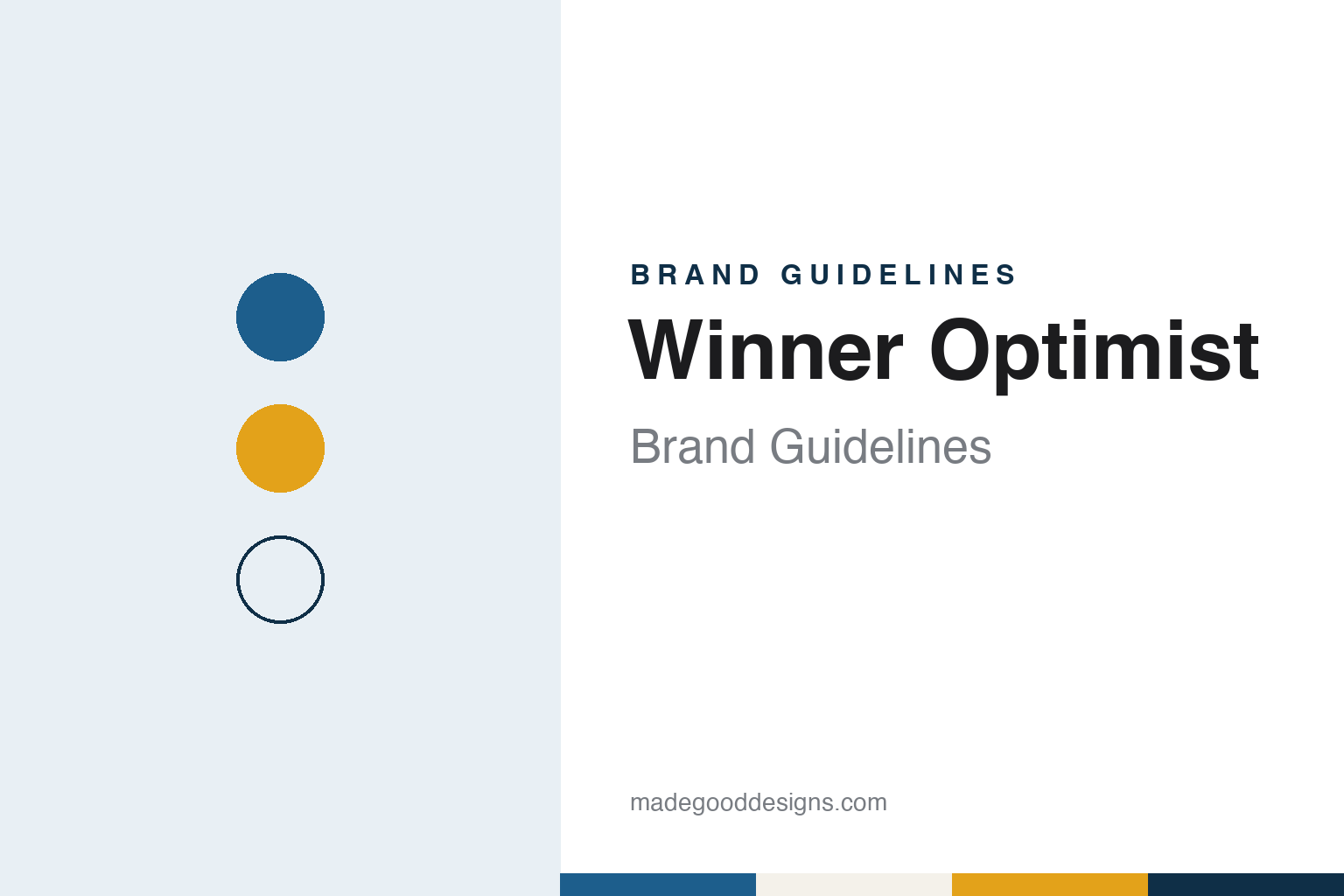
Winner Optimist Brand Guidelines
One small boat, built on Funen.
Aa
Two constants: a harbour blue, hull white and gunwale yellow palette and a rounded geometric sans register. Abstract homage — not a Winner Optimist product or mark; no boat, logo or sail is reproduced.
Winner Boats
A Funen harbour town and one class of boat.
Winner Optimist builds one kind of boat: the Optimist, the small single-handed dinghy that the Mariners’ Museum describes as one of the largest one-design classes designed specifically for children. The company is based in Faaborg, a harbour town on the south coast of the Danish island of Funen, and the pages of its website carry the title “Optimists Made in Denmark.” The International Optimist Dinghy Association’s list of class suppliers names Winner Optimists ApS of Faaborg as a boat builder, gives Denmark as its country of build, and lists Stig Blöcher as its owner.
The company dates itself to 1975. It says it was founded that year as Winner Boats by Henning Wind, after he ended a cooperation with a partner so that he could concentrate on making Europe and Optimist dinghies in fibreglass. Wind was a Danish sailor who competed in the Finn class at the 1964 and 1968 Olympic Games, according to English Wikipedia.
An independent record points a little earlier. The Mariners’ Museum in the United States holds an Optimist named “Minnow,” dated 1973, whose catalogue entry in the museum’s International Small Craft Center gives the builder as Winnerboats of Faaborg, Denmark. Both dates are given here as their sources state them.
The company’s own account then turns to its buildings. In 1977 a fire at the original plant by the harbour in Faaborg led to the whole of production moving to a new plant elsewhere in the town, Winner says, and that site has since been extended with offices and more space for production and storage. In 1997, the company says, production of Europe-class dinghies moved to what it calls its sister company in Spain, and the Faaborg plant has built only Optimists since then.
Colour
The 3D Star, the 3D Flex and the Race.
The range on Winner’s website is short and plainly named. The 3D Star is the top model, the company says, and the 3D Flex sits beside it; Winner describes both as boats made with racing in mind. The 3D Flex uses the same 3D-shaped hull with a more flexible layup, and Winner says it was developed with feedback from lighter sailors, gathered through its own Winner Team squad and at championships. The Race model, the company says, is mostly sold to clubs and national federations.
The Optimist is a strict one-design class, so a builder works to a hull shape and dimensions set by the class rules, and the class association lists its builders and suppliers with their country of build. Within those rules, Winner’s product pages concentrate on construction and fittings: the stiffness of the hull, the foam in the bottom, the mast step, the mainsheet system, the daggerboard fittings and the toe straps. The company names Ronstan Orbit blocks on its 3D models and offers Harken or Ronstan blocks as a choice.
Around the boats, the website presents a wider operation. It runs a charter service at regattas, a webshop for parts and equipment, a network of dealers, and pages for the Winner Team, with squads listed by year from 2013 to 2020. It also offers maintenance and repair advice and a trim guide for sailors.
The Optimist’s history gives the Danish builder a local link. English Wikipedia says the boat was designed in 1947 by Clarke Mills in Clearwater, Florida, as a low-cost pram for young sailors, and that a slightly modified version was introduced to Europe by Axel Damgaard and spread across Europe from Scandinavia. The design was standardised in 1960 and became a strict one-design in 1995, the article says.
Typography
How dinghy builders and sailmakers present themselves.
Dinghy builders and sailmakers present themselves mostly through names and numbers. A builder’s name usually sits on the hull and on its website, while the sail carries the marks that racing needs: a class emblem and a sail number, placed as each class’s rules describe. When a class changes its name, the sail changes with it; in 2019 the International Laser Class Association said new class sails would carry its updated ILCA logo.
Much of this branding lives at the water’s edge rather than in shops. Builders and lofts show their boats and sails at boat shows and on regatta stands, and many of their news pages read like club noticeboards, carrying class championship calendars, results and event reports alongside new models. Class associations, which are often run separately from the builders, organise much of that racing and publish their own rules and websites.
Ownership in the trade takes several forms, and the companies describe it in different ways. Some are family businesses that name their founders and later generations on their own pages; some sailmakers work through franchised or licensed lofts that share one name across many countries; and some builders have passed to investors or merged with former rivals, or have sold individual boat designs and their production rights to other firms. Building is often shared: a brand may design its boats and buy hulls, sails and spars from specialist suppliers.
This guide sets out what can be checked about each company: who founded it, who owns it now, where its boats or sails are made according to dated sources, and how it presents its name. It marks clearly what rests only on the company’s own word, and it makes no claims about speed or safety.
Aa
A rounded geometric sans, friendly at small sizes. (Specimen set in Outfit, a sans STAND-IN; NOT the Winner Optimist logo.)
Winner Optimist
A name in capitals and colour chosen by the buyer.
Winner’s website often sets its own name in capitals, WINNER, in headings and product text, and the company name itself is the main message: the home page opens with the line “The name fits!” This guide does not reproduce the company’s logo or any sail or hull graphic.
The clearest design choice the company offers is the personalised boat. On its “design your own” page Winner lists a coloured gunwale, a coloured midship section or waterline, non-slip decking in different colours, a choice of airbags and of mainsheet systems, and toe straps from Winner’s own range or from Zhik. The company says the aim is a boat that nobody else has. In a class where the hull shape is fixed, colour and fittings are the parts of the boat that a buyer can change.
Some of what a Winner boat shows is set by the class, not the builder. English Wikipedia notes that the “IO” monogram on an Optimist sail, after the class association’s initials, is a registered trademark used under licence, and that each boat carries a national sail number made of its country’s Olympic abbreviation and a sequential number. The builder’s identity sits around those class marks. The company’s web address is winneroptimist.dk, and the .com address forwards to it.
For a design guide, Winner Optimist shows how a builder of a single, fixed one-design boat builds an identity from a confident name, a home town and the colours its buyers choose; compare Elvstrøm Sails, another Danish sailing name, and Ronstan, whose blocks Winner fits. For this guide we use a harbour blue, a fjord ink, a hull white, a gunwale yellow and a non-slip grey with a rounded sans, an unofficial interpretation; no product or logo is reproduced.
Explore & save
Keep Winner Optimist’s identity on hand — save it to a board in the Made Good inspiration library.
Winner Optimist identity set
Pin the Winner Optimist harbour blue, hull white and gunwale yellow palette and the rounded geometric sans register to your own board.
Source & notes
Frequently Asked Questions
What font can I use to match the Winner Optimist look?
This guide describes Winner Optimist’s type as “A rounded geometric sans, friendly at small sizes”. Its type specimen is set in Outfit from Google Fonts as a stand-in; Outfit is not Winner Optimist’s own lettering.
What colours are in the Winner Optimist palette?
This guide’s Winner Optimist palette is Harbour blue #1D5E8C, Fjord ink #0F2F47, Hull white #F4F1EA, Gunwale yellow #E3A21A and Non-slip grey #A3A7A6. The tones are the guide’s own unofficial interpretation, not official Winner Optimist hex codes.
When was Winner Optimist founded?
Winner Optimist was founded in 1975, as Winner Boats (company account), in Faaborg, Denmark.
Who founded Winner Optimist?
Winner Optimist was founded by Henning Wind in 1975, as Winner Boats (company account).