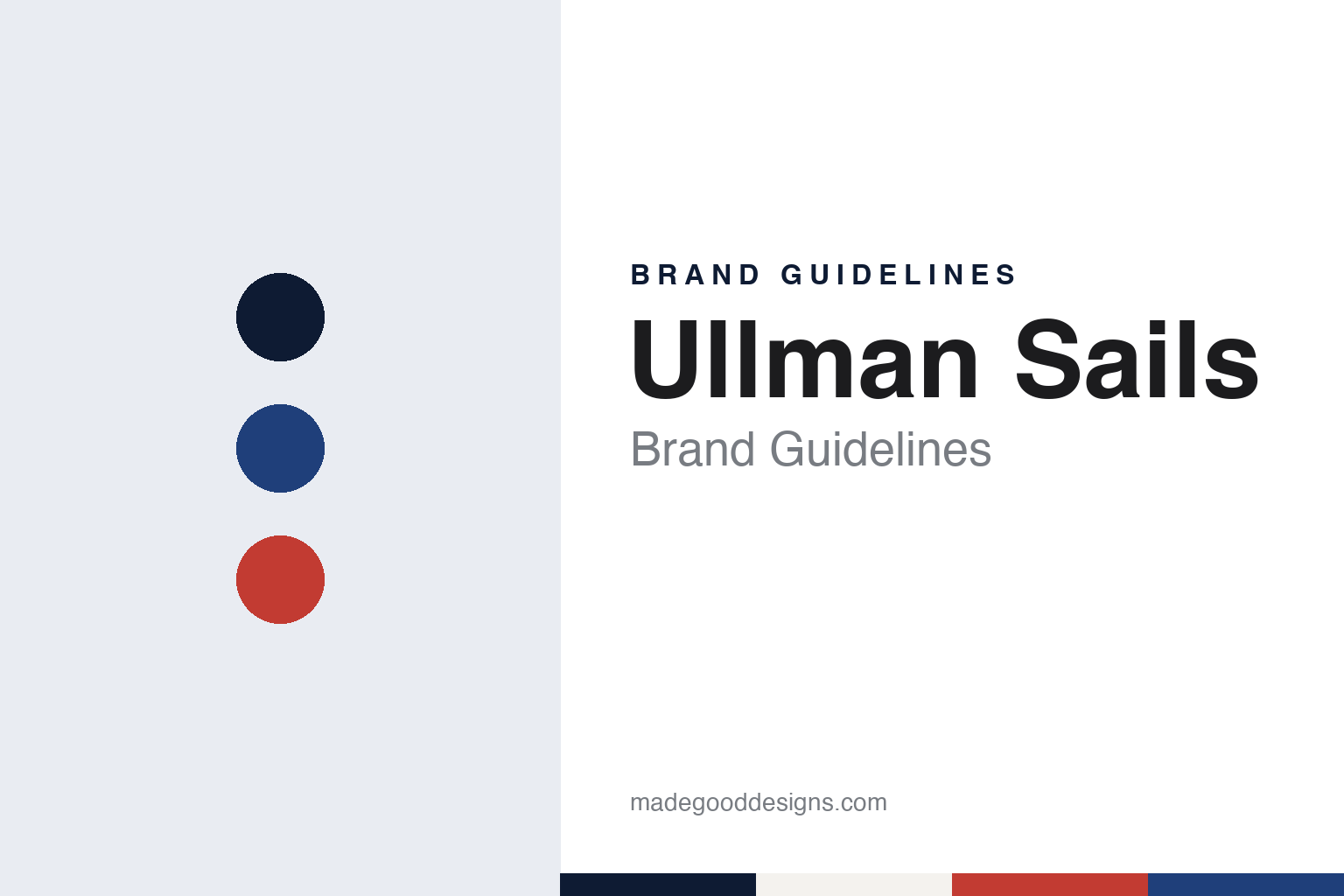
Ullman Sails Brand Guidelines
Dave Ullman’s 1967 loft and a network of licensed lofts.
Aa
Two constants: a blue and red palette and a condensed sans register. Abstract homage — not an Ullman Sails product or mark; no sail, logo or insignia is reproduced.
Lido 14
A dinghy sailor’s loft on the Californian coast.
Ullman Sails was founded in 1967 by the sailor and sailmaker Dave Ullman in Newport Beach, California, according to English Wikipedia and Scuttlebutt Sailing News, which wrote in 2013 that “it all began in the coastal community of Newport Beach.” The company’s own timeline is more precise: it places the original loft in Corona del Mar, the seaside community within Newport Beach, and says the earliest sails bearing Ullman’s blue and red logo were made for the Lido 14, a popular local dinghy.
The business grew out of small-boat racing. The company says the Corona del Mar loft soon expanded to take on larger repairs and to build new sails for local dinghies such as the Naples Sabot, the Lido 14 and the Snipe, and that between 1973 and 1978 it moved to a larger site on the Newport Beach Peninsula. Ullman raced the boats he made sails for: English Wikipedia records his wins at the 470 World Championships in 1977, 1978 and 1980, and a book, Championship Dinghy Sailing (1978), written with Christopher Caswell. The National Sailing Hall of Fame says he opened his loft at a young age and treated winning races as the way to sell sails.
That close link between a sailor’s name and a sailmaker’s brand remained for decades. The Newport Beach loft stayed on the peninsula until the early 2000s, when, the company says, it moved inland to its present site in Santa Ana, which is also the address of the group’s head office today.
Colour
From one loft to a licensed network.
Ullman Sails spread by adding lofts under the same name. The company dates its earliest satellite loft, in Dallas, to between 1979 and 1983, followed in the later 1980s by lofts in San Diego, Ventura and the United Kingdom, and by locations in Italy, Brazil, Japan, Monaco, Norway and Mexico. In the 1990s, it says, Ullman Sails International was established to oversee the growing network.
The structure is what makes the brand distinctive. Scuttlebutt Sailing News reported in June 2013 that all the facilities in the group were independently owned, at that time more than 80 locations in 31 countries, and that Ullman Sails International, Inc. was the licensing company that owns and manages the brand. Dave Ullman had sold his own original loft in 2007, the same report said, to concentrate on the international company. The Ullman timeline describes that step as handing ownership of the Newport Beach loft to a longtime colleague while Ullman moved to overseeing the group as a whole.
The company now explains the model in two tiers. On its business-opportunity page it says licensees are established regional sail lofts that represent the brand within a regional territory reserved to them and provide sailmaking, sales and service there, while dealers act as local representatives focused on sales, measurement and after-sales support, working with their regional licensee. The company’s current figure for the network is 25 countries and 75 locations, and it says a meeting of loft owners in Cape Town in 2014 brought together 25 lofts. Each loft keeps a local name of the form Ullman Sails plus a place, which gives the brand a consistent signature from Sweden to the Whitsundays.
Typography
How sailmakers present themselves.
Dinghy builders and sailmakers present themselves mostly through names and numbers. A builder’s name usually sits on the hull and on its website, while the sail carries the marks that racing needs: a class emblem and a sail number, placed as each class’s rules describe. When a class changes its name, the sail changes with it; in 2019 the International Laser Class Association said new class sails would carry its updated ILCA logo.
Much of this branding lives at the water’s edge rather than in shops. Builders and lofts show their boats and sails at boat shows and on regatta stands, and many of their news pages read like club noticeboards, carrying class championship calendars, results and event reports alongside new models. Class associations, which are often run separately from the builders, organise much of that racing and publish their own rules and websites.
Ownership in the trade takes several forms, and the companies describe it in different ways. Some are family businesses that name their founders and later generations on their own pages; some sailmakers work through franchised or licensed lofts that share one name across many countries; and some builders have passed to investors or merged with former rivals, or have sold individual boat designs and their production rights to other firms. Building is often shared: a brand may design its boats and buy hulls, sails and spars from specialist suppliers.
This guide sets out what can be checked about each company: who founded it, who owns it now, where its boats or sails are made according to dated sources, and how it presents its name. It marks clearly what rests only on the company’s own word, and it makes no claims about speed or safety.
Aa
A compact condensed sans for loft names and sail numbers. (Specimen set in Barlow Semi Condensed, a sans STAND-IN; NOT the Ullman Sails logo.)
Cape Town
A South African owner and a membrane plant.
Ownership of the brand changed in 2013. Scuttlebutt Sailing News reported in June that year that Ullman Sails had formed a union with Jannie Reuvers Sails of South Africa, and that an investor group including Reuvers had purchased ownership of Ullman Sails International. Central to the arrangement, the report said, was a large sail manufacturing facility and membrane plant in Cape Town, which over 35 years had built sails for other sailmakers, including Quantum Sails for 15 years, and for boat builders; the independently owned Ullman lofts could keep building in-house or use the South African facility.
The company’s timeline describes the next steps. In 2018 Ullman Sails International opened offices in Cape Town through a merger with its manufacturing loft in South Africa, and in 2019 it consolidated its ownership of Ullman Sails South Africa, ended manufacturing for lofts outside the Ullman network and set up Ullman Gear, which turns sailmaking waste into products for sale. The same timeline records new licensees in China and Canada in 2018, a loft in Croatia joining in 2023 and a new loft of 900 square metres for Ullman Sails Spain in 2025. The company names Michael England as president from January 2018. It says the group’s head office is in California, with its management team working from Cape Town.
The product line is presented through named families. FiberPath is the company’s range of laminated racing sails, which it says are designed by the Ullman Sails design team and built at its own lamination plant from carbon and aramid fibres; the Grand Prix and Regatta versions differ in construction. In December 2022 the company launched a further line under the name Six Seven by Ullman.
For a design guide, Ullman Sails shows how one founder’s name can become the shared signature of many separately owned businesses, held together by licensing, a blue and red mark and a common loft naming pattern. Compare Quantum Sails, another sailmaker that has used Cape Town production, and North Sails, another sailmaker that sells through lofts in many countries. For this guide we use a harbour blue, a deep navy and a spinnaker red with a condensed sans, an unofficial interpretation; no product or logo is reproduced.
Explore & save
Keep Ullman Sails’s identity on hand — save it to a board in the Made Good inspiration library.
Ullman Sails identity set
Pin the Ullman Sails blue and red palette and the condensed sans register to your own board.
Source & notes
Frequently Asked Questions
What font can I use to match the Ullman Sails look?
This guide describes Ullman Sails’ type as “A compact condensed sans for loft names and sail numbers”. Its type specimen is set in Barlow Semi Condensed from Google Fonts as a stand-in; Barlow Semi Condensed is not Ullman Sails’ own lettering.
What colours are in the Ullman Sails palette?
This guide’s Ullman Sails palette is Harbour blue #1F3F7A, Deep water #0E1B33, Spinnaker red #C23B32, Lido white #F4F2EE and Fog #DDE2E8. The tones are the guide’s own unofficial interpretation, not official Ullman Sails hex codes.
When was Ullman Sails founded?
Ullman Sails was founded in 1967, in Newport Beach, California.
Who founded Ullman Sails?
Ullman Sails was founded by Dave Ullman in 1967. Ullman Sails is known for Lido 14 sails, FiberPath, licensed lofts.