Ovington Brand Guidelines
The Tyneside dinghy builder behind Europe’s 49ers.
Aa
Two constants: a slate, grey and yellow palette and a workshop sans register. Abstract homage — not an Ovington product or mark; no boat, sail insignia or logo is reproduced.
Enterprises and foam sandwich
From wooden dinghies to vacuum-bagged hulls.
Ovington Boats was founded by Dave Ovington in 1975, the company says, and Yachting World gave the same year in April 2005. The company says he started by building traditional wooden boats, in particular racing Enterprise dinghies.
The search for lighter boats changed the method. According to the company, Ovington moved from wood to glass fibre and developed the use of vacuum-bagged foam sandwich construction. By the mid-1990s, Yachting World wrote in 2006, he had been building high-technology racing boats for many years.
The business has always been on Tyneside, in the north-east of England. Yachting World placed its factory at Tynemouth in 2006; the company now gives its base as North Shields, where it says it works from a workshop of 2,500 square metres. Marine Industry News reported in July 2023 that Ovington had been exporting from North Shields for 47 years. The present company, Ovington Boats Limited, was incorporated in May 1997 and is listed as active, according to Companies House.
The people running the firm have changed over time. In April 2005 Yachting World reported that the Ovington family had appointed an interim management team led by Adam Ovington as managing director. By September 2006, the same magazine wrote, the company was run by three people with separate roles: Veronica Brown on finance, Dave Hall on sales and marketing, a job he had held since 1998, and Chris Turner on boatbuilding. Yachting World put the workforce at 15 people at that time. In July 2023 Marine Industry News named Chris Turner as managing director.
Colour
Builder of the 49er for Europe.
Since 1996 Ovington has been tied to the 49er. English Wikipedia says the twin-trapeze skiff was designed by Julian Bethwaite and developed by a group that included the Bethwaites, Performance Sailcraft Japan, Peter Johnston and Ovington Boats. Yachting World’s 2006 profile describes the trials held on Lake Garda in September 1996 to choose a new two-person skiff for the Sydney 2000 Olympics, and says the 49er was confirmed in November 1996. The task of building 49ers for the European market went to Ovington, the magazine wrote, and the first year of production brought a waiting list of eight months. By the class’s first international regatta, the European Championship at Weymouth in September 1997, 80 boats were already racing, Yachting World reported.
The arrangement has lasted. English Wikipedia says the 49er, as a one-design class, has two licensed suppliers: Mackay Boats in Oceania and Ovington in Europe. It describes the hull as epoxy glass fibre and foam sandwich laminate with carbon fibre in high-load areas. The 29er, which Yachting World called the smaller cousin of the 49er, followed; in 2006 Dave Hall told Yachting World he expected the company’s 29er production that year to exceed 170 boats.
A second Olympic class came in 2020. On 20 August 2020 the International Laser Class Association announced that Ovington Boats Ltd had been fully approved as a builder of class-legal ILCA dinghies, after a five-month approval process in which its sample boats were checked against a list of more than 150 points. The association said the boats would be made from moulds taken from its master tooling and sold under the ILCA brand, in line with World Sailing’s Olympic Equipment Policy, so that builders can sell them anywhere without trademark restrictions. Marine Industry News reported in July 2023 that Ovington had built ten prototypes to win its licence and had since completed its 1,000th ILCA.
The same report said the ILCA sits among a further thirteen dinghies and keelboats that Ovington produces in North Shields, and that it had finished an extension in April 2022 that doubled the size of the factory, with air-conditioning and temperature and humidity control for glass and carbon fibre moulding. The report described how the production side is run: an operations director with a background in the car industry was appointed in 2012, and the company records figures such as the weight of gel coat applied, the amount of resin in each boat and the weight of the finished boat. The company says all its boats are hand-built and that it can design and develop boats to order.
Typography
How dinghy builders and sailmakers present themselves.
Dinghy builders and sailmakers present themselves mostly through names and numbers. A builder’s name usually sits on the hull and on its website, while the sail carries the marks that racing needs: a class emblem and a sail number, placed as each class’s rules describe. When a class changes its name, the sail changes with it; in 2019 the International Laser Class Association said new class sails would carry its updated ILCA logo.
Much of this branding lives at the water’s edge rather than in shops. Builders and lofts show their boats and sails at boat shows and on regatta stands, and many of their news pages read like club noticeboards, carrying class championship calendars, results and event reports alongside new models. Class associations, which are often run separately from the builders, organise much of that racing and publish their own rules and websites.
Ownership in the trade takes several forms, and the companies describe it in different ways. Some are family businesses that name their founders and later generations on their own pages; some sailmakers work through franchised or licensed lofts that share one name across many countries; and some builders have passed to investors or merged with former rivals, or have sold individual boat designs and their production rights to other firms. Building is often shared: a brand may design its boats and buy hulls, sails and spars from specialist suppliers.
This guide sets out what can be checked about each company: who founded it, who owns it now, where its boats or sails are made according to dated sources, and how it presents its name. It marks clearly what rests only on the company’s own word, and it makes no claims about speed or safety.
Aa
A plain, sturdy sans for a working boatyard. (Specimen set in Barlow, a sans STAND-IN; NOT the Ovington logo.)
Ovington
A builder’s name on other people’s classes.
Ovington’s brand sits alongside the brands of the classes it builds for. Two of the classes it builds are licensed: English Wikipedia lists Ovington as one of two licensed 49er suppliers, and under the 2020 approval the boats it builds for the ILCA class are sold under the ILCA brand rather than its own, the class association said. The name Ovington appears in the company’s own name, Ovington Boats, and on its website, its dealer listings and its parts shop.
The company presents itself through its range and its dealers. Its website groups its boats into skiffs, single-handers and double-handers, sells used boats, parts and spars, and lists a network of dealers through which it says it distributes boats and spares across Europe and the rest of the world. Its home page carries the line “Built to Win,” and its about page gives the founder’s story and the size of the North Shields workshop.
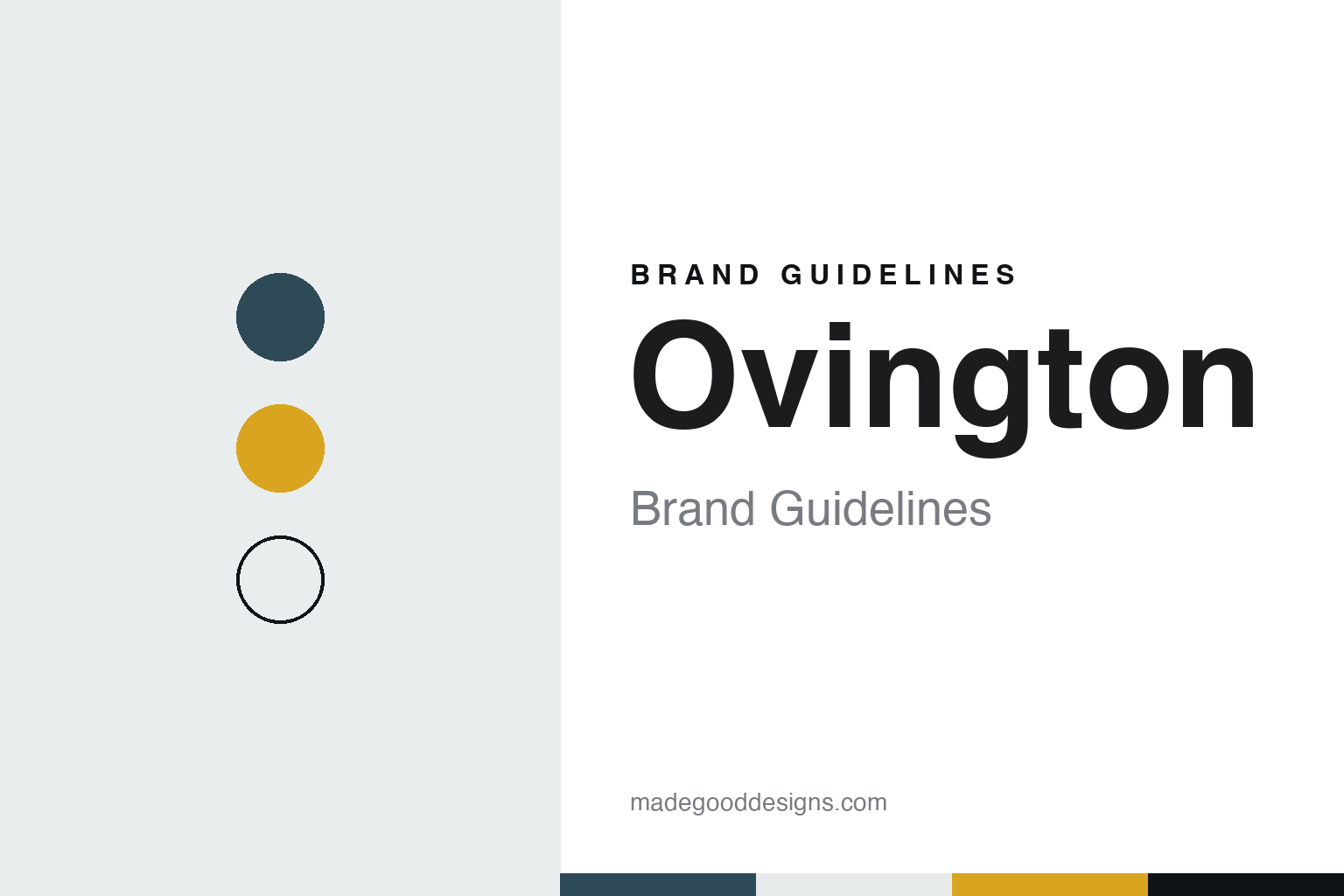
For a design guide, Ovington shows how a builder can make its name through the classes it is licensed to build rather than through a mark of its own. Compare RS Sailing, another British dinghy brand, and LaserPerformance, a builder of Laser-branded single-handers. For this guide we use a Tyne slate, a foam grey and a signal yellow with a sans, an unofficial interpretation; no product or logo is reproduced.
Explore & save
Keep Ovington’s identity on hand — save it to a board in the Made Good inspiration library.
Ovington identity set
Pin the Ovington slate, grey and yellow palette and the workshop sans register to your own board.
Source & notes
Frequently Asked Questions
What font can I use to match the Ovington look?
This guide describes Ovington’s type as “A plain, sturdy sans for a working boatyard”. Its type specimen is set in Barlow from Google Fonts as a stand-in; Barlow is not Ovington’s own lettering.
What colours are in the Ovington palette?
This guide’s Ovington palette is Tyne slate #2F4A57, Ink #101315, Foam grey #E7EAEA, Signal yellow #D9A521 and Paper #F7F7F5. The tones are the guide’s own unofficial interpretation, not official Ovington hex codes.
When was Ovington founded?
Ovington was founded in 1975, in Tyneside, England. Ovington is known for 49er, 29er, ILCA.
Who founded Ovington?
Ovington was founded by Dave Ovington in 1975. Ovington is known for 49er, 29er, ILCA.