Cleankill Brand Guidelines
A Croydon firm that built its name on awards and a three-step method.
Aa
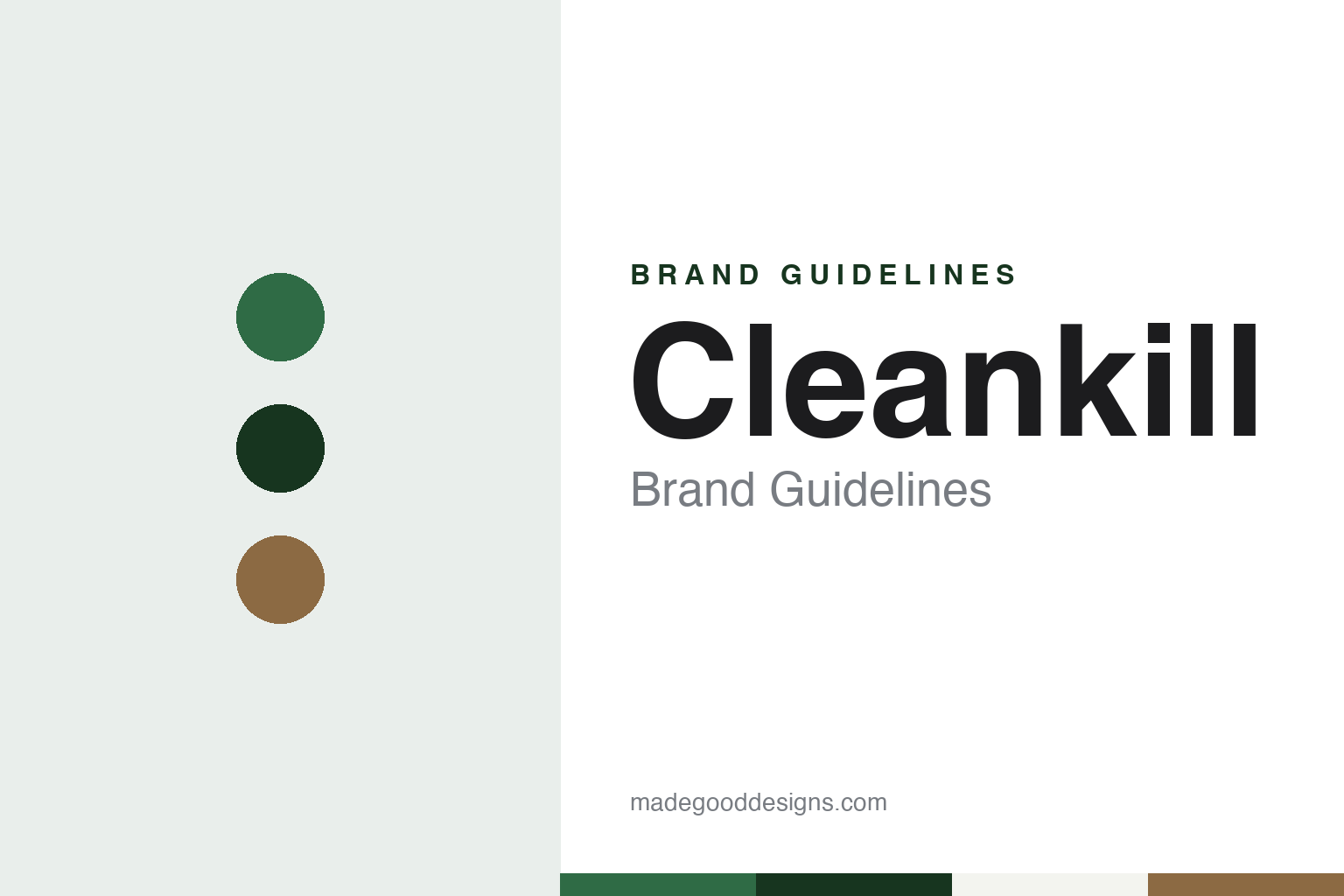
Two constants: a hedge green, deep pine and chalk palette and a friendly grotesque register. Abstract homage — not a Cleankill product or mark; no logo or livery is reproduced.
A bedroom office
A 1995 start on London’s southern edge.
Cleankill Pest Control started in 1995 in Croydon, on the southern edge of London. The company says it began trading “from a bedroom office” that year, and describes itself as founded “by a team of pest control professionals who saw a gap in the market for a company with a focus on customer service.” Companies House records show the trading company, Cleankill (Environmental Services) Limited, incorporated on 25 January 1995, with Clive Bury listed as a director from the start.
Paul Bates joined in 1997, after 16 years at Rentokil where, the company says, he worked his way from technician to sales, service and branch management. He became managing director and the company’s public voice in newspapers and on local radio, and Cleankill calls him one of its original founders. Companies House lists him as a director from May 1997 until July 2024.
The company’s head office is in Kenley, in south Croydon, and it names further offices in East Sussex, Buckinghamshire and the Bristol area. From that base it describes a market across London, Surrey, Kent and Sussex and, after a run of acquisitions, much of southern England. Most of its work, it says, is for commercial customers, from offices, warehouses and residential blocks to restaurants, schools, heritage sites and places of worship, with domestic call-outs alongside.
Colour
Growth by acquisition, and a method with a name.
Cleankill grew by buying smaller local firms. In November 2018 it bought Good Riddance, a pest control business in Clevedon, North Somerset, serving companies around Bath, Bristol and Weston-super-Mare, Business Live reported in February 2021. Cleankill told the paper it had taken on Good Riddance to fill a gap in the Bristol market for commercial pest control aimed at facilities managers, and in 2021 it began rebranding the business as Cleankill so that it could deliver its services “under one award-winning brand,” in Bates’s words.
The company says it has also bought Bird Control Sussex, of Hove, Pest Control Bucks and Totalcare Pest Control of Alton, Hampshire, which served East Hampshire and West Surrey. Bates called Totalcare “the final piece in the jigsaw,” saying it completed the company’s expansion along the M4 corridor and let it offer its services across southern England “from Kent to Devon.”
Its services are set out in plain categories, among them commercial and residential pest control, wildlife management, pest control waste services and inspection services, with electric fly killers and fly screen windows among the products it fits. Business Live described Cleankill’s bird-proofing work on roofs and solar panels, and its use of Harris hawks to disperse pigeons and gulls from industrial estates. The company names wasps, fleas and bed bugs among the “distress” pests it handles, alongside routine contract work on rats, mice and pest birds.
The company’s working method has a name too. It says it treats infestations in a fixed order — exclude, restrict, destroy — with pesticides as the last resort, and that it keeps chemical use to a minimum, using tools such as pheromone attractants for moths and remote sensor cameras for rodents. It is a corporate member of the Bat Conservation Trust and says it has a long association with the Children’s Trust at Tadworth Court, in Surrey, where staff have raised funds and helped redecorate dining areas.
Typography
How pest-control companies present themselves.
A pest-control brand is mostly met in working places rather than in shops: on the side of a service van, on a technician’s shirt, on a branch sign, on a service agreement and on an invoice. When Rentokil Initial bought Western Exterminator in 2012, the seller’s president told the Orange County Register that customers would “still see our trucks” and the same people at the door. The companies themselves publish these vehicles, uniforms and branch pages as the public face of the business, so a guide to the category starts there.
Some of the older American firms lean on a character or a family name. Western Exterminator’s little man with a big hammer has been in use long enough to be parodied on The Simpsons in 1995, according to English Wikipedia, while Ehrlich still carries the surname of the man who started it in Reading in 1928.
Service plans are the other naming layer. A company that sells recurring visits gives its plans names, and those names sit beside the company name on websites, quotes and contracts; they have to read clearly in small type and stay consistent with the main mark. This guide looks at names, marks and colour as the companies present them, and does not reproduce any logo, livery or uniform.
Behind many local names sits a larger owner. Rentokil Initial’s 2012 annual report lists Ehrlich, Presto-X and Western as “country-specific” brands under one shared brand essence, and its 2025 report describes keeping 30 pest brands, national, regional and local, in North America. Corporate pages on owners, acquisitions and branch networks are therefore part of how these brands present themselves, and each guide notes who owns the name today.
Aa
A friendly grotesque for a plain-spoken brand. (Specimen set in Work Sans, a sans STAND-IN; NOT the Cleankill logo.)
Cleankill
Awards, accreditation and a new parent.
Awards are central to how Cleankill presents itself. It says it was the first pest control company in England to hold the Investors in People Gold standard, and that it has held Investors in People accreditation since 2005; Business Live repeated the Gold point in 2021. Cleankill was named Company of the Year at the British Pest Management Awards in 2019, Business Live reported, and the company lists Large Company of the Year at the National Pest Awards and a BPCA sustainability award, both in 2023. Its staff have won individual honours too, including the young pest controller category at the National Pest Awards 2026, the company says. It names membership of the British Pest Control Association and ISO 9001 and ISO 14001 approval among its accreditations, and it calls its internal code “The Cleankill Way.”
The company is no longer independent. Companies House shows that on 8 July 2024 control of Cleankill passed to Pest Control Partnership (UK) Limited, with new directors appointed that day and the long-serving directors stepping down. Pest Control Partnership says it was formed in 2023 by the private equity firm Partners Group with a founding team that includes Alan Brown, a former chief executive of Rentokil, to build an international pest control group across the UK and continental Europe. Cleankill still trades under its own name, and in 2026 it referred to Pest Control Partnership as its parent company.
The website’s headline line is “Let your pest be our problem,” set beside a promise of “big company” professionalism with the feel of a friendly, small local business. The company publishes no colour or typeface specification, so the palette here is our own: two greens and a chalk white, with a warm brown as a second accent.
For a design guide, Cleankill shows how a regional firm can build a brand on awards, staff training and a plain-spoken method, and keep its name after joining a larger group. Compare Rentokil, where its long-time managing director began his career, and Pelsis, another British name in the trade. For this guide we use a hedge green, a deep pine and a chalk white with a sans, an unofficial interpretation; no product or logo is reproduced.
Explore & save
Keep Cleankill’s identity on hand — save it to a board in the Made Good inspiration library.
Cleankill identity set
Pin the Cleankill hedge green, deep pine and chalk palette and the friendly grotesque register to your own board.